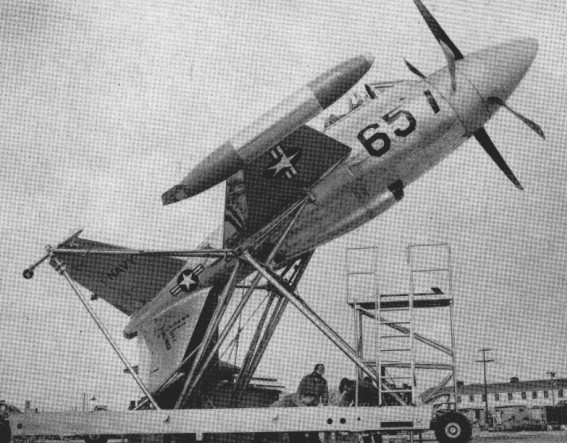
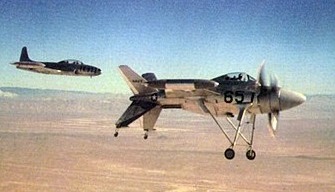
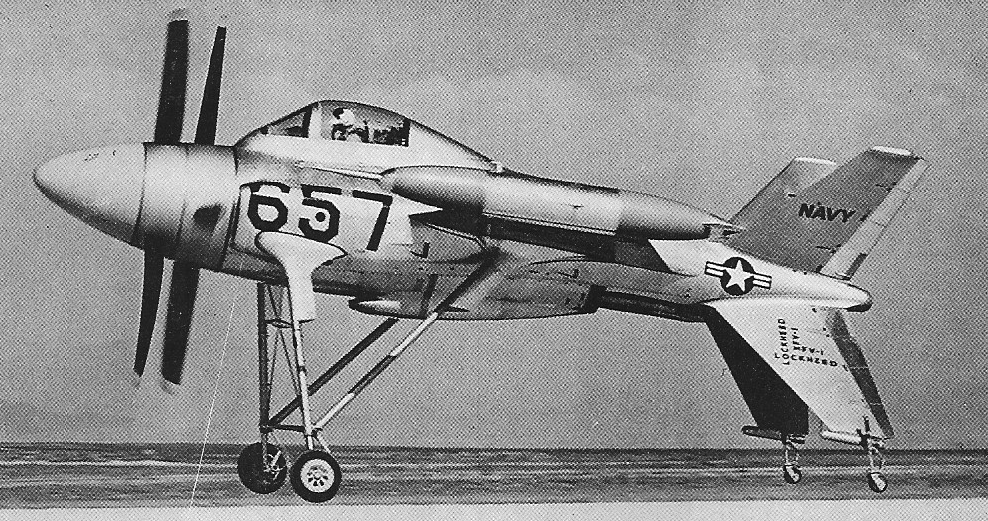
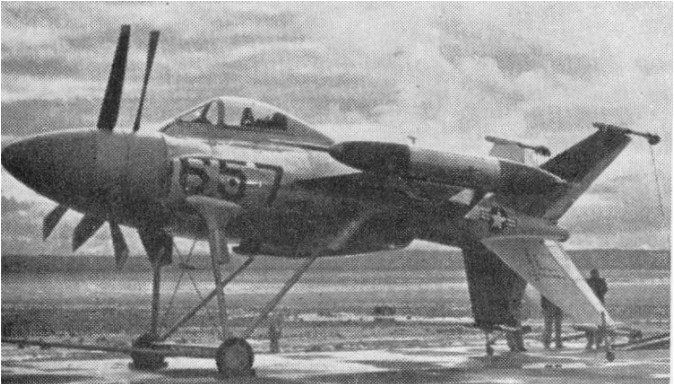
From 1949 the US Navy actively pursued a policy of VTOL research. The results were two prototypes, the Lockheed XFV-1 and the Convair XFY-1 Pogo. Both aircraft were of the ‘tail-sitter’ concept and powered by the 5500-shp (4101-kW) Allison T40-A-6 turboprop driving large contra-rotating propeller units. These provided more thrust than the weight of the aircraft, making possible VTOL operation.
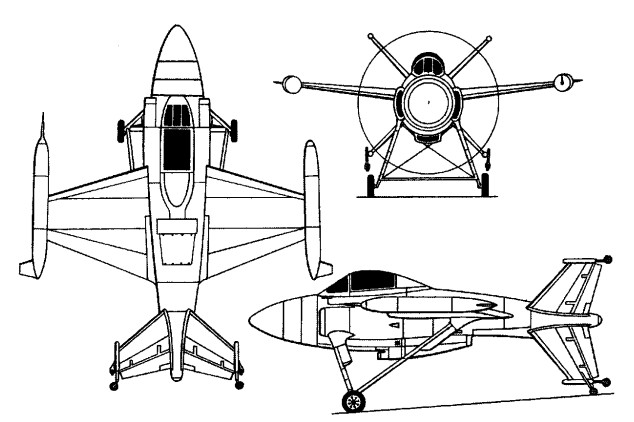
The XVF-1 was the more conventionally configured of the two types, with a mid-set wing of low aspect ratio, but for VTOL capability had a cruciform arrangement of tail surfaces indexed at 45 degrees to the wings. Each fitted with a small castoring wheel on the outboard end of its trailing edge. For flight trials with an engine not cleared for VTOL operation the type was fitted with a lightweight but very stalky fixed landing gear arrangement to permit conventional rolling take-off and landing, and in this guise first flew in June 1954. The aeroplane flew 22 times, in the process recording 32 operations in the vertical mode, when variation of the engine power made possible descending, hovering and ascending flight. No pure VTOL operations were undertaken with the only one of the two XFV-ls that flew.
The performance was similar to the P-80 Shooting Star.
The whole programme was cancelled in June 1955 and construction of the second prototype abandoned.
A contract for two prototypes of a new type VTOL aircraft was placed with the Lockheed company’s Georgia factory by the U.S. Army in June 1961. This followed more than two years of privately financed development of the jet ejector augmentation principle by Lockheed, including wind tunnel and test rig work.
The Army contract was for the Lockheed Model 330 Humming Bird, a research vehicle which was to be capable of development for use in the battlefield surveillance and Army support role.
Basis of the Lockheed concept is to augment the thrust of a jet engine by ducting its exhaust through a large diameter tube so that a large volume of cold air is drawn through it by friction and vacuum effect. This can augment the basic thrust of the engine by as much as 40 per cent.
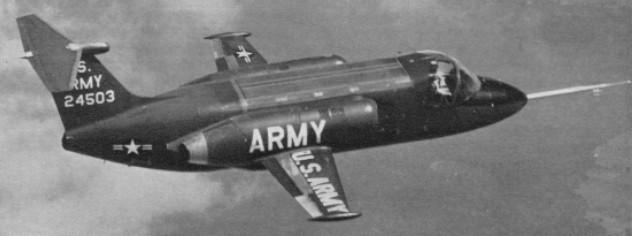
In the VZ 10 which was re designated XV4A in July 1962 two 3,000 lb.s.t. Pratt & Whitney JT12A 3s are located each side of the fuselage above the wing root. For vertical operations, their exhaust jet is turned through 180 degrees and ejected downwards through a series of nozzles into a duct or mixing area in the centre fuselage. Doors covering this duct, top and bottom, are opened. To convert from vertical to horizontal flight, the VZ 10 is first tilted slightly nose down to obtain a small thrust component from the jet exhaust from the fuselage duct. As speed builds up the wings begin to contribute lift and the thrust of one engine is then deflected from vertical to horizontal. This increases the speed still more and the second engine can then be deflected, too, and the duct doors are closed.
The first VZ 10 (62 4503) made its first flight at Marietta on July 7th, 1962, taking off conventionally. Hovering trials began in 1963. On 20 November 1963 the first successful flight involving transitions from vertical to horizontal flight, and vice versa, was completed.
The second VZ 10 was tested in the 40 ft by 80 ft low speed tunnel at Ames Research Center before joining the flight test programme.
By then, redesignated XV-4A, the two prototypes were handed over to the US Army. In late 1966 Lockheed modified one of the XV-4As to a new XV-4B configuration, the major change being replacement of the XV-4A’s two 1361kg thrust engines by four each of 1368kg thrust. Testing began in August 1968, but when the aircraft was destroyed in an accident in early 1969 further development was abandoned.
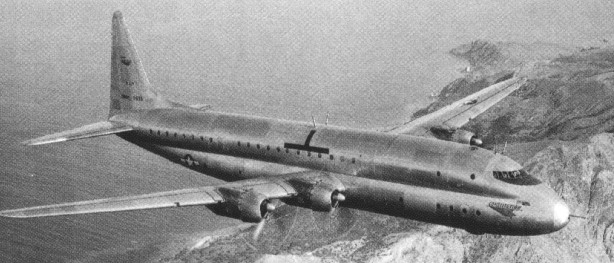
The Constitution design effort began during the war to provide an airplane capable of carrying more payload farther than could contemporary types. Pan American engineers assisted Lockheed in the initial development of the Constitution, officially sponsored by the US Navy. It was slightly larger than the DC-7, both dimensionally and in weight, and was powered by four 3,500hp (2,600kW) Pratt & Whitney Wasp Major engines. The pressurized fuselage would have provided accommodation for as many as 92 passengers on the upper deck and 76 on the lower deck.
Because of greater wartime priorities, the first of two military Model 89 Constitutions did not fly until November 9, 1946. By that time, both Pan American and the Navy had lost interest. The airplanes were delivered to the Navy in 1949 with the military model designation XR6O-1.
Later designated XR6V-1s, both Constitutions were sold by the US Navy in 1958 after less than 2,000 flying hours each. The first ended its days at Opa-locka, Florida, in the 1970s, while the second was scrapped at Las Vegas, Nevada, in 1969.
Engines: 4 x Pratt & Whitney Wasp Major, 3,500hp (2,600kW) Wingspan: 57.63m Crew: 12 Pax capacity: 168
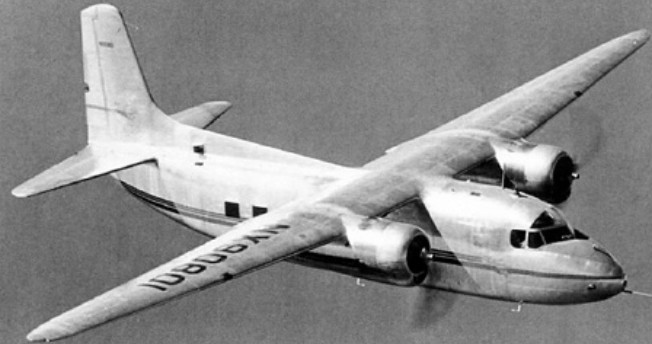
Before the war, Lockheed was very successful in providing airliners for routes that did not generate quite enough traffic for the larger DC-3s. By the end of the war, it was firmly committed to do battle with Douglas for the long-range, high-volume routes, but it did not lose sight of the less-traveled ones on which its prewar designs served so well. Lockheed’s entry in that market was the unpressurized, 14-passenger Saturn. The prototype first flew on June 17, 1946, with two 600hp (450kW) Continental GR9A engines. Difficulties were experienced with these powerplants and consequently 700hp (520kW) Wright C7BA Cyclone engines were substituted shortly thereafter. Like the others who offered new designs for this market, Lockheed found there were just too many military-surplus DC-3s available at bargain prices. The Saturn program was terminated and the two prototypes were scrapped in 1948 for tax purposes.
Engines: 2 x 700hp Wright 744C-7BA-1 7-cylinder radial Wingspan: 22.56 m / 74 ft 0 in Length: 15.69 m / 52 ft 6 in Height: 6.05 m / 20 ft 10 in Loaded weight: 7257 kg / 15999 lb Empty weight: 5153 kg / 11360 lb Max. speed: 367 km/h / 228 mph Cruise: 187 mph Range: 600 miles (960 km)
In early 1940, the US Army reserved for itself the right to refuse permission for its American military aircraft suppliers to export these aircraft to overseas customers. This was particularly true if the Army felt that the foreign order might possibly result in undue delays in deliveries of these aircraft to its own squadrons. Consequently, when Britain and France wanted to purchase the Model 322 Lightning from Lockheed, the Army was reluctant to give its approval since it had already ordered YP-38 Lightnings for its own use. However, the USAAC finally did grant authorization to export the un-turbosupercharged Lightning to Britain and France, but only under the condition that Lockheed agree to develop and produce at no cost to the U.S. government a prototype of an advanced version of the Lightning. The formal agreement was signed on April 12, 1940.
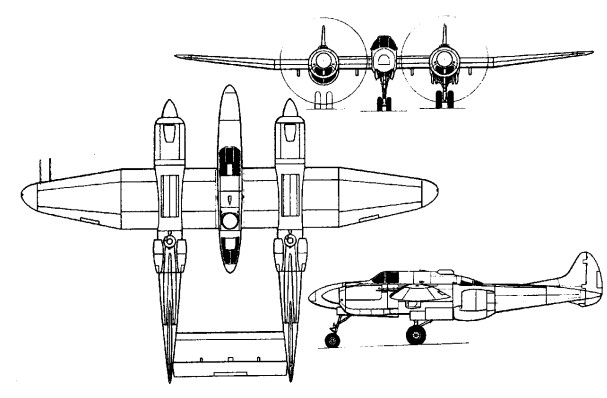
This advanced Lightning was given the company designation of L-121, and James Gerschler was named as project engineer. The L-121 was to be powered by a pair of turbo-supercharged Continental IV-1430 liquid-cooled engines. It was to be offered in two versions, a single- seater and a two-seater. The single-seat version was to retain the standard P-38 armament of one 20-mm cannon and four 0.50-inch machine guns. The two-seat version was to have an additional armament of a single 0.50-inch machine gun mounted in a remotely-controlled barbette situated at the end of each tail boom. Gross weight was estimated at 16,500 pounds, and the aircraft was expected to attain 450 mph at 25,000 feet.
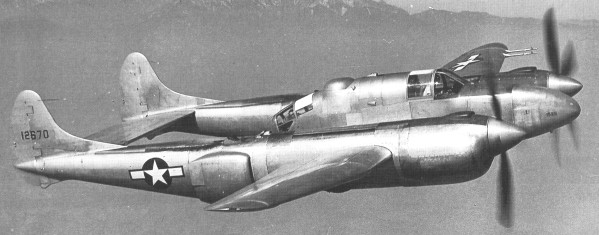
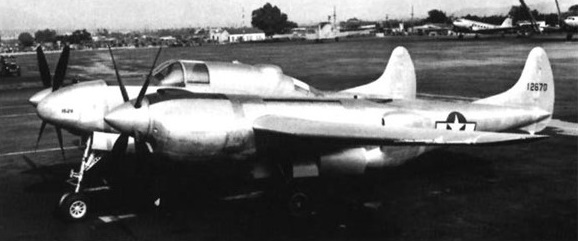
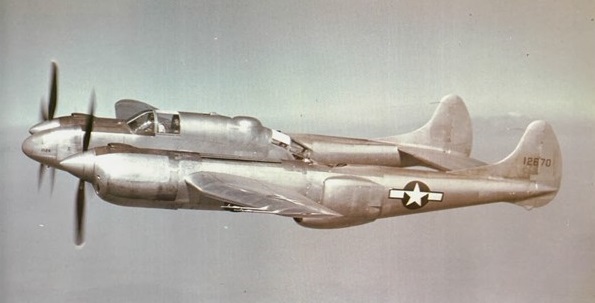
During a meeting at Wright Field in May 1940, it was decided to drop the single-seater and proceed with the two-seat version, which was assigned the designation XP-58. In July 1940, it was concluded that the XP-58 would be underpowered with the Continental engines, and the decision was made to switch to a pair of 1800 hp Pratt & Whitney XH-2600-9/11 liquid-cooled engines. The re-engined XP-58 was given the company designation of Model 20-14, and revised specifications were issued by Lockheed on September 10, 1940. A second 20-mm cannon was added to the forward-firing armament. The tail boom guns were deemed to be highly impractical, and were replaced by a single remotely-controlled dorsal turret containing a pair of 0.50-inch machine guns. The serial number 41-2670 was assigned to the prototype. Estimated gross weight had crawled upward to 24,000 pounds, and estimated top speed had fallen to 402 mph. Range on internal fuel was anticipated to be 1600 miles.
Scarcely a month after these revised specifications had been issued, Lockheed’s new project engineer, Neil Harrison, was told that Pratt & Whitney was suspending development of the XH-2600 engine. The XP-58 was without an engine and attention focused on the XH-2470, the Continental XH-2860, and on the Pratt & Whitney R-2800, as possible choices for the XP-58 power plants.
Lockheed preferred the Pratt & Whitney R-2800 radial engine, and estimated that with these power plants the XP-58 would have a a loaded weight of 26,000 pounds and a maximum speed of 418 mph at 25,000 feet. However, the USAAC considered this performance to be inadequate, and suggested that Lockheed turn to the experimental Wright XR-2160 Tornado forty-two cylinder, six-row engine offering a power output of 2350 hp. This engine had an extremely small frontal area but the Tornado engine development was fraught with problems from the start. Still, in March of 1941 the USAAC announced that it was going to go with the Tornado for the XP-58.
Two months later, the USAAC issued a change order for the installation of cabin pressurization for the pilot and the aft-facing gunner, and for the addition of a remotely-controlled ventral turret to supplement the dorsal turret. These changes caused the estimated gross weight upward to 34,242 pounds. Estimated range had dropped to 1300 miles. Nevertheless, the top speed of the Tornado-powered XP-58 was estimated to be no less than 450 mph.
The XP-58 was scheduled for delivery to the USAAF in August of 1942, and to meet this deadline the project team grew to a peak of 187 people by October of 1941. However, following Pearl Harbor, the XP-58 was assigned a lower priority and most of the engineering staff were moved off to other more pressing projects. By early 1942, the XP-58 staff was down to twelve people.
In March of 1942, Lockheed suggested that the USAAF order a second XP-58 prototype using Government funds. Since the Tornado engines were already experiencing serious delays and were now not expected to be delivered until the spring of 1943, Lockheed felt that there was sufficient time to redesign the second XP-58 machine in order to provide it with enough fuel capacity to increase the range to 3000 miles. The USAAF agreed to this request and placed the order in May of 1942.
Shortly after, the USAAF began to rethink the ultimate mission for the XP-58. First, the USAAF suggested that the nose-mounted forward-firing armament should be changed to a 75-mm cannon with a 20-round automatic feeder plus a pair of 0.50-inch machine guns as a ground attack aircraft. This led to considerations of several different alternative configurations, including a two-seat attack aircraft with six forward-firing 20-mm cannon and a three-seat bomber with a bombardier in the nose, an enlarged central nacelle containing an internal bomb bay, and with or without the 75-mm nose cannon. In both the attack and bomber versions, the dorsal and ventral turrets were to be deleted, and un-supercharged engines were to be used.
With the Douglas A-26 Invader in production as an attack bomber, and the experimental Beech XA-38 Grizzly then under development as a low-altitude tank buster and ground attack aircraft. Consequently, the XP-58 program was then re-oriented back to its original role as a high-altitude aircraft, as a bomber destroyer rather than an escort fighter. The turbo-superchargers and the dorsal and ventral turrets were put back on.
The first prototype was to have four forward-firing 37-mm cannon, whereas the second was to have a 75-mm cannon and two 0.50-inch machine guns. Gross weight was now up to 38,275 pounds, and top speed was down to 414 mph at 25,000 feet. Range was only 1150 miles.
By early 1943, the XP-58 program was in chaos because of the constantly changing Army requirements. In desperation, Lockheed recommended in January 1943 that only one prototype actually be built, and that it have interchangeable noses that would permit the fitting of either type of forward-firing armament.
The trouble-ridden Tornado engine program finally collapsed in February 1943, leaving the XP-58 without engines once again. Lockheed and the USAAF both agreed to switch to a pair of turbo-supercharged Allison V-3420-11/13 twenty-four cylinder liquid-cooled engines, rated at 2600 hp for takeoff and 3000 hp at 28,000 feet.
The US Army contract, of 27 April 1943, tasked Lockheed to build ‘one (1) airplane, pursuit, fighter, two-engine, two-place, known as the XP-58, complete and conforming to the contractor’s specifications’. In the final configuration, the aircraft had two crewmen; a pilot and a rear-gunner operating two power turrets although the turrets and the forward firing armament was never actually installed.
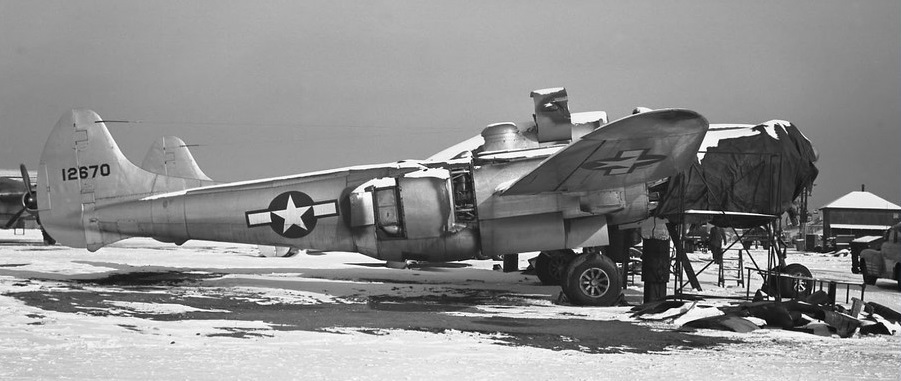
With these Allison engines, the XP-58 (serial number 41-2670) was finally completed in June of 1944, more than four years after its design had begun. Its company designation was now Model 20-86. When the XP-58 rolled out of the factory it was really only half-finished. No cabin pressurisation equipment was provided, no forward-firing armament was installed, and dummy dorsal and ventral turrets were fitted in place of the real things. It made its initial flight from Lockheed Air Terminal at Burban on June 6, 1944, piloted by test pilot Joe Towle. Its first flight was a 50-minute shakedown which took the XP-58 from the manufacturer’s Burbank plant to Muroc AAF. Twenty-five flights totalling 19.3 hours were made at Muroc prior to the delivery of the XP-58 to Wright Field in Ohio on October 22, 1944. These flights were marred by turbo-supercharger problems.
The second airframe was never fully completed but was trucked in parts to Muroc Dry Lake. Because of the cost of continuing a marginal programme with a ‘one-off’ machine, even with a second for spare parts, the programme was terminated in 1945 and it was transferred for use as a non-flying instructional airframe. Derelict at Wright Field as late as January 1946, the Chain Lightning was scrapped in 1947.
The XP-58 project, which started off its career as having absolutely no cost to the US government, ended up costing the taxpayer over two million dollars. $400,000 of this money covered the USAAF requested changes to the first prototype, and the rest of the money covered the government-ordered, but then cancelled, second prototype.
XP-58 Engines: Two turbo-supercharged Allison V-3420-11/13, 2,600 hp / 1950kW Span: 70 ft 0 in / 21.33 m Length: 49 ft 3 in Height: 16 ft 0 in / 4.88 m Wing area: 600 sq. ft / 55.74 sq.m Empty weight: 31,306- lb Gross weight: 38,874 – 42990 lb Maximum speed: 436 mph / 700 km/h at 25,000 ft. Cruising speed: 274 mph at 25,000 ft Service ceiling: 38,400 ft Initial climb rate: 2660 fpm Normal range: 1250 miles / 2000 km Maximum range: 2650 miles
The success of the Hudson in RAF service led Lockheed to propose a military version of the larger Lockheed 18 Lodestar and resulting British interest led to development of the Lockheed 37. Based on the existing Lodestar, the modifications were to provide increased power and an added lift capability of three tons, on the same wings and flaps, and the fuselage was to be re-designed to accommodate bombs, gun positions and other military equipment. The entire Lodestar double tail was retained along with its tendency to be blanketed out in certain landing attitudes by the large and effective Fowler wing flaps. As a replacement for the Hudson, and the Venture promised a 300mph top speed, an eight machine gun armament, twice the bomb load, and a range of up to 500 miles from base.
In February 1940 a proposal submitted by Lockheed for a Blenheim replacement was accepted by the Air Ministry. The aircraft was basically a military version of the Lockheed 18 Lodestar transport.
Lightning and Ventura
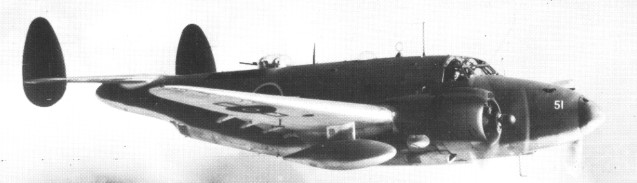
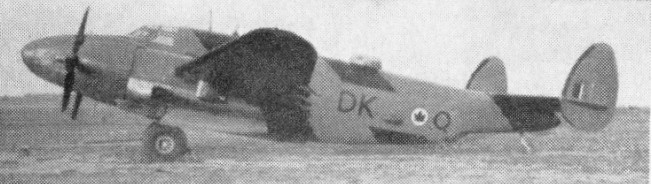
A direct purchase order was placed for 300 aircraft in May 1940, followed by a further order for 375. There were considerable delays in producing the first machine, which first flew on 31st July 1941, and it was not until April 1942 that the first Venturas arrived at Lockheed’s facility at Speke, Liverpool, from the Vega aircraft plant at Burbank, California. In the event, only 394 of the initial orders for Ventura Mk.Is and Mk.IIs (the latter having uprated engines) were delivered.
First used operationally by the RAF on 3 November 1942, the type was soon found to be unsuited to daylight operations and was transferred to Coastal Command.
In 1943 the GR.V version entered service. These machines were supplied under Lease Lend and were patrol aircraft based on the U.S. Navy PV 1. They had modified bomb bays to accommodate six depth -charges. A large proportion of the GR.Vs were delivered direct to the Middle East, South Africa, New Zea-land, Australia and Canada. In Britain No.519 Squadron was the first to receive the GR.V, replacing Hudsons and Hampdens at Wick, followed shortly afterwards by No. 521 Squadron at Docking, both squadrons being engaged in Meteorological flights. These two squadrons reverted to Hudsons the following year when the Venturas were required elsewhere.
By November 1942 the US Navy had taken over the patrolling of the US coastal water from the USAAF and had ordered their own version of the Ventura, the PV-1, for the role. The Vega production line was easily converted to this model from the previous B-34 variant in production for the USAAF. The PV-1 differed primarily from the B-34 Ventura in having two underwing stations capable of holding one 1,000lb bomb or one 155 US gallon drop tank. The streamlined Martin 250 electric turret, first fitted to the USAAF B-34, was retained. The most significant difference internally was the installation of the advanced ASD radar in the nose of the aircraft behind an opaque plastic nose cap. Indicators (or screens) were provided for the navigator in the nose compartment, and for the radio operator stationed behind the pilot. A new under-nose gun pack equipped with 3 x .50 Brownings was developed to replace the original nose mounted depress¬able guns fitted to earlier Venturas.
PV-2
Venturas served with all the Commonwealth nations, the Free French and with the Brazilian air force. A long-range version, the PV-2, had been ordered by the US Navy in June 1943 and, differing in several respects from the Ventura, was named the Harpoon; Ventura and Harpoon production totalled 3,028 in September 1945. Post-war surplus PV-2 aircraft were supplied to Italy, Japan, the Netherlands, Peru and Portugal.
PV-2
A few Ventura 5s had been modified for target towing duties with the RCAF and were still operating in 1955. Powered by two 2,000 h.p. Pratt & Whitney R2800-31 engines, they carry sleeve targets in their bomb-bay.
Ventura 5
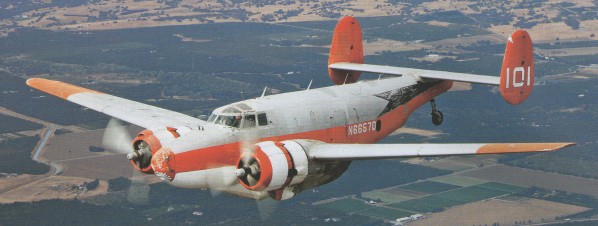
California-based Oakland Airmotive specialized in civilian executive transport conversions of surplus U.S. Navy Lockheed PV-2 Harpoon patrol bombers. The resultant Oakland Centaurus seated 8/14 passengers and was offered as a high speed corporate transport in the late 1950s and early 1960s.
Engines: 2 x Pratt & Whitney GR2800-¬S1A4 G, 2,000 h.p. Span: 65 ft. 6 in. Length 51 ft. 2.5 in. Height: 11 ft. 10.5 in. Weight loaded: 26,000 lb. Max. speed: 300 m.p.h. Cruising speed: 260 m.p.h. Range: 1,000 miles. Service ceiling: 25,000 ft. Armament: Two fixed 0.50 in. machine guns and two depressable 0.303 in. guns in nose, two or four 0.303 in. guns in dorsal turret, two 0.303 in. guns in ventral position; bomb load 2,500 lb. Crew 5.
PV-1 Engines: 2 x Pratt & Whitney R2800-31 Twin Wasps, 2000 hp / 1491kW. Max take-off weight: 14096 kg / 31077 lb Empty weight: 9161 kg / 20197 lb Wingspan: 19.96 m / 65 ft 6 in Length: 15.77 m / 51 ft 9 in Height: 3.63 m / 11 ft 11 in Wing area: 51.19 sq.m / 551.00 sq ft Max. speed: 518 km/h / 322 mph Cruising speed: 200 kts / 370 kph Service ceiling : 24,000 ft / 7315 m Ceiling: 8015 m / 26300 ft Range: 2189 km / 1360 miles Bomb load: 2500 lb. Armament: 2 x .5 in & 8 x .303 in mg, 1134kg Bomb Crew: 5.
Ventura 5 Engines: two 2,000 h.p. Pratt & Whitney R2800-31 Span: 65 ft. 6 in Weight: 26,500 lb Max. Speed: over 300 mph
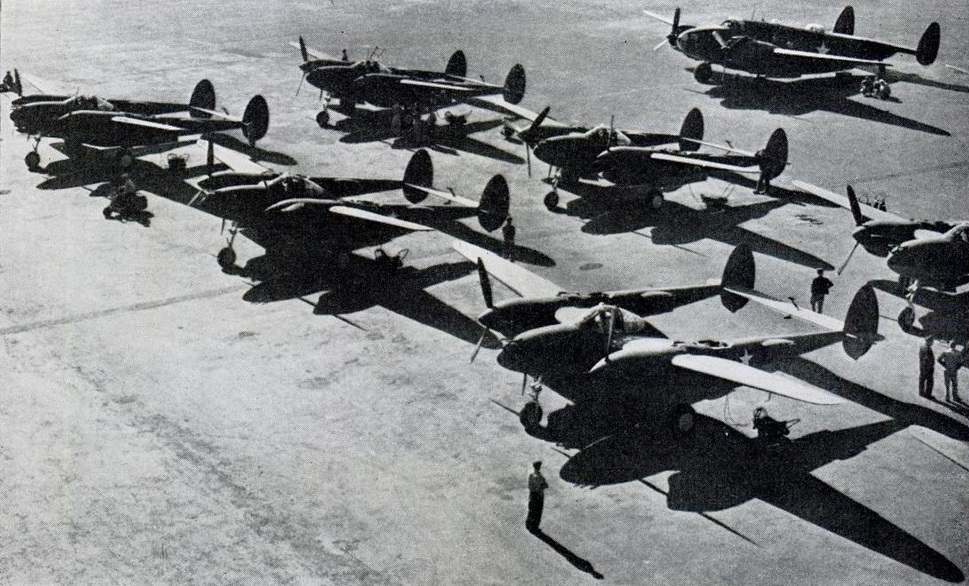
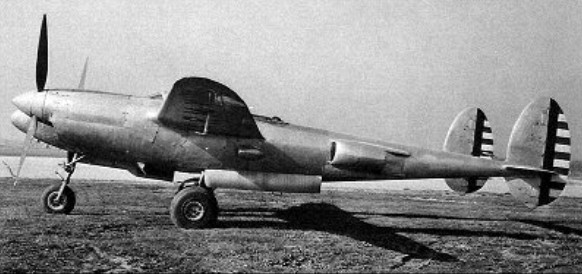
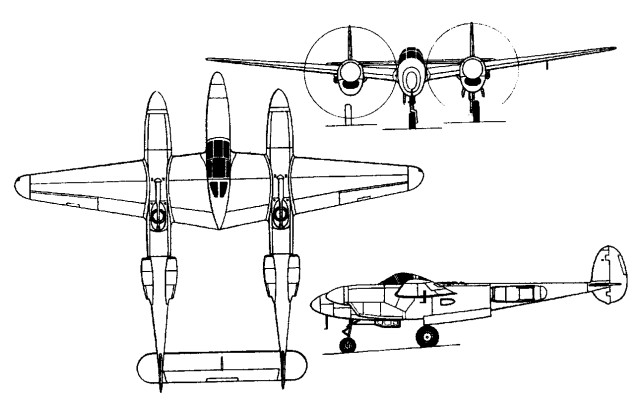
A conception of pre-war years, the Lockheed XP-49, was designed in 1939 with the goal of attaining 761km/h in level flight at 4572m. The XP-49 was to be armed with two 20mm cannon and four 12.7mm machine-guns. The XP-49 was an outgrowth of the P-38 Lightning but in most respects was an entirely new design by the Lockheed-Burbank fighter team under H. L. Hibbard and Clarence (Kelly) Johnson. Ordered by the US Army on 3 August 1939 to meet a twin-engine fighter requirement (which also produced the Grumman XP-50) the sole XP-49 was expected to attain unprecedented performance by mating the Lightning’s familiar twin-boom layout with two 1715kW Pratt & Whitney X-1800 24-cylinder inline engines. When plans to develop the powerplant proved too ambitious, twin 1006kW Continental XIV-1430-1 engines had to be substituted, reducing speed to 737km/h, although this was reached because the test ship lacked the added weight of protective armour which would have been fitted on a production variant. “We still felt we had a winner,” says a Lockheed engineer. “We had a roomy, pressurised cabin, good handling characteristics and, eventually, good manoeuvrability.” The XP-49 first flew 11 November 1942 at Burbank. When it became necessary to increase the vertical fin area to improve yaw characteristics, the result was an unusual set of markings: Army directives called for 13 alternating red and white horizontal stripes on the rudder, symbolic of the original 13 American colonies. When the tail was heightened, painters simply added non-regulation extra stripes. repaired, and was ferried to Wright Field, Ohio, on 25 June 1943. Though it was a clear improvement over the P-38, able to “fly rings around the Lightning” in the words of one pilot, minor but troublesome fuel leakage problems led to XP-49 tests being discontinued and the airframe being scrapped, just when Mustangs with long-range drop tanks were appearing over Berlin.
XP-49 Engine: 2 x Continental XIV-1430-13/15, 1010kW Max take-off weight: 9047-9977 kg / 19945 – 21996 lb Empty weight: 7013 kg / 15461 lb Wingspan: 15.85 m / 52 ft 0 in Length: 12.22 m / 40 ft 1 in Height: 2.98 m / 9 ft 9 in Wing area: 30.42 sq.m / 327.44 sq ft Max. speed: 650 km/h / 404 mph Cruise speed: 600 km/h / 373 mph Ceiling: 11400 m / 37400 ft Range: 1095 km / 680 miles Crew: 1