Mexico
Formed by Juan F. Azcarate in 1957 with Lockheed, to design an aircraft specifically to suit Central American conditions. Built the LASA-60 4/6-seat utility aircraft in 1959. Construction undertaken by Lockheed-Azcarate, Macchi and Aviones Lockheed-Kaiser. Lockheed acquired a substantial holding in Aermacchi 1959.
Author: Terry
Lockheed 44 Excalibur
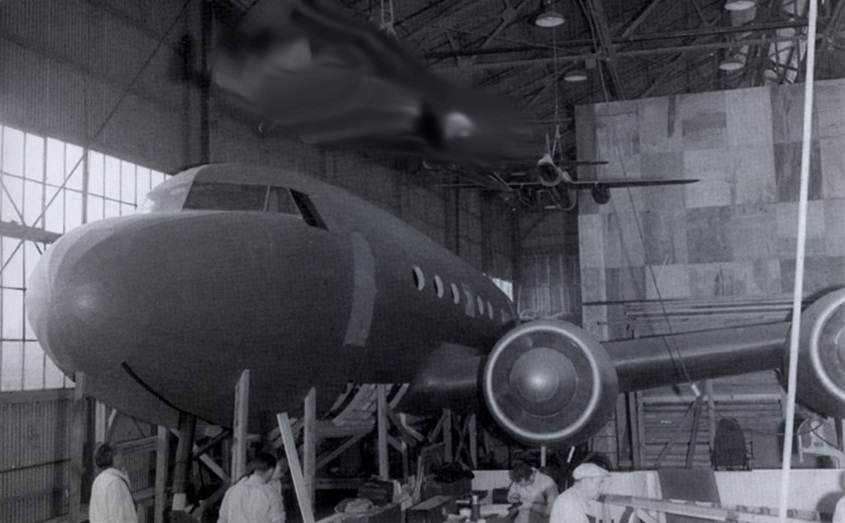
Around this time, the late 1930s Lockheed Aircraft Corporation was studying different airliner projects. The first was the Model 27, which had a canard configuration. The other two were the L-104 and L-105. The L-105 was smaller, with 1200 hp engines, and was more conventional than the L-104. These studies led Lockheed’s Burbank facility to settle on a design dubbed Model 44, a four-engined airliner that was announced to the public in April 1939. Soon afterwards, the new airliner was dubbed Excalibur. The Excalibur resembled an enlarged Model 10 Electra. It would be powered by four Wright GR-1820 Cyclone 9 radial engines, rated at 1000 hp (746 kW), or four Pratt & Whitney R-1830 Twin Wasp radials. Its wingspan was 95 ft 9 in (29.18 m), its length was 82 ft 6 in (25.15 m), and its projected maximum speed was in the 250-280 mph range (402–451 km/h). Several variants were proposed, to accommodate different passenger loads.
The original Excalibur design envisioned a 21-passenger payload, with a 240 mph (386 km/h) cruising speed. This was revised to 36 passengers at 268 mph (431 km/h) cruise at 12,000 feet (3,660m) altitude. This change included increasing the fuselage diameter, making it comparable to the Model 18 Lodestar, and increasing the wingspan to 95 ft 9 in (25.19 m) with an area of 1,000 ft² (92.9 m²). A tricycle landing gear with steerable nosewheel was envisioned. With the revised specifications, the Excalibur could now effectively compete with the near monopoly Douglas had on the airliner market. Its projected performance was better (except in range) than the Boeing 307. The revision of specifications was partially due to a request from Pan American Airlines; their influence also caused the addition of the third tailfin. A variant designated the L-144, able to carry 40 passengers was planned, but was ultimately cancelled even though South African Airways had placed a potential order for two examples. Lockheed proceeded with a full-scale mockup of the proposed Excalibur, including most of the airliner except the right wing.

The billionaire Howard Hughes, who had recently gained ownership of Transcontinental & Western Air (TWA), decided to provide funding for the new Excalibur. He had a plan in mind to vastly improve the characteristics of the Excalibur by increasing comfort, speed and profit of the aircraft. It was thus that Hughes invited three workers from Lockheed and Jack Frye (president of TWA) to a meeting at his Hancock Park residence. The Lockheed employees included Clarence “Kelly” Johnson and Robert E. Gross. Hughes expressed his requirements for the “airliner of the future”: a payload of 36 passengers (or 20 sleeping berths), a six-person crew, a 3,600 mile (5,800 km) range, a 300 mph (483 km/h) cruise speed, and a weight of 23.5-25 metric tonnes. This meant that the Excalibur would have to get a 100 mph (161 km/h) increase in speed and be able to fly 1,000 ft (305 m) higher. It would need to cross the United States nonstop. The first decision was to re-engine the Excalibur with Wright R-2600 radials, which had not been tested yet. The next decision was to start from scratch while saving the overall shape and triple tail configuration of the original Excalibur.
The new design differed so much from the original Excalibur, that a different model designation was needed. It was first given the temporary designation L-104, then it was later officially designated the Model 49 or “Excalibur A”. In time, the Model 49 would become a completely different aircraft from the original Model 44. Lockheed later dropped the name “Excalibur” as the new airliner had little to do with its predecessor. The end result was the Lockheed L-049 Constellation.
Powerplant: 4 × Pratt & Whitney Twin Wasp S4C-4-G, 1200 hp (895 kW) each
Wingspan: 95 ft 0 in (28.96 m)
Wing area: 1000 sq.ft (92.90 sq.m)
Aspect ratio: 9.025
Length: 74 ft 11½ in (22.85 m)
Empty weight: 26,424 lb (11,986 kg)
Gross weight: 40,000 lb (18,144 kg)
Crew: two
Capacity: 32 passengers
Lockheed (Vega) V.307
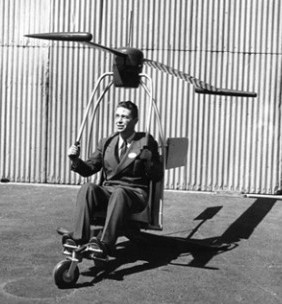
A single-seat helicopter
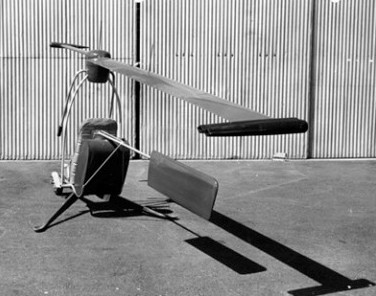
Rotor diameter: 20 ft 0 in
Height: 6 ft 0 in
Gross weight: 450 lb
Fuel capacity: 15 USG
Vert ROC: 800 fpm
Max speed; 80 mph
Pwr off sink: 16 ft/sec @ 25 mph
Lockheed CL-595 / Model 186 Aerogyro / Model 286 / XH 51A Aerogyro

Lockheed began developing its rigid rotor concept with the CL-475 helicopter design in 1959 and the performance of the CL-475 encouraged Lockheed to continue development. Lockheed submitted the CL-475 to the Army as a candidate to replace the Bell OH-13 Sioux and Hiller OH-23 Raven observation helicopters. Lockheed also tested the commercial market waters without success. However, in February 1962, Lockheed’s Model 186, a new design based on the CL-475 rigid rotor, was selected as the winner for a joint Army-Navy program to evaluate the rigid rotor for high-speed flight capability.
Two four-seat, three-bladed XH-51As were ordered and built for the program. Powered by the 550 shp (410 kW) Pratt & Whitney Canada PT6B-9 turboshaft engine, XH-51A (serial number 61-51262) first flew on 2 November 1962. As flight testing progressed, the original three-bladed, rigid rotor system demonstrated instability at higher speed ranges. Lockheed engineers solved the problem by modifying the aircraft with a four-bladed rotor system. In 1963, the Army’s Technology Research and Evaluation Command (TRECOM) contracted with Lockheed to modify one of the XH-51 aircraft into a compound helicopter.
The second XH-51A (serial number 61-51263) was subsequently converted by adding wings with a span of 16.1 ft (4.9 m), and a 2,500 hp (1,864 kW) Pratt & Whitney J60-2 turbojet engine mounted on the left wing to increase performance. The XH-51A Compound first flew without powering up the turbojet on 21 September 1964, while tests were conducted for balance and handling. The aircraft’s first flight as a true compound helicopter took place on 10 April 1965, and on 29 November 1967 achieved a speed of 263 knots (302.6 mph, 486.9 km/h).
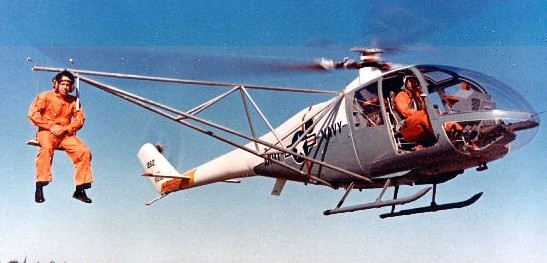
In June 1964, NASA ordered a five-seat, three-bladed variant, the XH-51N (NASA 531) as a helicopter test vehicle.
Lockheed built two demonstrator aircraft, designated the Lockheed Model 286, to market to the public (registration numbers N286L and N265LC). These aircraft had the five-seat configuration of the XH-51N with the four-bladed rotor system of the XH-51A. The Model 286 was certificated for civil operation by the FAA on 30 June 1966, but Lockheed never sold any aircraft. Lockheed used the aircraft for several years as executive transports, eventually sold them to a collector where they were destroyed by fire in 1988.
The two XH-51A examples (Serial Numbers 61-51262 and 61-51263) are stored at the United States Army Aviation Museum at Fort Rucker.
Variants:
186
Civil version of 286/XH-51
Rotor dia: 35 ft
Length: 32 ft
286 / XH-51A
four place, three-bladed rotor
Engine: 1 × Pratt & Whitney Canada PT6B-9 turboshaft, 550 hp (410 kW)
Length: 40 ft 9 in (12.40 m)
Rotor diameter: 35 ft 0 in (10.67 m)
Height: 8 ft 2½ in (2.50 m)
Disc area: 962 ft² (89.4 m²)
Empty weight: 2,790 lb (1,265 kg)
Max takeoff weight: 4,100 lb (1,864 kg)
Maximum speed: 151 knots (174 mph, 280 km/h)
Cruise speed: 139 knots (160mph, 257 km/h)
Range: 226 NM (260 mi, 418 km)
Service ceiling: 16,000 ft (4,876 m) (hover ceiling (in ground effect))
Rate of climb: 2,000 ft/min (10 m/s)
Disc loading: 4.26 lb/sq.ft (20.9 kg/sq.m)
Power/mass: 0.27 hp/lb (0.44 kW/kg)
XH-51A Compound
modified with a four-bladed rotor and stub wings and an auxiliary 2,900 hp Pratt & Whitney J60-2 engine.
Rotor diameter: 31 ft 7 in
Length: 31 ft 7 in
Model 286
five place civilian or military light helicopter offered for sale, none were sold.
Model 286 / XH-51N
five place, three-bladed rotor modified for NASA test purposes.
Lockheed CL-475
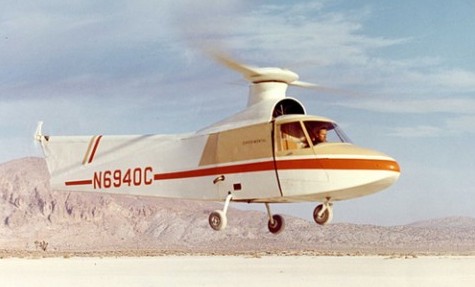
The concept of the rigid rotor coupled to a gyroscope system was developed by an Advanced Concepts Group led by Irven Culver to seek significant improvements in performance, cost, reliability, and handling characteristics of helicopters. Following testing of a small radio-controlled vehicle – with a 1.52m diameter, two blade, hingeless rotor driven by a McCoy 60 model aeroplane engine – the small design team undertook in July 1959 to design and build an experimental two-seat helicopter for full-scale demonstration of the new concept.
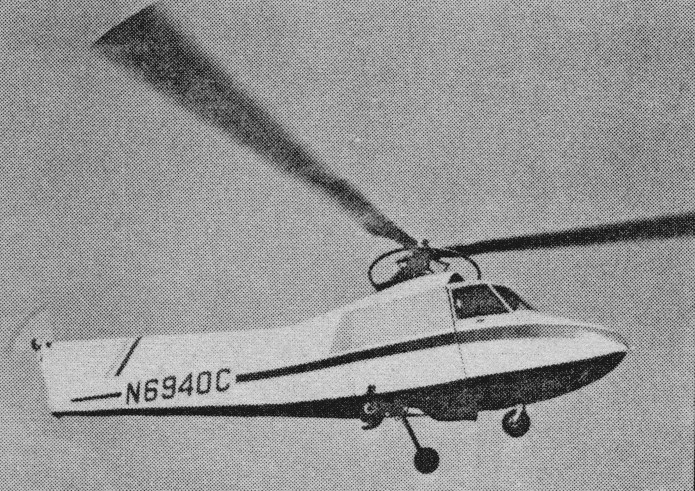
Designated CL-475, this research helicopter had a steel and aluminium tubing covered frame with fabric and a Plexiglass cabin with side-by-side seats. Its 140hp Lycoming VO-360-AIA four-cylinder air-cooled engine initially drove a two-blade wooden rotor, with gyroscopic control being provided by a double metal ‘lollipop’ attached to the blades and connected to the swashplate by springs. In this form the CL-475, which was registered N6940C, was completed in autumn 1959 and was trucked to Rosamond Lake in the Mojave Desert where initial trials could be made without attracting undue attention.
Excessive vibration was encountered during the first flight on 2 November, 1959, and forced Irv Culver’s team to experiment during the next six months with a variety of three- and four-blade wooden rotor designs. The vibration problem, however, was brought within reasonable limits only after the adoption of a three-blade metal rotor and the installation of a new gyroscopic ring attached directly to the swashplate. The CL-475, which in mid-1960 had been moved to the Lockheed facility at Rye Canyon, was then evaluated by FAA, NASA and military pilots and proved to be easy to fly. In fact, a pilot without previous helicopter experience was once able to ferry it alone. Pleased with the results, Lockheed incorporated the rigid-rotor concept in its entry for the US Army light observation helicopter (LOH) competition in 1961. Although the Army did not select this Lockheed design, it had sufficient confidence in the new concept to order jointly with the Navy two Lockheed XH-51 research helicopters.
At the end of its trial programme, the CL-475 was put in storage until 1975, when it was donated by Lockheed to the National Air and Space Museum, Smithsonian Institution. It has now been loaned to the US Army Aviation Museum at Fort Rucker, Alabama.
Lockheed began developing its rigid rotor concept with the CL-475 helicopter design in 1959 and the performance of the CL-475 encouraged Lockheed to continue development. Lockheed submitted the CL-475 to the Army as a candidate to replace the Bell OH-13 Sioux and Hiller OH-23 Raven observation helicopters. Lockheed also tested the commercial market waters without success. However, in February 1962, Lockheed’s Model 186, a new design based on the CL-475 rigid rotor, was selected as the winner for a joint Army-Navy program to evaluate the rigid rotor for high-speed flight capability.
Lockheed CL-475 prototype
Registration: N6940C
Engine: 1 x 140 hp Lycoming VO-360-AIA
Main rotor: three-blade
Main rotor diameter: 32 ft
Weight: approx 2,000 lb
Seats: two side-by-side
Lockheed Vega Starliner
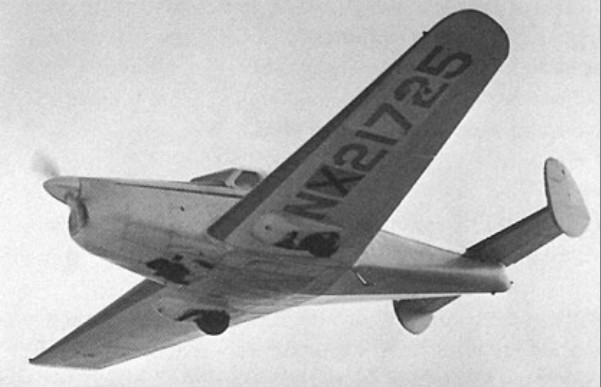
The Vega Starliner NX21725 was a five/six-seat low-wing cabin monoplane with retractable landing gear and an unusual powerplant. The model 22 was a modification with 640hp Menasco Unitwin 2-544 and a single tail. This comprised two 194kW Menasco C6S-4 inline engines, mounted side-by-side, and coupled to drive together, or independently in emergency, a single propeller.
First flown on 22 April 1939 (piloted by B A Martin), the Starliner was abandoned after some 85 flight test hours as there was no demand for an aircraft in this category.
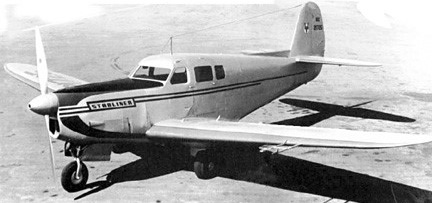
The aircraft was sold to a film studio and its track faded.
Engines: two 194kW Menasco C6S-4 Unitwin
Wingspan: 12.50 m / 41 ft 0 in
Length: 31’6″
Max take-off weight: 2722 kg / 6001 lb
Useful load: 1660 lb
Max. speed: 338 km/h / 210 mph
Cruise speed: 180 mph
Stall: 60 mph
Range: 600 mi
Seats: 6
Lockheed AH-56 Cheyenne Gallery


Lockheed AH-56A Cheyenne

In March 1966 Lockheed began development of an advanced armed heli¬copter, designated as the AH 56A Cheyenne. Known as a compound helicopter, being provided with small low set cantilever wings to off load the main rotor in high speed flight, it was designed to have a maximum level speed 244 mph (393 km/h). Army support came to an end in 1969, and economic considerations eventually caused Lock¬heed to end its development programme.
AH-56A Cheyenne
Engines: 1 x General Electric T64 GE 16, 3925 shp.
Rotor dia: 51 ft 3 in (15.62 m).
Length: 60 ft 1 in (18.31 m).
Height: 13 ft 8.5 in (4.18 m).
Max TO wt: 18,300 lb (8300 kg).
Max level speed: 244 mph (393 kph).
Range: 1,225 miles.
Ceiling: 20,000 ft.
Lockheed YO-3A

Potential of the QT-2 / Q-Star was such that Lockheed produced a refined version for the US Army: The YO-3A. Also based on the Schweizer SGS 2-32 Sail-Plane wings and tail unit, but with wings mounted low on the fuselage, retractable landing gear, upgraded (SLAE) avionics, State-Of-The-Art Sensor (NVAP with LTD) and the Tactical Observer seated forward for better visibility. A 156.5kW IO-360D Continental Engine provided propulsion power. The YO-3A was deployed in Southeast Asia from mid-1969 to late-1971.
It was the first military aircraft to employ an integrated NOD Sensor with a YAG Laser. It also had an Infrared Illuminator for other tactical sensors (INFANT LLTV, NODs, etc). The YO-3A was deployed in Vietnam for more than a year.
It was later operated by the Louisiana Dept of Wildlife & Fisheries (LDWF) and FBI. NASA operated the former 69-18010 as NASA 818 (or similar).
One YO-3A is preserved in the Army Aviation Museum at Fort Rucker, Alabama. YO-3A 69-18005 is on display at the Museum of Flight in Seattle, Washington. YO-3A 69-18006 is on display at the Pima Air and Space, Tucson AZ. YO-3A 69-18007 is in storage at the Western Museum of Flight in Torrance, California. As of 2014, YO-3A 69-18010 (NASA 818) is in flyable storage at Armstrong Flight Research Center.
YO 3A
Engine: Continental, 210 hp.
Wing span: 57 ft 0 in (17.40 m).
Length: 30 ft (9.14 m).
Gross weight: 2,167 lb (983 kg).
Max speed: 149 mph (240 km/h).
Crew: 2.

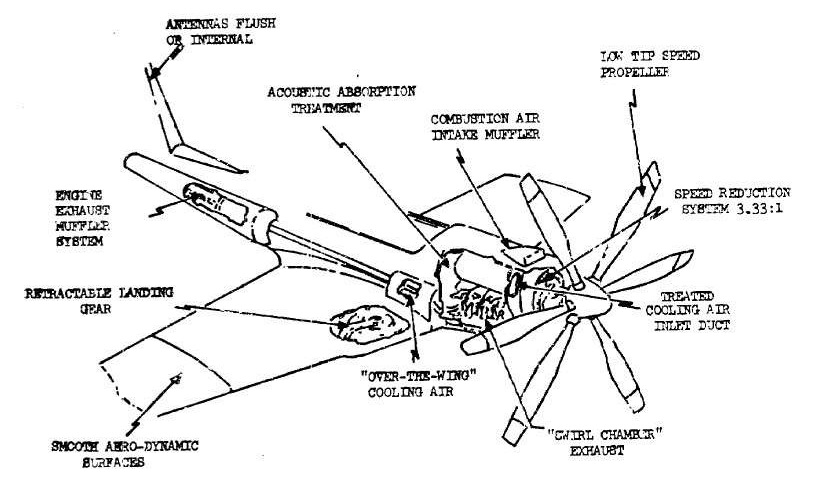
Lockheed QT-2 / Q-Star
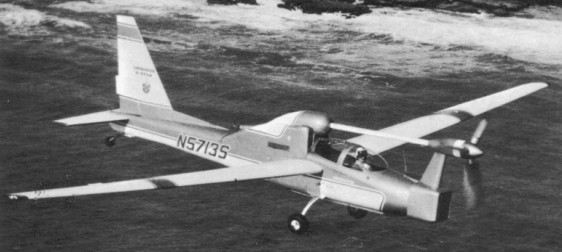
Faced with the military requirement for a quiet observation aircraft, Lockheed Missiles & Space Co. (LMSC) developed the “Q” Series Aircraft: QT-1 (conceived, but not constructed), QT-2 (N2471W and N2472W) later modified to QT-2PC configuration (#1 and #2), and Q-Star. Note: “QT: for Quiet Thruster.
The Q-Star Aircraft was LMSC’s “House Aircraft” for evaluating “quiet recon” concepts. Eighteen propeller/reduction systems and other items were evaluated. It flew early versions “Black Crow” Sensors and was the first aircraft to use a rotary combustion chamber (Wankel) engine for primary power.
Two Schweizer 2-32s (67-15345 and 67-15346) from the U.S. Naval Test Pilot School X-26 Program (USNTPS) were modified to QT-2 configuration (QT for Quiet Thruster) by the Lockheed Missiles & Space Co. (LMSC) and civil registered as N2471W and N2472W.
In 1967 the aircraft were modified by adding a Continental O-200 engine, V-Belt RPM reduction system, four-bladed fixed pitch wood (Fahlin) propeller, and airframe upgrades. The QT-2 first flew in August 1967.
After demonstrating quiet flight, the aircraft were again modified to military QT-2PC configuration, known only as Tail Numbers “1” and “2”, with GFE avionics and camouflage for night operation. They were successfully evaluated in Southeast Asia (Prize Crew OpEval) for covert (“stealth”) tactical airborne observation in the spring of 1968 (during Têt). Arriving in South Vietnam just before the 1968 TET Offensive, they accumulated approximately 600 hours flying exclusively tactical night missions during the first three-month deployment. They continued to operate in Vietnam during most of 1968 (Prize CrewII) and were then transferred to the Navy (NTPS Pax. R.) as X-26Bs in 1969. The QT-2PCs were the first military aircraft to use “Starlight Scopes”.
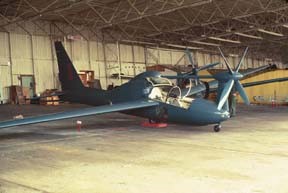
The two QT-2PCs were returned to USNTPS in 1969 and re-designated X-26Bs.
The #1 QT-2PC was re-designated “67-15345” and the #2 aircraft was used for spare parts.
The #1 ship is now at USAAM at Ft. Rucker, AL. The #2 ship QT-2PC N2472W was retro-verted to SGS 2-32 configuration and is operated by Mile High Gliders in CO.
Lockheed Aircraft Corp. offered the rotating combustion engine its first chance to fly. Under a Navy contract, Lockheed was experimenting with ul¬tra quiet aircraft for undetected low altitude reconnaissance. Several air¬frame configurations, were developed culminating in the QT 3. Basically the QT 3 (QT for quiet thruster) consisted of a highly modified Schweizer 2 32 sailplane equipped with art amidship mounted Continental 100 horsepower engine turning a large slow turning propeller through a reduction drive and long overhead propeller shaft. The QT 3 yielded airframe and propellor noise so low that the most noticeable remaining sound was valve action in the engine. Endeavoring to eliminate valve noise, Lockheed’s engineers seized upon the RC engine since it has no valves, only ports.
Replacing the air cooled Continen¬tal with an RC 2 60 U5 liquid cooled engine required extensive reengineer¬ing. A Corvette aluminum radiator was grafted to the nose and redesigned reduction gearing was required. A 5.34/1, two stage ‘V’ belt reduction system reduced 6,000 rpm at the en¬gine down to 500 propeller rpm. Only 185 horsepower was used in the Q Star due to carburetor limitations. Nevertheless, power was increased by 85% with only a 6% increase in air¬frame weight. A three blade 90 100in constant speed propeller converted power to thrust. Laminated birch was used for blade material but at least one propeller had a balsa wood core covered with glass fibre.
Throughout the QT proj¬ect, Lockheed tested five 4 blade, two 6 blade, and two 3 blade props.
Flight testing revealed previously un¬attainable levels of quiet flight. Com¬pound muffling culminated in a discharge pipe pointing straight up. Re¬sidual noise was thereby directed away from the ground. As a test a Cessna 182 and the Q Star, both load¬ed to 2,600 pounds gross weight, were flown over the airport at 800 feet. The 182 was easily detectable by engine and propeller noise; Q Star was almost impossible to detect. Even at 400 feet the Q Star sounded only like leaves rustling in a light wind. In the cockpit, engine noise is similar to the hum of an electric motor and even then, most noise in the cockpit seemed to be aerodynamically originated.
Potential of the QT-2 / Q-Star was such that Lockheed produced a refined version for the US Army: The YO-3A.
Engine: 1 x Cont. IO-360, 154kW
Wingspan: 17.4 m / 57 ft 1 in
Length: 9.2 m / 30 ft 2 in
Wing area: 17.0 sq.m / 182.99 sq ft
Crew: 2
QT-2PC
Engine: 1 × Continental O-200, 100 hp (75 kW)
Propeller: Ole Fahlin four-blade, 8 inch chord, fixed-pitch 100 inch diameter
Wingspan: 57 ft 1.5 in (17.37 m)
Wing area: 185 ft² (16.7 m²)
Wing aspect ratio: 18
Length: 30 ft 9 in (9.33 m)
Height: 9 ft 3 in (2.74 m)
Loaded weight: 2,500 lb (kg)
Fuel Capacity: 20 gallons (nominal)
Service ceiling: 13,000 ft (m)
Rate of climb: 200 ft/min (m/s)
Quiet cruise speed: 70 – 80 mph
Wing loading: kg/m² (lb/ft²)
Flight endurance: Planned = 4+ hours; demonstrated = 6.7+ hours
Crew: two

