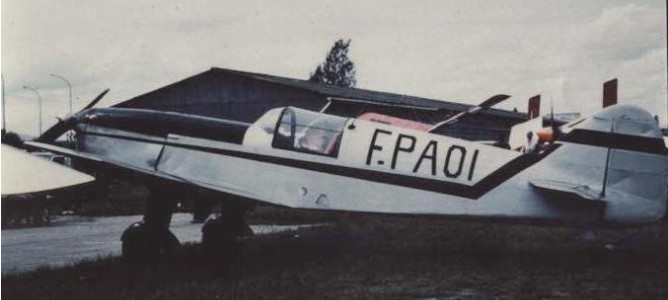
A 1941 single-seat trainer, Only one was built.
Engine: 1 x 95hp Régnier 4Eo
Wingspan: 7.28 m / 23 ft 10 in
Wingarea: 502 sq.ft
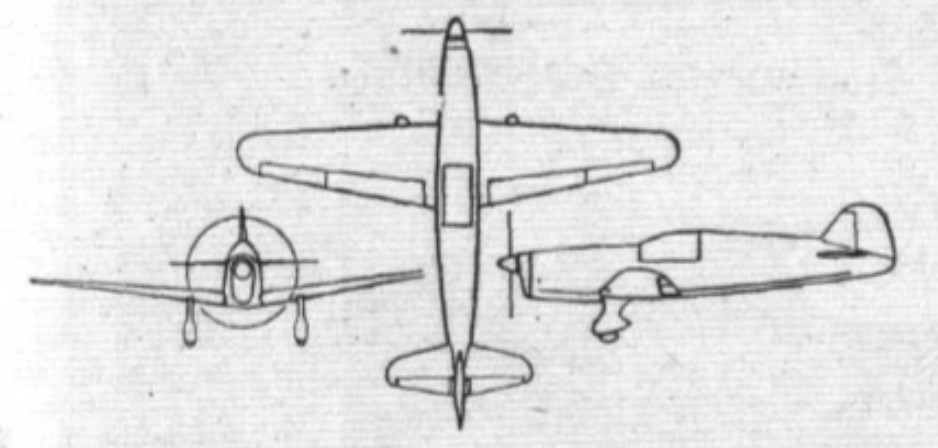
A 1941 single-seat trainer, Only one was built.
Engine: 1 x 95hp Régnier 4Eo
Wingspan: 7.28 m / 23 ft 10 in
Wingarea: 502 sq.ft
A single-seat lightplane design with tricycle u/c.
The Mauboussin M.200 was 1939 single-seat low-wing monoplane racer built by Fouga (F-AROP).
The M.200 set an FAI record of 255km/h over 1000 km on 7 May 1939.
The Mauboussin M.201 was a 1939 single-seat trainer with 1 x 150 hp Régnier 4Eo and 7.28 m span. It was never completed. The unfinished M.201 airframe may have been basis for the M.202
M.200
Engine: 1 x 115 hp Régnier 4Eohp
Wingspan: 28m
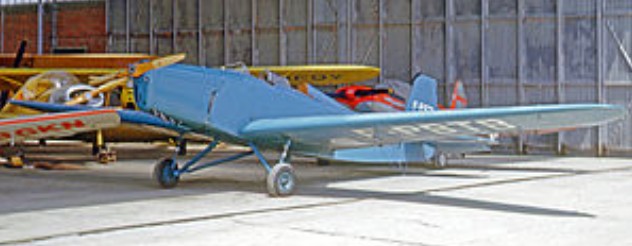
The Mauboussin M.120 was based on a 1931 collaboration between Louis Peyret and Pierre Mauboussin, the Peyret-Mauboussin PM.XII, and like it, was a low-wing cantilever monoplane of wooden construction. The undercarriage was of fixed tailskid type, and the pilot and instructor sat in tandem, open cockpits. Mauboussin built a number of prototypes himself, followed by a small series manufactured for him by Breguet in 1934.
One of first M.120s took part in the international touring aircraft contest Challenge 1932, flown by André Nicolle. It completed contest on the last 24th place, but it had the weakest engine of all participants and completing this contest was quite a success anyway.
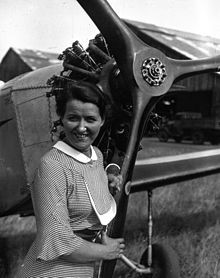
In 1935 Maryse Hilz set a women’s altitude record of 7,388 metres on 24 September in the M.122.
In 1936, Fouga, then a builder of railway rolling stock, purchased all rights to the design as part of an effort to enter the aircraft industry, and was able to secure a contract from the Armée de l’Air to supply the type as the M.123.
The Mauboussin 123 was built 1937-1938.
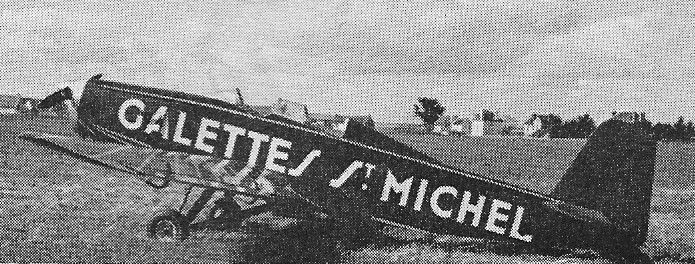
Production was restarted by Fouga after the war for the French flying clubs.
The M.129-28 Corsaire post-war production version was built 1947-1948. Fifty were built powered by a 60 hp Salmson 9 Adr. Twenty M.129-28 Corsaire were produced in 1948 by Fouga et Cie, the first flying on 20 March 1948.
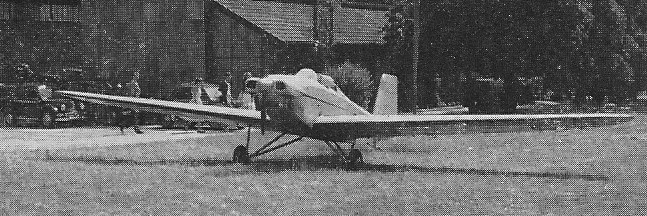
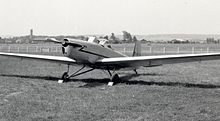
One of first M.120s took part in the international touring aircraft contest Challenge 1932, flown by André Nicolle. It completed contest on the last 24th place, but it had the weakest engine of all participants and completing this contest was quite a success anyway. Two competed the following year, one of them with an all-women crew for probably the first time. Again, low engine power left them low in the final table.
After the Angers competition on 2 August 1933, one of the women (Hélène Boucher) set a new women’s world altitude record at 5,900 m (19,357 ft) in the M.120. In 1935 Maryse Hilsz increased it to 7,388 m (24,239 ft) on 24 September in the M.122.
Variants
M.120 – 1932 low-wing monoplane trainer/tourer, 1 x 60 hp Salmson 9Adr, 116 built
M.120: PM XII deriv. (PM XII consid. prototype), wooden constr.
M.120/32: 1932 Zodiac-built M.120, 3 built (c/n 104, 106, 109)
NB: M.120/32 c/n 106 subsequently rebuilt by Brequet as an M.120/34
M.120/34: Breguet-built M.120, 10 built (c/n 111-121, 113 was rebuilt M.112)
NB: count incl. c/n 113 (rebuilt M.112) but not c/n 106 (rebuilt 120/32)
M.120/37: [Project] 2-seat tandem trainer, became M.123 Corsaire
M.121: as M.120 but with supercharged Salmson 9A 68–80 hp (51–60 kW) (2 built)
M.121P 1935 Corsaire Major: version with 75 hp Pobjoy R Cataract engine, aka M.121-35, (1 built F-AMHS)
M.122 – 1935 Corsaire Major, record a/c for Maryse Hilz, 75 hp Salmson 9 Aers, 1 built
For women’s light aircraft altitude record (7338 m category), 24 Sept 1935
M.123 – 1937 2-seat low-wing monoplane trainer, 1 x 60 hp Salmson 9Adr, 11.75m span (65 built)
M.123: Corsaire, 60 for Aviation Populaire, wooden const., 1st flight Dec 1937
M.123 stemmed from 1936 Fouga contract for para-military training aircraft
M.123C: M 129/48 (F-PJKQ) with Minié replaced by flat 4-cyl Continental
M.123M: [Project] 70 hp Minié flat 4-cyl, later produced with 75hp Minié
M.123M Corsaire: post-WWII mod, 75 hp Minié 4DC32 flat 4-cyl, canopy, M = Minié
M.123M re-engined with 60 hp geared Salmson 9Adr by Gilbert Pollono, 1954
NB: 1958 Pollono re-engined with 75 hp Régnier, turning M.123M into M.125
M.123M (F-BCEP) re-engined with a Continental by Simon Glotin at Nates
M.123M re-engined with a 105 hp Hirth engine by M Grenet of Beynes, 1960
M.123R: [Project] 60 hp Régnier inverted 4 cyl engine, not built
M.123T: [Project] 60 hp Train 6T 6-cyl inline, not built
M.124 – first postwar version with 1 x 60 hp Aster 4A inline 4-cyl, 1 built
Aster engine (a licenced Walter Mikron) produced 100 hp
M.125 – 1946 M.123 variant, 1 x 60 hp Régnier 4Jo inline 4-cyl, 5 built
Differed from M.123 in powerplant and shorter 10.35 m wingspan
M.126 – 1946 M.123 variant, 1 x 80 hp Salmson Salmson 5Ap radial, 1 built
Differed from M.123 in powerplant and shorter 10.35 m wingspan
M.127 – 1946 M.123 variant, 1 x 95 hp Régnier 4Eo inline 4-cyl, 2 built
M.128 – 1946 M.123 variant, 1 x 95 hp Mathis G4G flat 4-cyl, 1 built
M.129 – 1939, sim, to M-123M, 1 x 75 hp Minié flat 4-cyl, 29 built
M.129-48: 1944 M-123 variant (F-BBSK, c/n 191), 1 x 75 hp Régnier 157 4.JO 4-cy l (23 built)
M.129-48: postwar production by Fouga, 1 x 75 hp Minié flat 4-cyl
M.129 (F-PJKQ) re-engined with Minié replaced by flat 4-cyl Continental
Metalair 1: a derivative of the M.123
Grenet PG-2 Bison
Mauboussin-Zodiac 17: Designation for Zodiac produced M.120 aircraft
Specifications:
M.123
Engine: 1 × Salmson 9Adr, 45 kW (60 hp)
Wingspan: 11.74 m (38 ft 6 in)
Wing area: 13.0 sq.m (140 sq.ft)
Length: 6.8 m (22 ft 4 in)
Height: 2.52 m (8 ft 3 in)
Empty weight: 349 kg (769 lb)
Gross weight: 609 kg (1,343 lb)
Maximum speed: 160 km/h (100 mph)
Range: 650 km (405 miles)
Service ceiling: 4,000 m (13,120 ft)
Crew: Two, pilot and instructor
M.129-48 Corsaire
Engine: 60 hp Salmson 9 Adr
Max speed: 102 mph
Cruise: 87 mph
Range: 390 mph
Empty weight: 876 lb
Loaded weight: 1382 lb
Wingspan: 38 ft 6 in
Length: 22 ft 7.5 in
Height: 8 ft 6 in
Wing area: 146.3 sq.ft
Fouga M.129-28 Corsaire
Engine: 70 hp Minie 4 DA-28
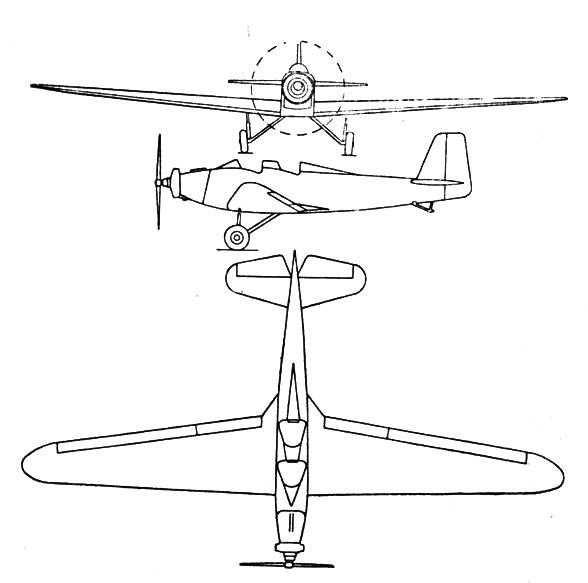
A 1932 redesign of the Zodiac-built Peyret-Mauboussin PM XII low-wing trainer.
The M.112 Corsaire is considered the prototype for the production M.120 Corsaire series by Zodiac.
A 1932 redesign of the Peyret-Mauboussin PM XI light high-wing cabin monoplane.
Avions Mauboussin
After his separation from Peyret, Mauboussin redesignated his designs in a sequence that derives the Peyret-Mauboussin designations. The PM XI and PM XII were redesignated as M.111 and M.112 (although still reported as ‘M.11’ and ‘M.12’ in the early 1930s).
Pierre Mauboussin established design office and factory at Puteaux, Seine, France, developing Corsair light aircraft which was built as Corsair 120 and Corsair Minor.
Production aircraft designations were in a more typically French pattern. The production PM XII/M.12 became the M.120 with major developments following as M.121-M.129. Inititially, M.120 developments received suffix numbers based on their year of original (eg: the M.120/37 project of 1937 which led to the production M.123 Corsaire).
Production license for all Mauboussin aircraft acquired by Societe des Etablissements Fouga in 1936. Mauboussin 123, development of Corsair, built 1937-1938, and as M.129 1947-1948.
According to Flight (30 Sept 1943), after the Armistice the Mauboussin plant was engaged in glider production.
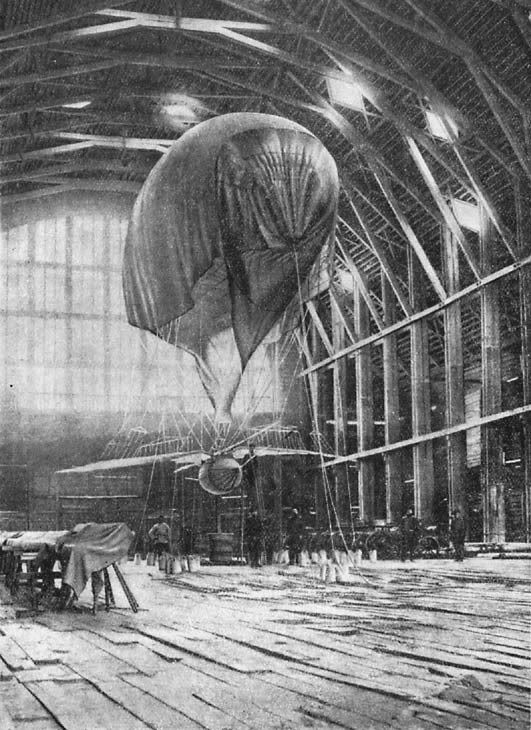
The “Mikst” of I. A. Matyunin was a mixed HTA/LTA flying machine of 1891.
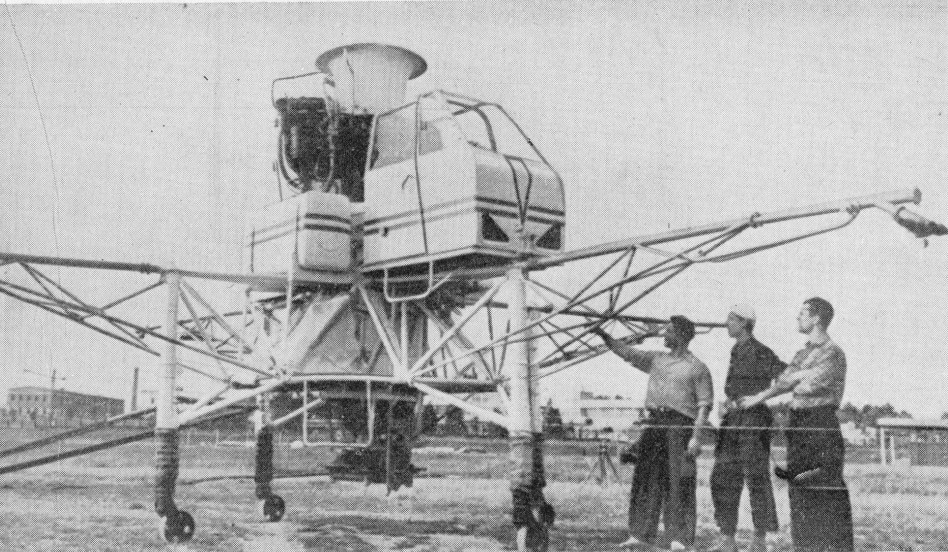
Demonstrated in Moscow during 1938, the Turbolet is a vertical take-off testbed developed by Prof. Vsevolod Matveyev. Comprising a turbojet engine mounted vertically, with fuel tanks and enclosed cockpit, the Turbolet is controlled by outrigger jet nozzles and vanes in the main jet stream.
In 1933 Mattley had in production a lightweight one/two-seat parasol-wing cabin monoplane named the Mattley Fliver, powered by a 40 hp Continental engine.

