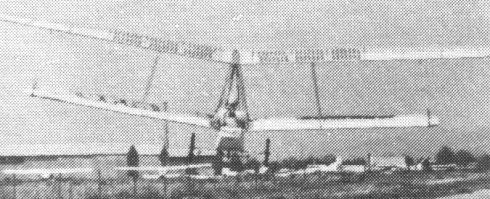
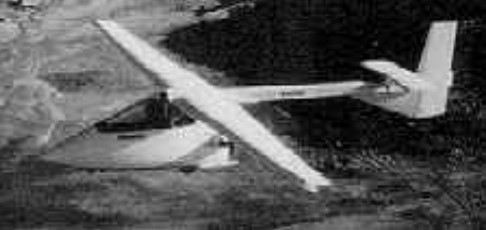
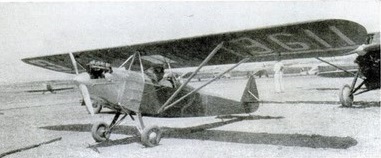
First flown in April 1979 the converted Easy Riser hang-glider is powered by 500 solar cells mounted on the top wing. The 40V, 10A output powers a 3 hp electric motor driving a 41 inch propeller. 1½ hrs of sunshine accumulated in the battery provides around 5 minutes of still air flight. The biplane was mylar covered.
Engine: Electric, 3 hp Wing span: 30 ft Empty wt: 125 lb
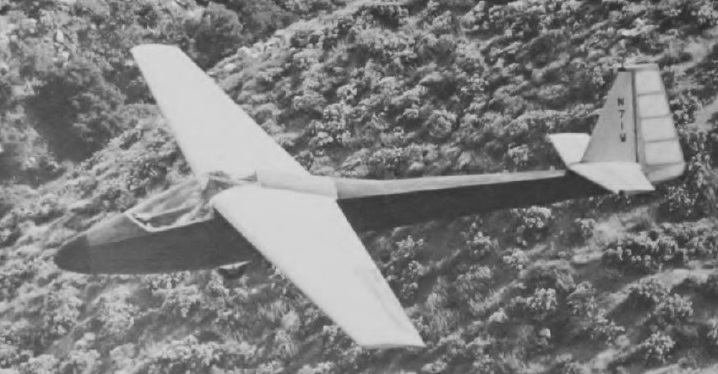
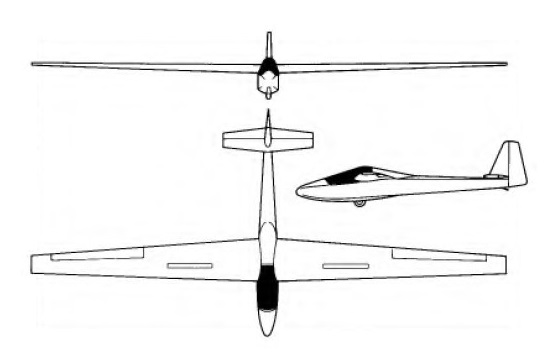
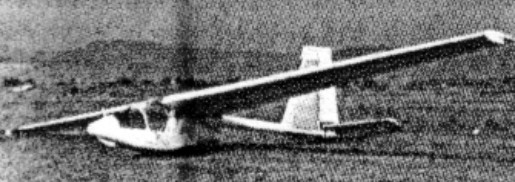
Jim Maupin of San Pedro, CA offered an inexpensive way to get into the action, with his homebuilt sailplane Woodstock, designed with the philosophy, “Build it light, build it small, build it cheap and simple.” Only basic tools are needed. Woodstocks wing, designed by lrv Culver, is built around a single main spar, formed as a hollow box out 8 feet and as a c-section beyond. Ribs are sawn from ¼-inch fir plywood, glued to the spar fore and aft. Spar runs the full length of the wing. Wing forward of the spar is covered with 1/4 -inch birch ply as a D section. Fuselage and tail are equally simple to build. An info kit was $5, plans $105 ($115 overseas).
Woodstock was designed with a wing having an 18 % section for the root, 13 % at the tip and no twis. The principal design objectives were low cost and simplicity of construction. Douglas Air was used for all major structural parts and all tail and wing skins were birch. It first flew in 1978 and won the Sailplane Homebuilders Association design contest in 1984. A tail wheel is an option instead of a skid. The main wheel is fixed. Approach control is by wing top surface spoilers. As an option, wings of 13.1 m./ 43.0 ft.
Woodstock Wing span: 11.89 m / 41.5 ft Wing area: 9.73 sq.m / 104.7 sq.ft Aspect ratio: 14.5 Airfoil: Culver Length 5.43 m / 17 ft 10 in Height: 1.22 m / 4ft 0 in Empty Weight: 111 kg / 245 lb Payload: 95 kg / 210 lb Gross Weight: 206 kg / 455 lb Water ballast: None Wing Load: 20.9 kg/sq.m / 4.29 lb/sq.ft L/DMax: 24 at 72 kph / 39 kt / 45 mph MinSink: 0.79 m/s / 2.6 fps / 1.54 kt Seats: 1
Woodstock 15M Wing span: 15 m / 49.2 ft Wing area: 10.18 sq.m / 109.6 sq.ft Height: 3.5 ft Length: 19 ft Empty Weight: 111 kg / 245 lb Payload: 120 kg / 265 lb Gross Weight: 206 kg / 455 lb Wing Load: 22.69 kg/sq.m / 4.65 lb/sq.ft Aspect ratio: 16.8 Airfoil: Culver Seats: 1 L/DMax: 26.5 72 kph / 39 kt / 45 mph MinSink: 0.79 m/s / 2.6 fps / 1.54 kt Stall: 35 mph Landing gear: single wheel Load limit 5.0 G
Designed by Jim Maupin and Irv Culver to meet SHA Homebuilt Sailplane Design Contest criteria: easy to built, low cost, soarable, self-launching, safe, the definitive powered Windrose first flew in 1984. The structural backbone is a hollow plywood box with corners longerons which carry the engine mounts, landing gear and fiberglass cockpit shell. The wings are shaped foam covered with fiberglass, but without a conventional spar. The spars are bands of unidirectional roving expoxied into recesses in the upper and lower wing skins, and separated by rows of vertical dowels between the bands to take compression loads off the foam. Ailerons are set inboard from the root to approximately two-thirds span operated by pushrods from the fuselage. The wing structure is free of controls, pushrods, cables etc. Glidepath control is by a triangular spoiler which rises above the wing center section. Both tail surfaces are all-moving. The design comes in 12.65 and 15.0 m models. Windrose was offered as partial or complete kit, or plans only. Plans used to cost $175 in the US and Canada, airmail overseas for $195.
The Windrose II motor glider has an optional shorter wing span or Cuyuna UL-II-02 engine.
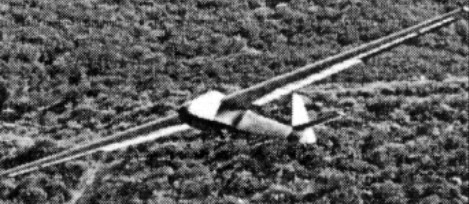
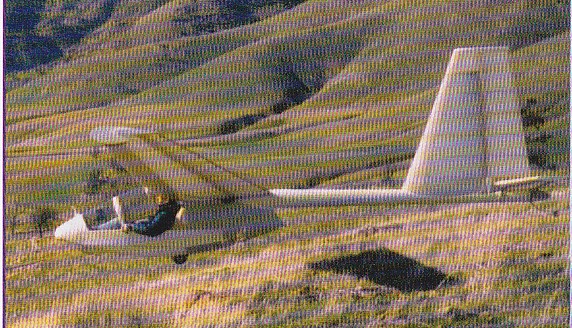
Designed by Jim Maupin & Irv Culver, the Carbon Dragon first flew in 1988. Altrough meeting the FAI definition of a hang glider, the Carbon Dragon can be launched by foot, aerotow, or bungee. Roll control and approach control are by full span 30 % chord flaperons, and at least one has been modified by the addition of a pentagonal shaped spoiler in the wing section, similar to that on the Maupin Windrose. It has a fixed main wheel. It complies with U.S. FAA Part 103 rules. In 1994 it became the first sailplane in that class to win against conventional gliders in a scheduled, non-handicapped cross-country contest. An ultralight sailplane, basic wood construction with use of carbon epoxy to reduce weight and improve stiffness. Was available as plans for $150. Price (1998) $ 170 (Plans) Building time estimated at 1500 hours.
Weight: 65 kg / 145 lb Gross Weight: 151kg / 335lb Payload: 85kg / 190lb Wing span: 13.2 m / 44 feet Wing area: 14.25sq.m / 153.34sq.ft Vne: 112 km / 70 mph L/D: 25:1 at 32 mph Stall: 20 mph Min sink: 0.51 m/s / 100 fpm / 0.99 kt at 26 mph. Seats: 1 Wing Load: 10.61 kg/sq.m / 2.18 lb/sq.ft Aspect ratio: 12.62 Airfoil: Culver CD Landing gear: single wheel
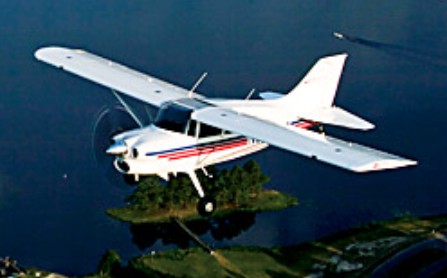
In 1981, Maule installed an IO-540-W1A5D out front of the M-5 and began delivering the M-6, also available with EDO floats. Two years later the model would morph into the M-7 and in 1989, the M-8.