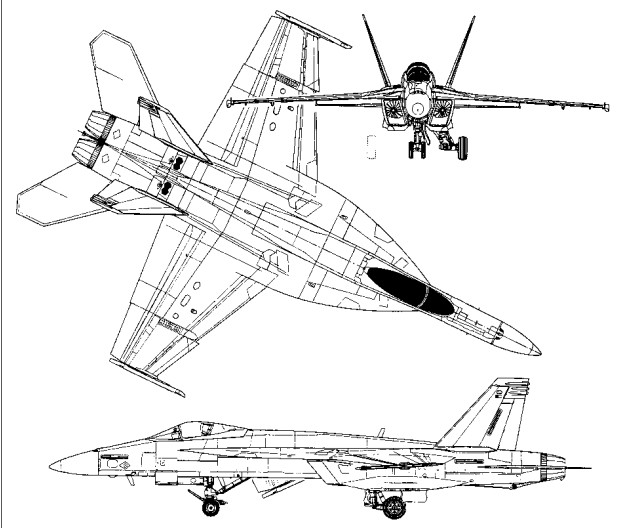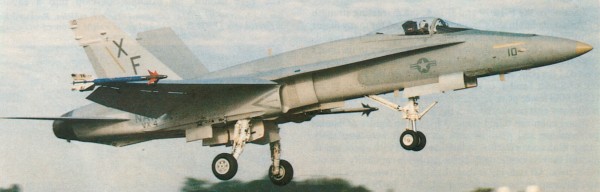
McDonnell-Douglas F-18 Hornet / EA-18 Growler

F/A-18

The McDonnell Douglas F/A-18 Hornet is a twin-engine carrier-based attack fighter derived from the YF-17 Cobra attempt at a new USAF lightweight fighter, on which the USN was a minor partner (the F-17 lost out to the YF-16).

The Navy preferred the YF-17 over the winning F-16 Fighting Falcon, because of its twin-engine design. For the Navy version, Northrop teamed with McDonnell Douglas and when the two services ended up choosing different aircraft, McDonnell Douglas became the primary contractor for the Navy design (McDonnell Douglas merged with Boeing in 1997).

The Navy’s design concept originated from Vice Admiral Kent Lee. An experienced naval aviator in WWII, he and his supporters pushed for a cheap and lightweight strike fighter, to complement the F-14 Tomcat which had become operational and was just being introduced to the carrier air wings in 1973.

The F/A-18 has a digital fly-by-wire flight control system, the cockpit equipped with three multi function displays. The entire avionics suite is digital. The F-18 is powered by two 71 2kN General Electric F404 reheated turbofans, and equipment includes a Hughes APG-65 radar with air-to-air and air-to-surface modes giving intercept and attack capabilities, a Ferranti/Bendix headup display, Kaiser multifunction displays, and Litton INS. Other externally carried sensors include laser tracker and Flir pods. As a carrier-capable platform, the F/A-18 maintains folding wings. The Hornet is capable of air-to-air refuelling.

The first of 11 full-scale development (FSD) Hornets flew on November 18, 1978, and was followed by the first production aircraft in April 1980. F/A-18 Hornets (A and B variants) entered service in 1983, replacing the F-4 Phantom II and the A-7 Corsair II. F/A-18A/B were single and two seat aircraft. The F-18B two-seat trainer retains full operational capability with only a six per cent reduction in internal fuel capacity.

McDonnell-Douglas F-18 Hornet Article

FY1986 and subsequent purchases are of the upgraded F-18C/D variants, which have AIM-120 Amraam and infrared Maverick compatibility, airborne self-protection jammers, Naces ejection seats, and improved computers. The first F-18C flight occurred in mid-1986. After a production run of 371 F/A-18As, manufacture shifted to the F/A-18C/D single and two seat variants in September 1987. Seventy-seven F-18A single-seaters and eight F-18B two-seaters delivered during 1986, including 24 for the USMC.

MDC handed over the 500th F-18 Hornet, an A model for the USMC, in May 1987.

Although the single seat variants, A and C, were first equipped with the AN/APG-65 radar, since 1994 all US Hornets feature the improved AN/APG-73 radar. The second seat of the B and D models is often manned by a weapon system operator or instructor.
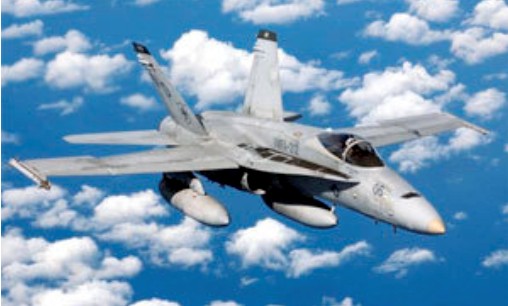
F/A-18

Test¬ing of a reconnaissance version, the US Navy F-18(R) continued. The nose-mounted 20mm rotary cannon was replaced by a sensor pallet with panoramic camera and infrared linscan. The aircraft can be reconfigured overnight for strike missions.

Licence-assembly of Hornets continued in Australia in 1987, where GAF has deliv¬ered more than 20 to the Royal Australian Air Force.

The CF-18 is the designation used for the Canadian licensed built aircraft. The Canadian Armed Forces purchased 138 examples of the CF-18 including 24 CF-18B two-seaters.

The first prototype F/A-18E Super Hornet flew on November 29, 1995.

The F/A-18E/F “Super Hornet” arrived in 2002 and represented an aircraft that was 20 percent larger and more powerful than the base Hornets. The Super Hornet is produced by a consortium of contractors that includes Boeing and Northrop Grumman. The tandem-seat Super Hornet was designed to be ultra-capable in both strike and interceptor roles and squadrons are already operating on various USN carrier battle groups. The Super Hornet is built on the F414-GE-400 series of powerplants, which stands as a highly advanced modified version of the original F404 turbofans, bigger air intakes, and the airframe itself is longer. A 33% larger internal fuel capacity and larger ordnance carrying capacity improves the range significantly. As a whole, the Super Hornets, despite their advanced infrastructure, is compiled of less parts than the original Hornets making the Super Hornet that much easier to maintain. Additional hardpoints make the Super Hornet a viable replacement to the F-14 Tomcat and A-6 Intruders.
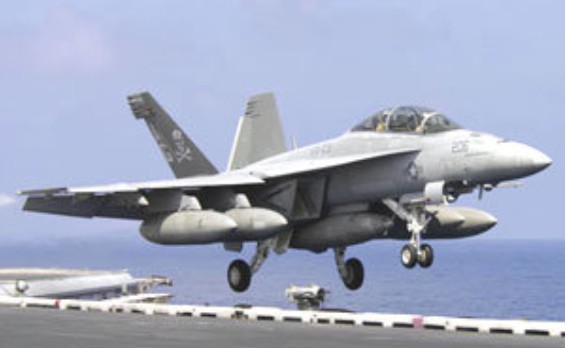
F/A-18E Super Hornet

The F/A-18E (single seat) and F/A-18F (two seat) Super Hornets provides increased range and improved combat mission endurance. The Super Hornet also makes use of an increased payload. F/A-18F Super Hornets with a WSO in the rear seat are replacing the F-14 Tomcat.

The US Navy took delivery of its first Super Hornet in 1999. Super Hornets are larger than the original models with many detail improvements. Their increased wing area allows them to carry more stores further on their extra hardpoints. They are most easily recognised by their rectangular engine air intakes.

The Royal Australian Air Force was to obtain 24 Boeing F/A-18F Super Hornets by 2010, until the full introduction into service of the F-35 Lightning Joint Strike Fighter. Twenty-four F/A-18F Super Hornets were to replace the F-111s at Nos 1 and 6 Squadrons at RAAF Base Amberley from 2010.

Boeing modified an F/A-18 Super Hornet as the EA-18 airborne electronic attack (concept) aircraft, carrying three ALQ-99 jamming pods.

The EF-18 designation is also used for Spanish F/A-18A/B Hornets (EF-18A and EF-18B) where the E stands for Espanga.

The RF-18 which is a dedicated reconnaissance version.

The Boeing EA-18G Growler electronic warfare variant, to replace the EA-6B Prowler, differs from the F/A-18F in several areas. It is wired in production differently with additional wiring and databuses from the wing stations and various fuselage antennae points. The nose gun is replaced with additional avionics for jamming missions, and carries two ALQ-218 tactical jamming receivers pods on the wingtips, and between one and five AN/ALQ-99 jammers on centreline and wing stations. There remains two wing and two should stations. It is also equipped with the APG-79 AESA radar.

The F/A-18 first saw combat action in 1986, when Hornets from the USS Coral Sea (CV-43) flew SEAD missions against Libyan air defenses during the attack on Benghazi.

Ten F/A-18’s were lost in the Gulf War, most to surface to air missiles although one was alleged to have been shot down by an Iraqi MiG-25PD in the first hours of the air campaign. F/A-18’s were credited with two kills, both of MiG-21’s, during that conflict.

Operators: US Navy, US Marine Corps, Australia, Canada, Finland, Kuwait, Malaysia, Spain, Switzerland.

Gallery

Variants:

F/A-18A
Engine: 2 x General Electric F404-400 turbofan, 7258 kg / 16,000 lb
Wingspan: 11.43m / 37 ft 6 in
Length: 17.07 m / 56 ft 0 in
Wing area: 37.2 sq.m
Empty wt: 10,460 kg
MTOW: 21,887 kg / 48,253 lb
Fuel internal: 6140 lt
Max speed: 1912 kph / 1188 mph / 1.8 Mach
Initial ROC: 45,000 ft / min
Ceiling: 15,240 m
TO run: 425 m
Ldg run: 850 m
Range: 3706 km / 2303 sm
Combat radius: 740+ km
Armament: 1 x 20 mm / 570 rds
Hard points: 7 + 2 wing tips
Max external load: 17,000 lb / 7711 kg
Air refuel: Yes

F/A-18A (from early 1992)
Engine: 2 x General Electric F404-GE-402 turbofans, 78.73 kN (17,700 lb st) with afterburning.
Length 17.07m (56 ft 0 in)
Height 4.66m (15 ft 3 in)
Wing span 11.43m (37ft 6 in)
Take-off weight (clean) 10.455 kg (23,050 lb)
Max Take-Off Weight 25.401 kg (56,000 lb)
Max level speed at altitude Mach 1.8+ / 1.915+ km/h / 1,190+ mph)
Combat ceiling about 15,240m (50,000 ft)
Armament: one 20mm M61A1 Vulcan six-barrel cannon with 570 rounds
Disposable stores: 7031 kg (15,500 lb)
Hardpoints 9

F/A-18B
Engines: 2 x General Electric F404-GE-400 turbofan, 16,000lb / 7,258kg thrust
Length: 17.1 m
Wingspan: 12.4 m
Height: 4.7 m
Empty Weight: 23,049lbs (10,455kg)
Maximum Take-Off Weight: 55,997lbs (25,400kg)
Maximum Speed: Mach 1.8 / 2200 kph
Maximum Range: 2,073miles (3,336km)
Combat radius: 740km
Rate-of-Climb: 45,000ft/min (13,716m/min)
Service Ceiling: 50,033ft (15,250m; 9.5miles)
Armament: 1 x M61 20mm cannon
Hardpoints: 9 (including wingtip mounts)
Seats: 2

F/A-18C

F/A-18D
Seats: 2

F/A-18E
Engines: 2 x General Electric F414-GE-400, 10000kg / 72.5kN
Max take-off weight: 29937 kg / 66000 lb
Empty weight: 13387 kg / 29513 lb
Wingspan: 11.43 m / 37 ft 6 in
Length: 18.31 m / 60 ft 1 in
Height: 4.88 m / 16 ft 0 in
Wing area: 46.45 sq.m / 499.98 sq ft
Max take-off weight: 20000 kg / 44093 lb
Max. speed: 1.8M
Ceiling: 15240 m / 50000 ft
Range: 1500 km / 932 miles
Crew: 1

F/A-18F Super Hornet
Engines: 2 x General Electric F414-GE-400 turbofan, 9,800kg. 22,000lbs thrust with afterburner.
Length: 60.07ft (18.31m)
Width: 44.69ft (13.62m)
Height: 16.01ft (4.88m)
Wing area: 46.45 sq.m / 499.98 sq ft
Empty Weight: 30,565lbs (13,864kg)
Maximum Take-Off Weight: 47,003lbs (21,320kg)
Maximum Speed: Mach 1.6 / 1,960 kph
Ferrying range: 2,700km
Combat radius 740km
Service Ceiling: 49,213ft (15,000m; 9.3miles)
Armament: 1 x M61 20mm cannon
Hardpoints: 11
Ordnance: 17,750 lb
Crew: 2

CF-18

EF-18A

RF-18

EA-18G Growler

McDonnell Douglas F-18 Hornet
McDonnell Douglas F/A-18E Super Hornet

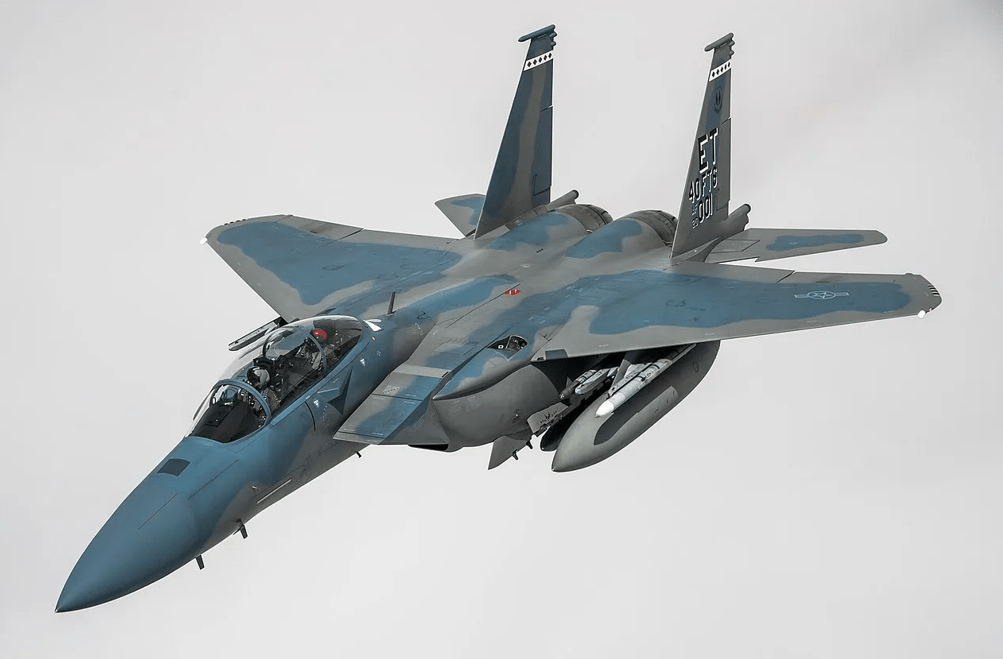
McDonnell-Douglas F-15 Eagle / Boeing F-15

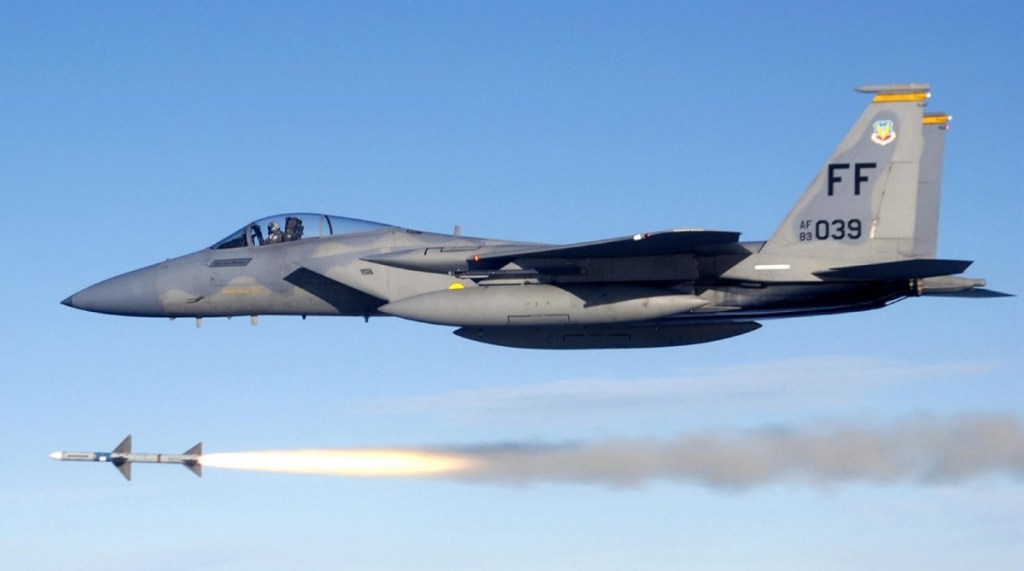
F-15C

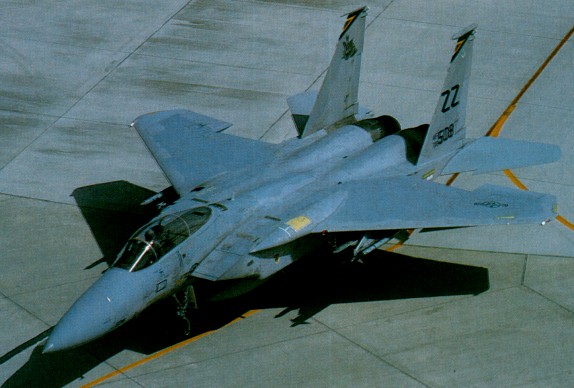
In September 1968, the USAF issued a request for proposals for a new FX fighter. The Air Force wanted a single air superiority fighter able to defeat the Mach 3 MiG 25 Foxbat, the MiG 21 Fishbed, and the MiG 23 Flogger. McDonnell was short listed and in late 1969 was selected to develop and produce the F-15 under the direction of Air Force Systems Command, full scale development being authorised in January 1970.

In February 1970, the Pratt & Whitney F100 turbofan was selected for development and a few months later the Hughes APG-63 radar was chosen for the F-15.

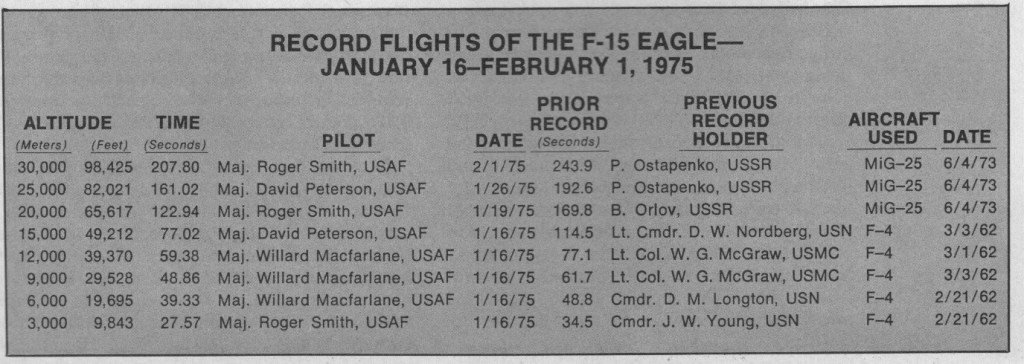
The initial contract called for 18 single-seat F-15As and two TF-15 trainers (re-designated F-15B in December 1977). The first F-15A was rolled out in June 1972, and made its maiden flight on 27 July 1972, to be joined by the first two-seater on 7 July 1973. Most of the major test hurdles had been successfully negotiated by late 1974, clearing the way for the Eagle to join TAC’s inventory.

The F-15 was the first USAF fighter to be developed under the DoD “Fly-Before-Buy” concept, but funding for long-lead items for the first wing of aircraft was released late in 1972, followed by full production funding in early 1973. The second wing was ordered late 1974. The first production aircraft was flown on 25 September 1974.

On 14 November 1974 President Gerald Ford formally accepted the first aircraft (actually a two-seat TF-15A designated F-15B) to be handed over to TAC at Luke AFB, Arizona. Initial operational capability was declared in July 1975, with delivery of the 24th aircraft, and the first wing was completely equipped by the end of 1976. From the outset the USAF planned a force of 729 production aircraft, of which 589 had been delivered by 1 May 1981.

McDonnell-Douglas F-15 Eagle Article

The first two models to enter service were the F-15A single-seater and TF-15A (later F-15B) combat-capable tandem two-seater. Both variants had the APG-63 radar and 10855kg Pratt & Whitney F100-P-100 afterburning turbofans, with AIM-7 Sparrow air-to-air missiles along the bottom of its large inlet ducts and 20mm cannon mounted in the right inboard wing. The two-seat F-15B combat trainer which first flew on 7 July 1973 is about 360kg heavier than the F-15A fighter, but retains most of its combat capability. The Eagle is equipped with Hughes APG-63 pulse-Doppler radar with computerised data-processing and the F-15 pioneered the HOTAS (hands on throttle and stick) concept.

The 1st Tactical Fighter Wing at Langley AFB, Virginia, was the first USAF recipient of the F-15A, while the first operational aircraft in Europe were assigned to the 36th TFW at Bitburg AB, West Germany.

The production totalled 366 and 58 respectively for the US Air Force plus 19 and two respectively for the Israeli Air Force.

Israel, the first export country, ordered 40 F-15 under the ‘Peace Fox’ program. Delivery started in 1976 on an initial batch of 25 aircraft. At least one Syrian MiG-23 has been shot down in clashes with Israeli F-15s over Lebanon.

Japan’s programme to acquire the F-15 began in 1975. The first of the two single-seat F-15Js produced by the parent company was accepted on 29 July 1980, with the second following on 29 July, and after 39 test flights with ASDF pilots, were ferried to Japan landing at Kadena Air Base on 1 March 1981. Essentially similar to the USAF’s F-15C, the F-15J differs in having various avionics changes, the Tactical Electronic Warfare System – the TEWS pod being omitted from the tip of the port fin.

Continuing procurement of the F-15A variant enabled two more TAG wings and one more USAFE squadron to be equipped between 1977-9, production thereafter switching to the F-15C and the basically similar two-seat F-15D.

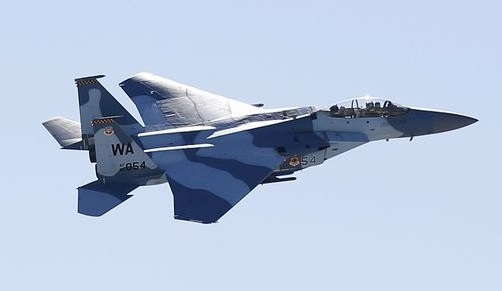
In June 1979 deliveries of the improved and more advanced F-15C single-seat (flown for the first time on 27 February 1979) and F-15D two-seat models began. Equipped with AGP-70 radar (with a programmable digital signal processor, synthetic-aperture ground mapping and track-while-scan air-to-air capability), an uprated powerplant, and provision for low-drag conformal packs carrying fuel and fitted with tangential attachments for weapons. The two variant were built for the USAF, Israel and Saudi Arabia and are still operated today. These variants were also built under licence in Japan by Mitsubishi and designated F-15J.

F-15D

In addition, it is also compatible with the company-developed FAST (Fuel And Sensor Tactical) packs, whereby conformal fuel tanks and/or sensor packages can be attached to the outside of each air inlet. Extra fuel tanks conform to the sides of the fuselage and hold an additional 10,000 lb / 4536 kg of fuel to supplement the 11,600 lb / 5260 kg of internal fuel, or a variety of sensors (such as reconnaissance cameras, infra-red equipment, radar warning receivers, laser designators and low-light-level television cameras to be carried. Thus, overall capability the Eagle has been significantly enhanced. Operational deployment of the F-15C and F-15D began in 1979. The 18th TFW at Yridena, Okinawa, was the first unit to receive this version, re-equipment of this Wing’s three squadrons being effected between September 1979 and April 1980. Subsequent deliveries were made to existing Eagle units, most of which were progressively re-equipped during the early 1980s.

The first single-seat air superiority F-15C incorporating MSIP enhancements was rolled out in June 1985.

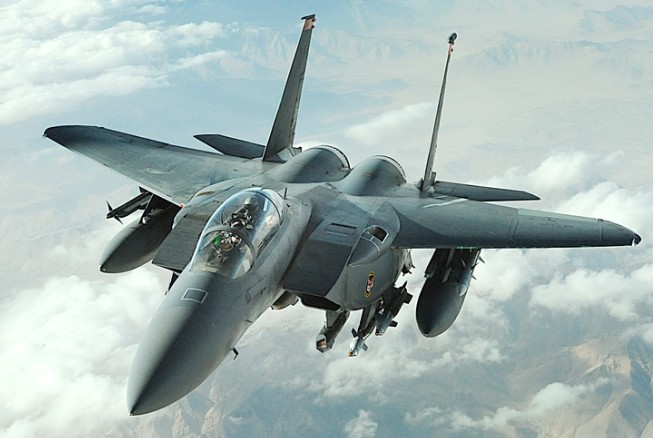
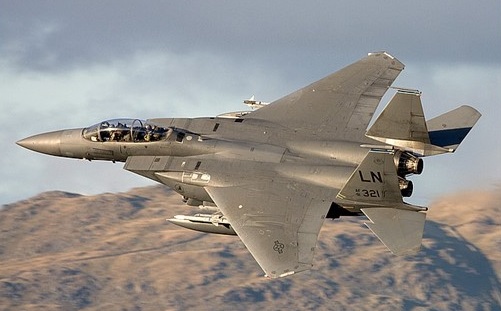
Renowned as an extremely capable interceptor, the F-15D Eagle was modified in 1980 to perform in the all-weather interdictor role whilst still retaining the ability to operate as an air superiority aircraft. This private venture, first known as the Strike Eagle, first flown on 8 July 1980, was redesignated McDonnell Douglas F-15E Enhanced Eagle when the USAF expressed interest in the concept and conducted an evaluation between November 1982 and April 1983. Together with the delta-winged General Dynamics F-16E, the Enhanced Eagle was competing for selection in the USAF’s Derivative Fighter Program as a supplement and eventual replacement for the General Dynamics F-111.

The dual-role F-15E Strike Eagle is basically a converted F-15B/D trainer for the ground-attack role. It has a total of 18 external hardpoints.

On 11 December 1986 the F-15E made its first flight and the US Air Force announced that it was to order 392 examples though this requirement was later reduced to 200 and deliveries began in 1988, initially to the 405th TTW for training and then the 4th TFW for operations, replacing the F-4E. The rear cockpit of the prototype (a converted F-15B trainer) has been fitted with four multi-purpose cathode ray tubes (CRTs) for information display to the systems operator and three more CRTs are to be installed for the pilot in production versions.
Beneath the nose-cone, high resolution radar provides long-range ground-mapping of remarkable clarity, whilst forward looking infra-red (FLIR) gives close range images of similar quality. In combination, these systems allow rapid target identification in all weathers and ensure accurate weapon delivery. Ordnance carriage has been improved by addition of bomb attachment points on the ‘conformal’ wing-root fuel and sensor packs, resulting in less drag and freeing wing pylons for additional fuel tanks. Called Tangential Carriage, the modification extends the Eagle’s endurance by 40 per cent in some cases. During proving trials, the F-15E demonstrated an ability to take off at a weight of 34020 kg (75,0001b), some 3175kg (7,0001b) above the previous maximum.

McDonnell Douglas F-15E Strike Eagle

The type has an advanced nav/attack system with APG-70 main radar as well as several radar and infra-red navigation and targeting options displayed to the rear seat, leaving the pilot free to concentrate on tactical flying using his head-up display. Equipment installed in the F-15E includes the LANTIRN night nay/attack pod system, FLIR sensors, threat-warning displays, digital map displays, APG-70 radar, a wide-angle HUD an improved mission computer and provision for AIM-120 AMRAAM missiles and the integral M61 Vulcan cannon.

F-15E Strike Eagle

21 Strike Eagles were exported to Israel designated F-15I. The Israeli Defence Force/Air Force aircraft have been involved in several dogfights with Syrian MiG-21s and MiG-23s and are officially confirmed as having shot down at least one MiG-25. On 7 June 1981, Israeli F-15s escorted F-16s making the strike against Iraq’s Osirak nuclear powerplant, covering a radius of 966km.

On the 1st of November 1968, Japan signed a letter of agreement with Mc Donnell Douglas and it was also announced that it would become one of the few countries worldwide that was going to license-produce this aircraft. Over the following years, the Nihon Koku Jietai (Japan Air Self-Defence Force) received a total of 154 F-4EJ and RF-4Es. The F-4EJs (the export version for Japan) were mostly similar to the F-4Es, although the Japanese aircraft had their in-flight refuelling and ground-attack capabilities removed to align with Japan’s defensive posture, the F-4EJs were delivered without the AN/AJB-7 bombing computer system.

The first two F-4EJs (JASDF serials 17-8301 and 17-8302) were built by McDonnell Douglas in St Louis and first flew on January 14, 1971. The next 11 F-4EJs (JASDF serials 27-8303/8307, 37-8307/8310, and 47-8311/8313) were built by McDonnell Douglas in kit form and were assembled in Japan by Mitsubishi Heavy Industries, Ltd. The first Japanese-assembled aircraft (27-8303) flew on May 12, 1972. Seven more F-15Js single-seat version based on F-15C were to be assembled by August 1982, leading to manufacture by Mitsubishi against contracts placed for a total of 45 F-15Js and 12 two-seat F-15DJs (including two aircraft assembled in the USA by McDonnell Douglas). Funding of 43 more F-15Js in the FY82 budget brought total procurements to 100. Subsequently, Mitsubishi built all the rest 127 F-4EJ during the following nine years. The last example was delivered to the JASDF on May 20, 1981.

Mitsibishi produced 213 McDonnell Douglas F- 15J/DJ fighters for the JASDF by 1998.

Japan also acquired 14 RF-4Es built by McDonnell Douglas to serve in the reconnaissance role. These RF-4Es were delivered between November 1974 and June 1975. They were virtually identical to the USAF RF-4C, with the only differences being the deletion of certain equipment such as the radar homing and the warning suite which had not been released for export to Japan.

The F-4EJs entered service with the JASDF in August 1972 with a total of six squadrons operating the aircraft: the 301st, 302nd, 303rd, 304th, 305th and 306th squadrons. The RF-4Es equipped the 501st that had previously operated one of the less-well-known Sabre models, the RF-86F.

Korea ordered the Boeing F-15K to replace its F-4 Phantom II fleet. The F-15K is more advanced than the original F-15E, it has better radar and improved systems and a helmet-mounted cueing system.

Saudi Arabia ordered the F-15 variant and took delivery of 72 downgraded F-15Es, redesignated F-15S.

The F-15 Eagle has a perfect combat record of 101 victories and zero defeats. F-15s downed four Mig-29 fighters during the Balkan conflict and 33 of the 35 fixed-wing aircraft Iraq lost in air combat during Operation Desert Storm.

Singapore ordered the F-15SG (previously known as F-15T), another customized advanced derivative of the F-15E Strike Eagle, to replace the A-4 Skyhawk in the ground-attack role.

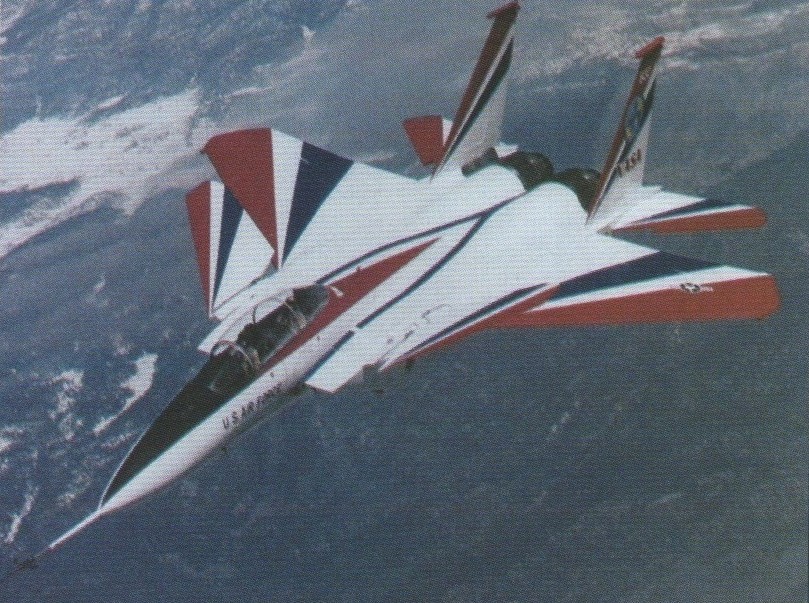
The McDonnell Douglas F-15S/MTD, AF71290, is the prototype F-15B modified under a $US117.8 million programme for the US Air Force Wright Aeronautical Laboratories to investigate short take-off and landing using vectored thrust jet nozzles and canards mounted on the engine intakes. The aircraft’s first flight was made on 7 September 1988 and after the fitment of the thrust vectoring reversing nozzles on the jet pipes these were flown for the first time on 10 May 1989. The aircraft was involved in a 13 month, 100 flight test schedule at Edwards. The aircraft’s controllable canard foreplanes are adapted tailplanes from the F/A-18 Hornet and can operate independently of each other for pitch and roll manoeuvres having a 20 degree dihedral.

F-15S/MTD 1989

Samurra Air Battle – F-15 vs MiG-25

The US signed a US$29.4 billion deal to sell 84 new F-15 fighter jets to Saudi Arabia in December 2011. The sale includes the 84 advanced Boeing F-15SA fighters with Raytheon Co radar equipment and digital. electronic warfare systems. Also included are upgrades that wilI bring Saudi Arabia’s 70 older F-15s up to the new standard, as well as HARM, AGM-88 AntiRadiation Missfies; Laser JDAM and Enhanced Paveway munitions and related equipment and services. The first new F-15s’ were expected to be delivered to Saudi, Arabia in early 2015.

By 1990, since the development two-seat Strike Eagle was displayed in 1984, this all-weather interdictor/strike aircraft has entered service with the USAF’s 4th TFW and production of 200 was underway. Powered by 23,800 lb st (10 800 kgp) P& W F100-PW-220s, the F-15E The F-15E has a range of 2,400 nm (4,445 km).

The Boeing F-15EX Eagle II represents the ultimate evolution of the F-15, thoroughly modernised to remain relevant against emerging threats.

The F-15EX incorporates 21st-century technology, including an APG-82 AESA radar, advanced cockpit displays, digital fly-by-wire controls, and the Eagle Passive Active Warning Survivability System (EPAWSS), a sophisticated electronic warfare suite that drastically improves survivability against modern air defence systems.

Powered by twin Pratt & Whitney F100-PW-229 engines, each producing 29,000 pounds of thrust, the F-15EX reaches Mach 2.5 (approximately 3,100 km/h).

It can carry up to 22 air-to-air missiles or a mix of air-to-ground ordnance.
The US Air Force planned to acquire 144 F-15EX aircraft at $87 million each to replace aging F-15C/D models.

F-15EX_Eagle_II
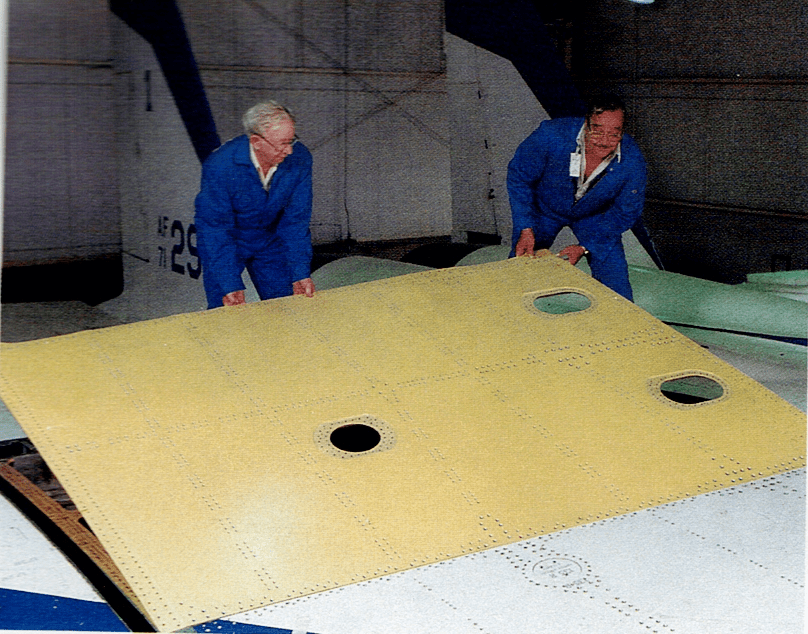
F-15 wing skin panel of aluminium-lithium alloy – lighter than conventional aluminium alloys

Gallery

F-15A
Engines: 2 x Pratt & Whitney F-100-PW-100, 29,000 lb.
Wing span: 42 ft 9.75 in (13.05 m)
Length: 63 ft 9.75 in (19.45m)
Height: 18 ft 7.25 in (5.67m).
Wing area: 56.5 sq.m / 608.16 sq ft
Take-off weight: 18145-25000 kg / 40003 – 55116 lb
Empty weight: 12245 kg / 26996 lb
Max. speed: 2655 km/h / 1650 mph
Ceiling: 20400 m / 66950 ft
Range w/max.fuel: 8000 km / 4971 miles
Range w/max.payload: 4500 km / 2796 miles
Seats: 1
Internal fuel: 5278 kg (11,635 lb)
Armament: 1 x 20mm Vulcan, 6800kg ordnance

F-I5B / TF-15A
Engines: 2 x Pratt & Whitney, 29,000 lb.
Wing span: 42 ft 9.75 in (13.05 m)
Length: 63 ft 9.75 in (19.45m)
Height: 18 ft 7.25 in (5.67m).
Seats: 2
Weight: F-15A + approximately 363 kg (800 lb)

F-l5C
Engine: 2 x P&W F100-220, 105.73 kN (23,770 lb st)
Installed thrust (dry/reheat): 134 / 211 kN
Span: 13.05 m (42ft 9.75in)
Length: 19.43 m (63 ft 9in)
Height: 5.63m (18ft 5.5in)
Wing area: 56.48 sq.m (608 sq.ft)
Wheel base: 5.42m (17ft 9.5in)
Wheel tract: 2.75m (9ft .025in)
Empty wt: 12,247 kg (27,000 lb)
Take-off weight (clean): 20,244 kg (44,630 lb)
MTOW: 30,845 kg (68,000 lb)
Internal fuel: 6,103 kg (13,455 lb)
Conformal fuel tank capacity: 4536 kg (10,000 lb)
Max speed: 2.5+ Mach
Time to height: 1 min / 12,200 m
Service ceiling: 18,300 m
TO run: 274 m
Ldg run: 840 m
Fuel internal (external): 6100 kg (9820 kg)
Air refuel: Yes
Combat radius: 1062 nm.
Seats: 1
Hardpoints: 9
Armament: one 20mm M61A1 Vulcan six-barrel cannon with 940 rounds; 10,705 kg (23,600 lb) disposable stores

F-15D
MTOW: 68,000 lb
Fuel internal: 6100 kg
Fuel external: 9820 kg
Seats: 2

F-15E
Powerplant: two 10855-kg (23,930-lb) thrust Pratt & Whitney F100-PW-100 afterburning turbofans.
Span 13,05 m (42 ft 9¾ in)
Length 19.43 m (63 ft 9 in)
Height 5.63 m (18 ft 5½ in)
Wing area 56.5 sq.m (608 sq ft).
Maximum speed Mach 2.5 + at altitude
Maximum speed 1481 km/h (920 mph) at sea level
Ceiling 20000 m (65,610 ft)
Endurance 5 hours 15 min
Armament: one M61A1 Vulcan 20-mm gun (with 940 rounds)
External load: 24,000 lb / 10,885 kg
Hardpoints: 3 fuselage / 6 fuel pack
Seats: 2

F-15E Eagle
Engines: two 23,450-lb (10,637-kg) reheated thrust Pratt & Whitney F100-P-220 turbofans.
Maximum speed 1,650+ mph (2,655+ km/h) or Mach 2.5+ at 36,000 ft (10,975 m)
Climb to 39,370 ft (12,000 m): 1 minute 0 seconds
Service ceiling 60,000 ft (18,290 m)
Radius 1,150+ miles (1,851+ km)
Empty weight 31,700 lb (14,379 kg)
Maximum take-off 81,000 lb (36,742 kg)
Wing span 42 ft 9.75 in (13.05 m)
Length 63 ft 9 in (19.43 m)
Height 18 ft 5.5 in (5.63 m)
Wing area 608.0 sq ft (56.48 sq.m)
Armament: one 20-mm multi-barrel cannon, up to 24,250 lb (11,000 kg) disposable stores.

F-15E
Powerplant: two 129.45 kN (29,100 lb st) Pratt & Whitney F100-PW-229 turbofans
Length 19.43m (63 ft 9 in)
Height 5.63m (18 ft 6 in)
Wing span (over tip launchers) 13.05m (42ft 10 in)
Take-off weight (‘clean’) 14.515 kg (32,000 lb)
Max Take-Off Weight 36.741 kg (81,000 lb)
Wing loading: 133.25 lb/sq.ft / 650.0 kg/sq.m
Max level speed at high altitude (‘clean’) 2,655+ km/h (1,650+ mph)
Service ceiling: 60039 ft / 18300 m
Max rate of climb at sea level 15,240+ m (50,000+ ft)/min
Range int. fuel: 686 nm / 1270 km
Max range 4,455 km (2,762 miles)
Armament: one 20mm M61A1 Vulcan six-barrel cannon with 512 rounds; 11.000 kg (24,250 lb) ordnance
Hardpoints: 18
Crew: 2

F-15I

F-15J

F-15DJ

F-15K

F-15S

F-15SG

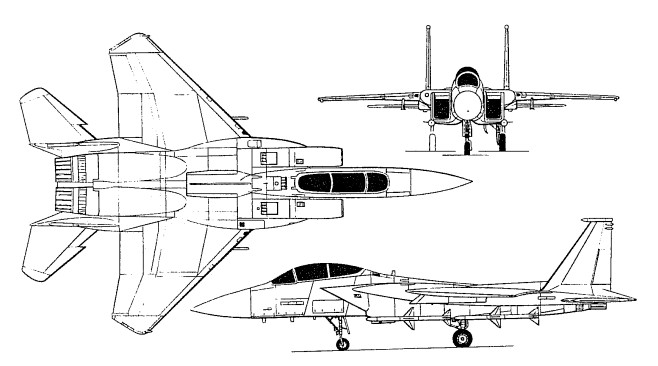
McDonnell Douglas F-15 Eagle

McDonnell-Douglas C-17 Globemaster III / Boeing C-17 Globemaster III

C-17A

The first prototype flew in September 1991

McDonnell-Douglas C-17 Globemaster III Article

Three flight test models were built, and the aircraft became operational in 1994.

By October 2002 C-17s were being delivered at a rate of 15 per year, with a planned run of 180 aircraft.
The C-17 Globemaster is a four-engine transport aircraft fitted with the reversible-thrust F117-PW-100 by Pratt & Whitney, with each of 40,000 pounds of thrust. This powerplant represents the military version of the commercial Pratt & Whitney PW2040 as found on the 757 airliner. The aircraft is designed for operations utilizing shortened runaways.

The C-17 Globemaster III is crewed by a pilot, copilot and a loadmaster.
At rear of the aircraft, the C-17 features a large access ramp. The aft-loading ramp allows for transportation and delivery of varying types of cargo including over 100 fully-armed troops and paratroopers, 36 medical litters and nearly 171,000 pounds of cargo. The cargo hold is able to carry most all of the military’s air-portable weapon and vehicle systems. With in-flight refueling, the C-17 has a global reach.

Unit Cost: $237 million (2007)

The Boeing-produced C-17 Globemaster III represents one of the latest additions to the United States Air Force mobile airlift fleet. By 1998, over 140 Globemaster III’s were in active or reserve service with the USAF, Air National Guard and the Air Force Reserve.

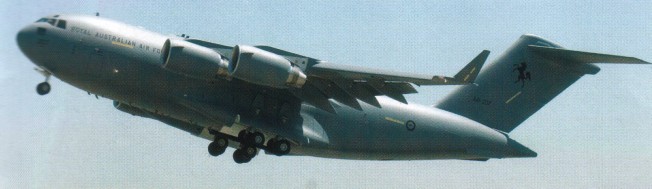
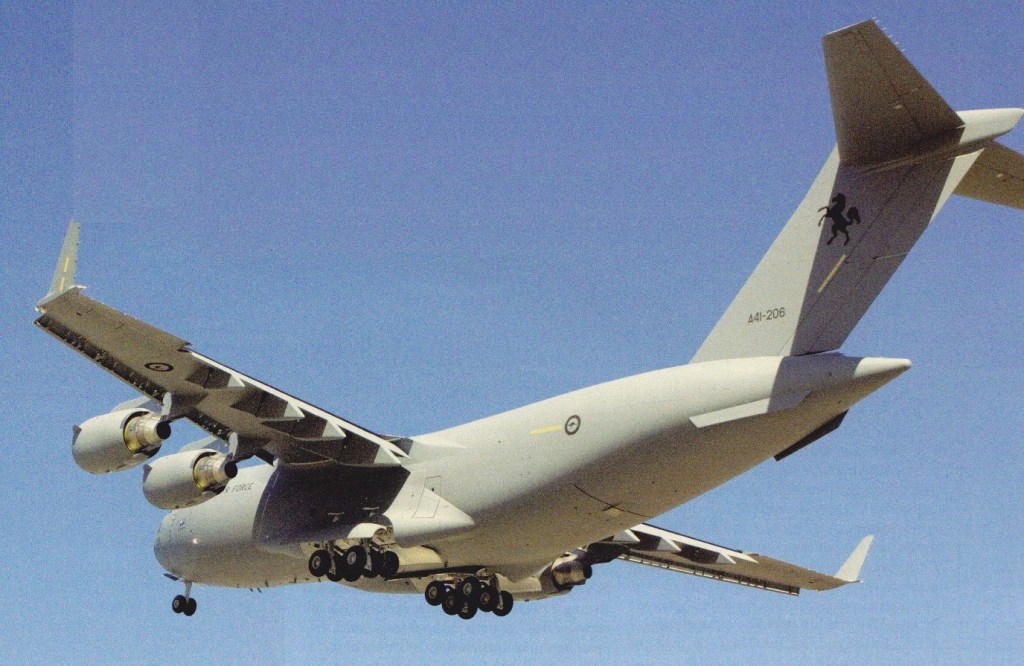
The first Boeing C-17 Globemaster III for the RAAF, A41-206, first flew at Long Beach on 8 November 2006. The Royal Australian Air Force had four C-17 Globemaster heavy transport aircraft.

RAAF A41-206

The first, A41-206, arrived in Australia on 2 December 2006. The RAAF’s second C-17 was handed over at Long Beach on 11 May 2007 and flown to Australia a few days later.

Gallery

C-17A Globemaster III
Engines: 4 x Pratt & Whitney F117-PW-100 turbofan, 40,440lbs of thrust each.
Installed thrust: 658.4 kN
Length: 173.88ft (53m)
Width: 169.78ft (51.75m)
Height: 55.09ft (16.79m)
Wing area: 3799.692 sq.ft / 353.0 sq.m
Weight empty: 269045.3 lb / 122016.0 kg
Maximum Take-Off Weight Peacetime: 585,001lbs (265,352kg)
Fuel internal: 79,925 lt
Air refuel: Yes.
Maximum Speed: 518mph (833kmh; 450kts) at 28,000 ft / 8,534m
Cruising altitude: 36007 ft / 10975 m
Wing loading: 152.73 lb/sq.ft / 745.0 kg/sq.m
Rate-of-Climb: 0ft/min (0m/min)
Service Ceiling: 45,000ft (13,716m)
Cruise speed: 442 kts / 820 km/h / 510 mph
Range: 8710 km / 5412 miles
Range w/max.payload: 2400 nm / 4456 km / 2769 miles
T/O run: 2320 m
Ldg run: 823 m
Armament: None.
Crew: 3
Payload: 72,500kg
Accommodation: 134 troops / 90 stretcher patients / 170,900 lb (77,519 kg) of cargo (18 pallet positions)

McDonnell Douglas C-17 Globemaster III

McDonnell-Douglas

Douglas files bankruptcy and was forced to sell at a knocked down price to McDonnell of St. Louis, which had been making handsome profits out of its F-4 Phantom, supplied to the air force in Vietnam. McDonnell-Douglas was created 28 April 1967 by merger of Douglas and McDonnell. Continued development and production of F-4 at St Louis (until 1979). On December 23,1969 received contract for F-15 Eagle air-superiority fighter, first flown July 27,1972, (first production F- 15E flown December 1986) suited to both air superiority and long-range interdiction. Evolved F/A-18 Hornet multi-mission carrier bome and land-based combat aircraft suited to fighter and attack missions (first flown November 1978, with the F/A-18E and F Super Hornet variants, first flown November 1995, placed into production by Boeing), STOVL AV-8B Harrier II and II Plus with British Aerospace for U.S. Marine Corps (first flights November 1981 and September 1992 respectively; and T-45 Goshawk naval jet trainer (first flown April 1988) from British Hawk.

Long Beach and Palmdale factories continued production of A-4 Skyhawk attack aircraft until 1979, DC-8 fourjet airliner (until the early 1970s, and in the 1980s instituted a re-engine program) and DC-9 twin-jet airliner (first tlown February 1965 and produced until the end of the 1970s, when the new designation MD-80 was adopted for developed models), and developed wide-body triple-engined DC-10 (first flown August 29,1970 and the last delivered in 1989, when replaced by the MD-11).

Purchased Hughes Helicopters January 1984, taking over that company’s range that included small helicopters and the AH-64 Apache, plus the NOTAR (no tail rotor) anti-torque system. Hughes Helicopters became McDonnell Douglas Helicopters.

Merger of McDonnell Douglas with Boeing announced in December 1996, and from August 1997 the combined company began operating as a single unit under the collective name The Boeing Company.

Boeing has sold its civil helicopter production line, formerly manufactured by McDonnell Douglas, to Dutch company MD Helicopters. The sale, coming only two years after Boeing themselves purchased the range through a merger. The sale includes the MD500, 520N, 530F and 600N models, as well as the twin-engined MD Explorer and the licence to incorporate the no tail rotor (NOTAR) system on future aircraft. Boeing does, keep the ownership of the NOTAR technology. Boeing was to continue to produce the machines, under contract to the new Dutch owners, until early 2000.

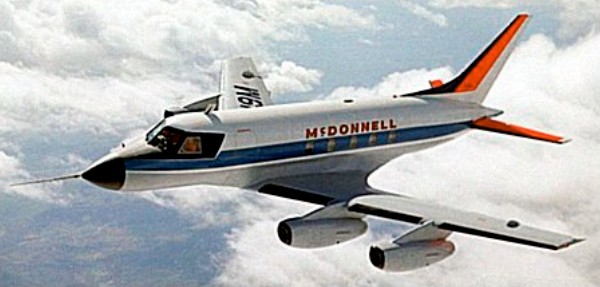
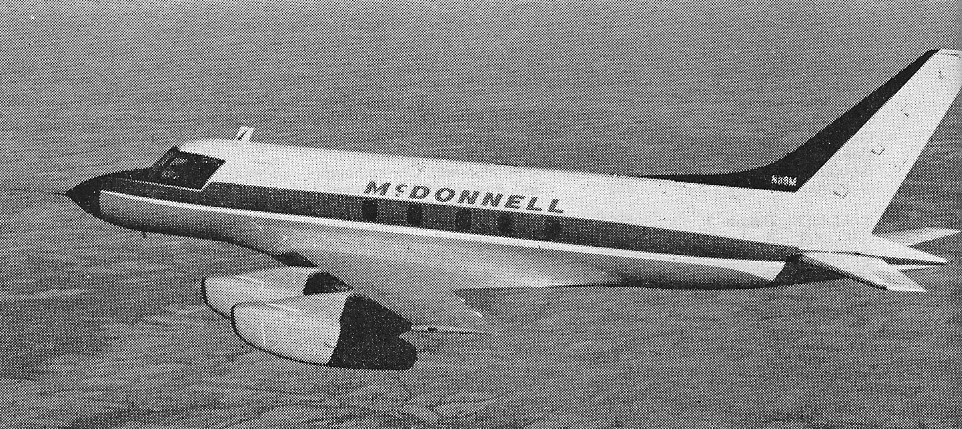
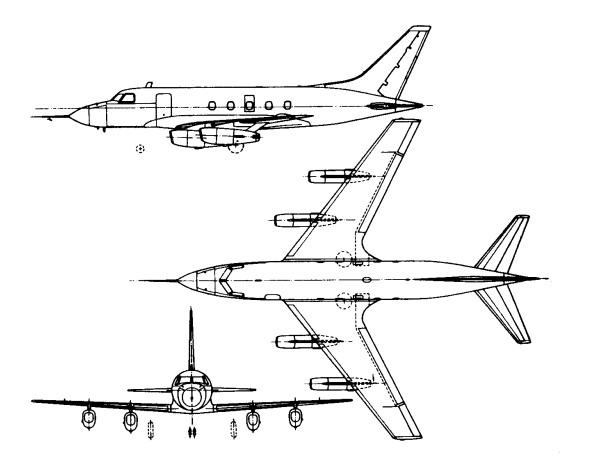
McDonnell 119 / 220

In the early 1960s Lockheed, McDonnell and North American were each vying for a military utility aircraft con¬tract and built commercial derivatives of their Air Force offerings to enter into the bizjet market.

First flown on 11 February 1959, the prototype was powered by 3250 lb Westinghouse J34 turbojets. They were to be replaced by newer 2900 lb Pratt & Whitney J60s.

The four engine McDonnell Model 220 only saw service as a one of a kind corporate barge for McDonnell executives.

The Model 119/220 was the first business, non-airline-type jet aircraft to receive an FAA Class I provisional type certificate as airworthy in the transport category.

Max take-off weight: 20560 kg / 45327 lb
Empty weight: 10529 kg / 23213 lb
Wingspan: 17.55 m / 57 ft 7 in
Length: 20.27 m / 66 ft 6 in
Height: 7.21 m / 23 ft 8 in
Wing area: 51.10 sq.m / 550.04 sq ft
Max. speed: 901 km/h / 560 mph
Cruise speed: 837 km/h / 520 mph
Ceiling: 13685 m / 44900 ft
Range: 3765 km / 2340 miles

McDonnell Model 119/220

McDonnell F-4 Phantom Gallery

Back to McDonnell F-4 Phantom

RF-4E 38+75
RF-4E 38+75
F-4F 38+58, 1984
F-4F 38+47, Apr 1984, Wittmund Airbase
F-4G Wild Weasel
Phantom FGR2
Phantom FGR-2 XV424 of 56 Sqn, 21 June 1979 crossed Atlantic from Goose Bay to Greenham Common to celebrate Alcock & Brown flight 60 years earlier.
Phantom FGR-2 XT597 A&AEE Boscombe Down 1983
37+55 JBG-36 Rheine Hopsten
Phantom F-4F 37+56 JG-74 Neuburg A/B 27 Sept 1986
RF-4E 35+76 in 1984
RF-4E 35+76 in 1984
McDonnell Douglas F-4D Phantom II of the USAF.
McDonnell Douglas F-4B Phantom II of the US Navy.
5,000th McDonnell Douglas F-4E Phantom II, (Serial Number 77-0290).
IRIAF F-4E 3-6552, as found by US troops at “Tallil” AB.
F-4E Phantom II
This wrecked McDonnell Douglas F-4 Phantom was shot down on May 14, 1967 during the Vietnam War, and now is – along with other American wreckage – outside the People’s Air Force Museum in Hanoi. The jet, build number 153001, was hit by a Russian-built surface to air missile (SAM).
McDonnell F4H-1F Phantom II N815WF
F-4S Phantom II
1964 USS Constellation in Tonkin Gulf
VF-121 F-4B, May 1967
F-4G of 35th TFW, George AFB, California
The 5000th Phantom, Missouri, March, 1978 – For Turkey
Proposed F3H-G mock-up, St.Louis, May 1954
F4H-1 mock-up, December 1955
The first F4H-1 BuNo 142259a nearing competition April 1958
F4H-1F BuNo 148268a (from the last production batch of F-4As) of VF-101 Det A, 21 May 1961 Bendix Trophy race
F-4B Lambert Field, St.Louis, June 1960
F-4Bs (BuNo 148419 in foreground) of VF-121, 26 April 1962
F-4B BuNo 150443 of VF-143 on USS Constellation, 28 June 1963
F-4E
F-4E
F-4E
CVW-7 VF-84 F-4B – raised oleo for take-off
CVW-17 VF-74 and VF-11 F-4B – USS Forrestal
VF-14 F-4B BuNo 149448 of VF-14, 29 July 1964
F-4B-8-MC BuNo 148412 of VFX-1 testing Phoenix missile systems September 1968
The 3rd F-4B BuNo 148365 ‘Iron Butterfly’ as QF-4B drone controller of Naval Missile Command, June 1978
F4H-1
US Navy F-4B loaned to USAF for evaluation. BuNo 149405
The 1st USAF F-4, January 1962
F-4C 63-7426 at Fort Leonard Wood, Missouri, October 1964
F-4C 63-7647 of 8th TFW “Wolfpack” enroute to Hanoi
F-4C 63-7420 September 1979
F-4C 64-952 North Dakota ANG 119th FIG – 30 August 1979
F-4C 64-942 North Dakota ANG 119th FIG
YRF-4C 62-12200 – the original photo-recon Phantom, first flying 1953
Later appeared as the YF-4E and more
RF-4C at Tan Son Nhut Air Base, Vietnam
RF-4C 65-040 of 18th TFW, Kadena Air Base, Japan, 1980
RF-4C 66-422 of 38th TRS, 26th TRW, Ramstein AB, West Germany
RF-4C 66-433 of 32nd TRS, 10th TRW, based at RAF Alconbury, with AT tail code
RF-4C 68-556 of 1st TRS, 10th TRW based RAF Alconbury
1st TRS RF-4C 65-944
26th TRW RF-4C, Spangdahlem AB, West Germany 1983
F-4D
F-4D 66-8805, Kunsan AB, Korea, 1979
F-4D 65-681 of 3rd TFW, Korat AB, Thailand, 11 March 1975.
F-4D 65-696 of 81st TFW, RAF Woodbridge
F-4D, Woodbridge, July 1978
F-4D 66-7768, Ramstein AB, West Germany, 1979
F-4D-30-MC 66-7527, Bitburg AB, 1979
F-4D 65-763, 496th TFS, Hahn AB, West Germany
F-4D-31-MC 77-7705, 53rd TFS
F4H-1F BuNo 145310 April 1961
F-4B BuNo 150642 July 1966
F-4B BuNo 151506 of VF-84 USS Independence launching from Saratoga.
RF-4C 64-1019 of 192nd TRG, Nevada ANG, over Canal Zone, 8 August 1979
F-4Ds – 66-7531 foreground) over South Korea
F-4E 71-1076 and F-5E, Clark AFB, 22 January 1981.
F-4D 66-7617 42nd TFW, Eglin AFB, Florida, 5 May 1970
F-4D-31-MC 66-7710
F-4D 66-7667, 474th TFW, January 1980
2nd production F-4E 66-285 modified for stall tests by extension of tail fairing to house two parachutes. Tests necessitated by new slotted tailplane and more powerful J-79-GE-17. 1 March 1970
F-4C 63-7445 during testing of the FIGAT (Fibre Glass Aerial Target), Edwards AFB, 24 March 1971
Ex-F-4D 65-713 modified into an F-4E testbed, July 1969
YF-4E (ex-YRF-4C s/n 62-12200).
F-4E 68-493
F-4E 68-493
AN/ALQ-119 ECM pod for F-4E
3rd TFW F-4E with a TISEO TV camera, 1979
F-4E 68-312 personal aircraft of the CO of the 3rd TFW
F-4E 72-165 in 1981
F-4E 68-384 of 313th TFS, Hahn AB, April 1981
F-4E
F-4E
L to R, Top to Bottom
RAF EE Lightning, RCAF Lockheed CF-104 Starfighter, Fokker-built Belgian F-104G w/droptanks, USAF McDonnell F-4D Phantom, USAF NA F-100D Super Sabre, French AF Dassault Super Mystere, German AF Lockheed T-33A
F-4K
F-4K
F-4E 74-657 of 536th TFS
F-4W 68-378 of 526th TFS, 86th TFW at Ramstein AB July 1980
F-4E 68-490 of 86th TFW at Ramstein AB 1981
F-4E 72-124 of 480 TFS. 52nd TFW, Spangdahlem AB, West Germany June 1980
Phantom FGR Mk.2
RF-4E
F-4E 74-1650 52nd TFW at Greenham Common 1983
F-4E
F-4E
F-4E 66-382 57th FIS Keflavik AB, 1980
F-4E 72-1479 4th TFW, 5 October 1978 at Ramstein
F-4E 66-293 4th TFW, the 10th production -E, 1980 at Ramstein
347th TFW F-4E
347th TFW F-4E 68-431
James S. McDonnell with the 5000th F-4 for built, May 1978
Alabama Guard RF-4C-22-MC 64-1041 May 1993
F-4S Andrews AFB, Maryland
November 1958 Bob Little with the first Phantom
1967 F-4M
F4H-1F
F-4CCV
F-4D
F-4E
F-4E
QRC-335-3 ECM pod on F-4E in 1970
F-4E
An-12 and F-4J
F-4G Wild Weasel