McKinnie 165

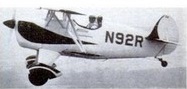
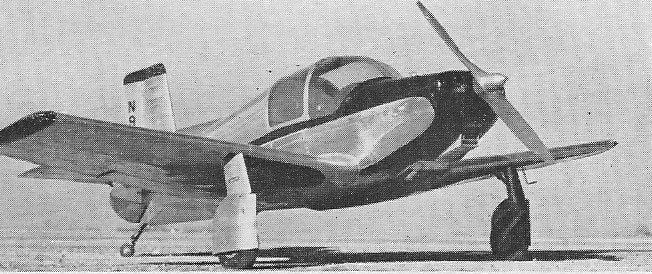
Transocean Air Lines subsidiary, Mckinnie Aircraft, developed the all-metal two-seat side-by-side McKinnie 165 with Franklin engine, first flown August 10,1952.

All structural components are of full cantilever construction and are fabricated from aluminium-clad sheet. The McKinnie 165 is fully aerobatic and dual controls are fitted.

Engine: 165 hp Franklin 6A4-165-B3
Wingspan: 23 ft 6 in
Length: 18 ft 3 in
Height: 7 ft
Empty weight: 1200 lb
Loaded weight: 1840 lb
Max speed: 175 mph at SL
Cruise: 160 mph
ROC: 1550 fpm
Range: 720 mi at 170mph at 8000 ft
Range: 1050 mi at 150mph

McGowan & Goguillot SE-5a

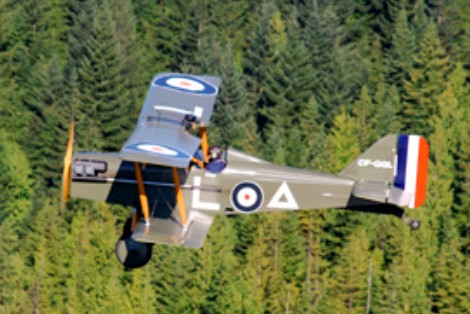
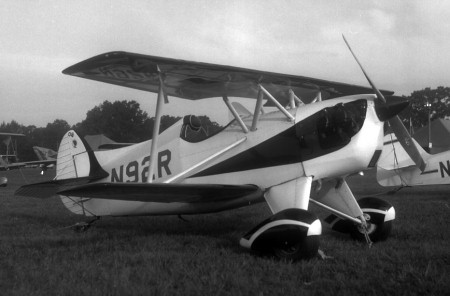
Dan McGowan and “Gogi” Goguillot of Yarrow, B.C., Canada, designed this 7/8 scale replica of the famous World War 1 British Fighter built by the Royal Aircraft Factory. While changes had to be made to accommodate a full size pilot, and an alternate engine chosen when designing the scaled down version as an amateur built sport plane, the replica does resemble the original. It is represented as a much modified, scaled down sport plane, and not a true replica of the original fighter.
Use of a modern 4 cylinder 85 hp Continental engine required a cowling to simulate the original water cooled 200 hp geared Hispano engine, but provides a practical solution for every day operation.
This airplane was built by Dan McGowan at Richmond, B.C. and was flown regularly since its construction in 1970, and was a regular participant in homebuilt flypasts at airshows. Donated to the Canadian Museum of Flight by Dr. Fred Hemming of Vancouver in 1983.
This aircraft was returned to flying condition by the Canadian Museum of Flight and since 1997 once again participated in airshows.

Serial 002, CF-QGL
Engine: Continental C-85, 85 hp
Cruise speed: 90 mph (145 km/h)
Empty weight: 790 lb (358 kg)
Loaded weight: 1,100 lb (499 kg)
Span: 22 ft 10 in (6.9 m)
Length: 14 ft 4 in (4.3 m)
Height: 7 ft 2 in (2.2 m)

McDonnell-Douglas / BAe T-45 Goshawk

Derived from the British Aerospace Hawk advanced trainer, the US Navy’s carrier-capable T-45A Goshawk prototype was scheduled to fly before the end of 1987, with service entry due in 1990. The Hawk was selected in 1981 as the aircraft element of the new VTX-TS training system, and a fixed-price contract covering the first three production lots and 15 simulators was signed in May 1986. Total cost of the T-45TS package, including 300 production aircraft, two prototypes, simulators, computerised instruction and integration system, and logistics support is estimated at $4,500 million. British Aerospace is the principal airframe subcontractor, building the wings, rear fuselage, canopy, and flight controls, although final assembly and some component manufacture will be undertaken by McDonnell Douglas in the USA.

McDonnell-Douglas / BAe T-45 Goshawk Article

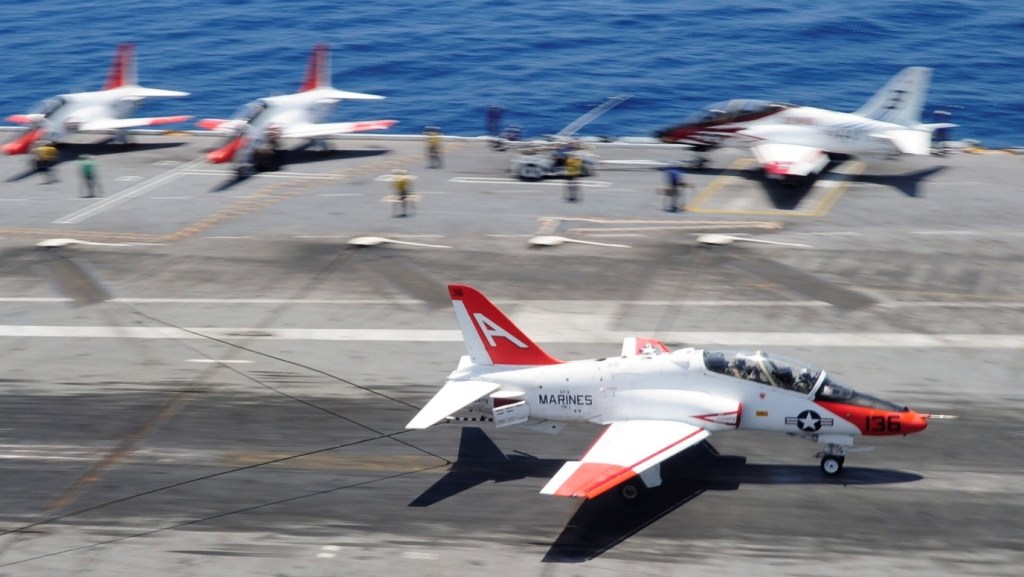
Changes from the basic Hawk design include a twin-wheel nose gear for catapult launching, a strengthened maingear to allow high-sink-rate landings, an arrester hook, rear side-fuselage airbrakes, and a cockpit modified to USN requirements. The empty weight of the T-45A will be 4,261kg, and maximum take-off weight 5,787kg, with an internal fuel load of 1,363kg. Approach speed will be 222km/hr (121 kt), maximum level speed Mach 0.85, and average fuel consumption 620kg/hr on a typical training sortie. Weapons delivery capability for armament training were be incorporated.

The T-45 Goshawk, of which the Navy owns 193 aircraft, is a jet trainer fleet used by the Navy and Marine Corps to qualify new pilots. Originally produced by what is now Boeing and derived from an earlier British aircraft made by BAE Systems, its first iterations joined the US Navy’s fleet in the 1990s.

BAe / Boeing T 45 C Goshawk
Engine: Rolls Royce/Turboméca F 405-RR401 (Adour Mk. 871), 25977 N / 2648 kp
Length: 39.272 ft / 11.97 m
Height: 13.419 ft / 4.09 m
Wingspan: 30.807 ft / 9.39 m
Wing area: 179.651 sq.ft / 16.69 sq.m
Max take off weight: 14083.3 lb / 6387.0 kg
Weight empty: 9399.9 lb / 4263.0 kg
Max. speed: 543 kts / 1006 km/h
Initial climb rate: 6982.28 ft/min / 35.47 m/s
Service ceiling: 42503 ft / 12955 m
Wing load: 78.52 lb/sq.ft / 383.0 kg/sq.m
Range: 999 nm / 1850 km
Crew: 2
Hardpoints: 3
McDonnell-Douglas YC-15

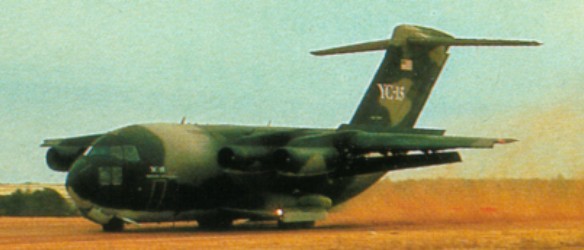
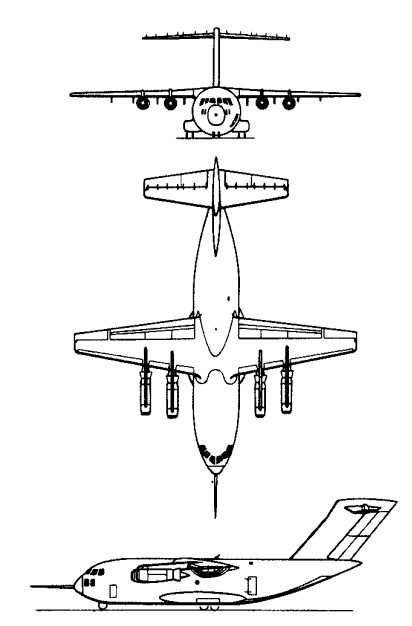
The McDonnell Douglas YC 15 first prototype (72 1875), an advanced military STOL transport, made the type’s maiden flight on 26 August 1975. Designed to contend against Boeing YC 14 pro¬totypes for the USAF’s advanced medium short take off and landing transport (AMST) requirement, it had an externally blown flap system that depended on the slipstream from four turbofan engines. The first flight was made three months ahead of schedule and the two YC-15 prototypes flew for three years before the test program ended.

YC-15
Engines: 4 x Pratt & Whitney JT-8D-17, 71.1kN
Max take-off weight: 68000 kg / 149915 lb
Wingspan: 33.6 m / 110 ft 3 in
Length: 37.9 m / 124 ft 4 in
Height: 13.2 m / 43 ft 4 in
Wing area: 161.7 sq.m / 1740.52 sq ft
Max. speed: 805 km/h / 500 mph
Range w/max.fuel: 4800 km / 2983 miles
Crew: 2-3

McDonnell Douglas YC-15