Back to MDM / Margański & Mysłowski EM-11 Orka


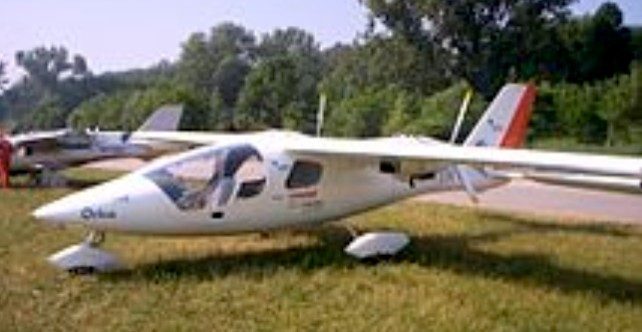
The EM-11 was designed by Edward Margański of Margański & Mysłowski Zakłady Lotnicze (Margański & Mysłowski Aviation Works). Work on this low cost, light utility aircraft, of unorthodox configuration, with slim glider-like fuselage and two pusher engines, started in 2001. The plane was constructed of composite materials with a car-like 4-seat cabin placed low to the ground. Room for cargo was created aft of the rear seats.
A four seater twin-engine aircraft with retractable landing gear, high-wing configuration, the shell structure is all-composite with honeycomb filler. Wings have foldable tips for easier hangaring. Two fuel tanks of 200 litres capacity each are installed in wings. Fuselage has upwards-opening door in the front part and cargo hatch in the central part. Passenger cabin has four separate seats, of which the front ones are reclining and sliding. The seats have 3-point inertial safety belts. Tail plane is in T type. Electrical trimming tabs are mounted on both planes. Flight control systems are controlled by a rigid push-rod transmission system, the rudder is controlled with use of a line. The aircraft is propelled by two counter-rotating engines LYCOMING IO-320 / LIO-320 of 160 hp each at 2,700 RPM. 3-blade constant-speed type MT-Propeller propellers are fitted. Hydraulically retracted landing gear is mounted on fuselage and has gas shock absorbers with hydraulic damping.
The first prototype EM-11, registered SP-YEN, first flew on August 8, 2003. It has a fixed tricycle landing gear and Rotax 912 (100 hp) engines. The second prototype, registered SP-YEP, being a pattern for serial production variant EM-11C, flew 20 October 2005 with Lycoming IO-320 engines and retractable landing gear. In April 2011 EM-11C Orka was EASA certified and in production. Prior to certification, the prototypes and three further aircraft had been built.
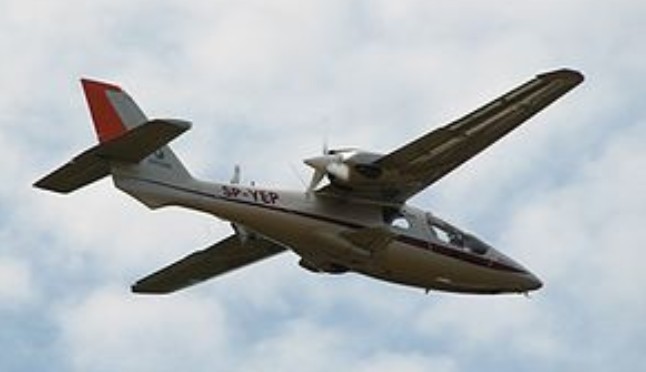
Several variants were planned including, a patrol aircraft with an FLIR head, an air ambulance, a cargo plane, and an amphibious version.
EM-11C Orka
Engines: 2 × Lycoming IO-320, 118 kW (160 PS)
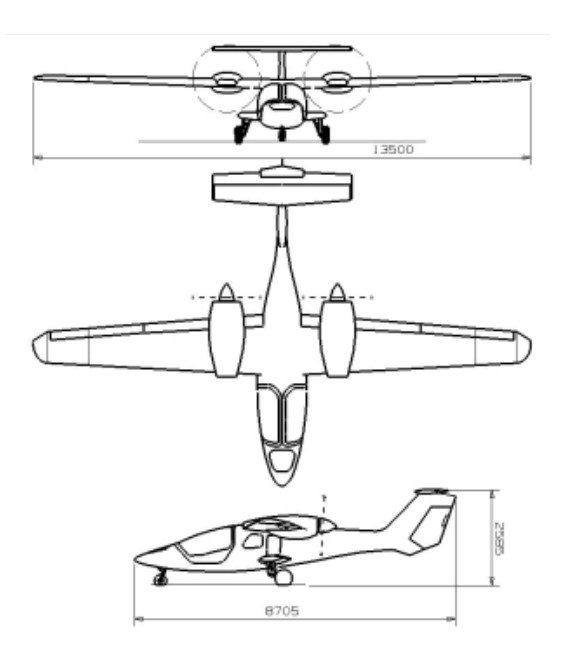
Length: 8.705 m (28.56 ft)
Wingspan: 13.5 m / 44.3 ft
Wingspan folded wing tips: 10.5m / 34.4 ft
Height: 2.585 m (8.48 ft)
Wing area: 16.5 sq.m (177.61 sq. ft)
Max. takeoff weight: 1,820 kg (4,012 lbs)
Useful load: 550kg (1,212.5 lbs)
Fuel burn 75% power: 52 l/h
Maximum speed: 261 km/h / 141 kts
Never exceed speed (VNE): 359 km/h (194 kts)
Cruise speed: 261 km/h (141 kts)
Landing speed: 142 km/h / 77 kts
Stall speed (landing config): 109 km/h (59 kts)
Range (45 min res): 1700 km (918 nm)
Rate of climb: 5,1 m/s (1000 ft/min)
Rate of climb SE: 1 m/s / 200 ft/min
Take-off ground roll: 358 m / 1174 ft
Landing ground roll: 556 m / 1824 ft
Crew: one, pilot
Capacity: 3 passengers
ZAKŁADY LOTNICZE Margański & Mysłowski S.A.
Margański & Mysłowski ZAKŁADY LOTNICZE dates back to 1986, when Edward Margański, an engineer, established “Aircraft Repair and Equipment Production Plant”. Initially, the company dealt with the inspection and repair of wooden gliders.
In 1990 company’s activity has been extended to glider constructions designing. Within 26 months SWIFT glider has been designed, flight tests have been performed and Type Certificate was obtained.
The successes of the SWIFT led to an order from MDM Ltd. to design an aerobatic two-seater glider. The company has developed MDM-1 Fox glider, which has gained many world’s and European aerobatics championships awards. On 27th July 1994, a Type Certificate was issued.
In 1999, on the basis of previous experience and preliminary preparations carried out in advance, the company began work on a prototype of the Iskra II jet training aircraft, with an engine thrust of 1,300 – 1,500 kg. The airplane was renamed the ‘Bielik’ and underwent test flights in 2003.
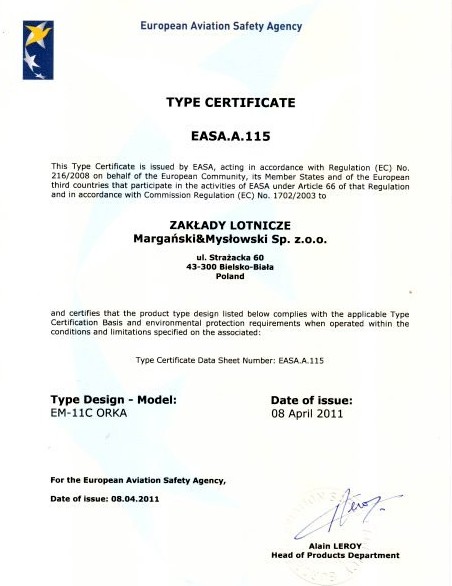
In 2001, work commenced on the development of a new aircraft structure; an executive aircraft, the EM-11 Orka, test flights for which took place in 2003. ORKA is a four seater twin-engine aircraft with retractable landing gear, high-wing configuration with push-type propellers and comfortable passenger cabin. On 8th April 2011 EM-11C Orka has achieved EASA Type Certificate.
Concurrent with aircraft production, the company has participated in a number of projects in other areas. – production tools and the first specimens of a 44 m diameter rotor blade made of glass-fibre-reinforced composite for a wind power plant generating 1000 kW of energy. In 2002, an order from ENECO for a prototype rotor for a wind power plant with a 1.2 MW output was built. In cooperation with ROTHENSEER ROTORBLATTFERTIGUNG GmbH, the company has made supporting elements for the construction of wind power plant rotor blades.
In 2010 production of MDM-1 Fox glider series was started again.
Since October 2011 the company has been transformed from limited company to joint-stock company and has been renamed to Zakłady Lotnicze Margański&Mysłowski S.A.
Certificates:
Production Organization Approval (POA) no PL.21G.0012
Design Organization Approval (DOA) no EASA.21J.117
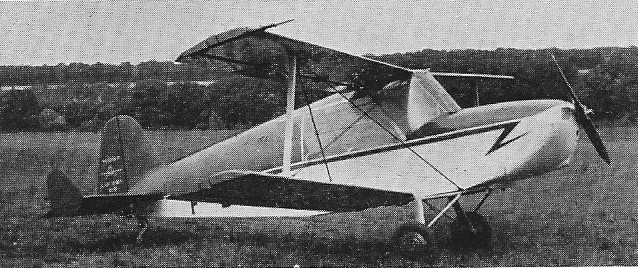
The LD-261 Midgy-Club was a development of the single-seat LD-45 and two-seat LD-46 of 1946-47, and a few were produced by Instruments de Precision M.D.G. The LD-261 are tandem two-seaters of mixed construction.
A sole example of a slightly modified version, known as the Indraero CB-10, was also built.
LD-261 Midgy-Club
Engine: Continental A65, 65 hp
Wingspan: 22 ft 11.5 in
Wing area: 114 sq.ft
Length: 17 ft 10.5 in
Height: 6 ft 5 in
Empty weight: 704 lb
Loaded weight: 1190 lb
Max speed: 112 mph
Cruise: 98 mph
ROC: 560 fpm
Absolute ceiling: 22,200 ft
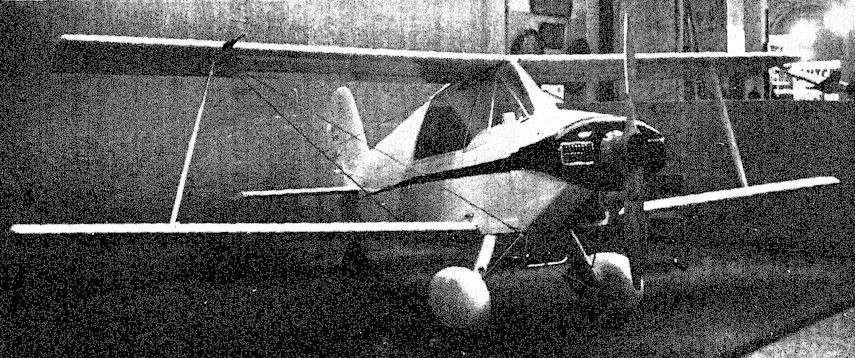
The MDG LD.45 was a single-seat biplane of 1946.
The M.D.G LD-46 of 1947 was two-place.
LD-45
Powerplant: 1 × 40 hp Mathis G2F engine

M&D Flugzeugbau are a German company based in Friedeburg, Lower Saxony in north-western Germany. M&D Flugzeugbau manufacture the Samburo motorglider and also provide maintenance services for other light aircraft.
In 2007 M&D identified the potential benefits of installing a small jet turbine sustainer in gliders but considered the range of jet turbines available for model aircraft had limitations. Such engines had not been designed from the outset to consider certification or in-flight starting. M&D decided that rather than convert a model aircraft jet turbine into a glider sustainer, it would be better to develop and certificate a new engine.
The key features of the TJ42 engine are:
Single spool jet turbine
Two stage axial-centrifugal stator-less compressor with a compression ratio of 1:3.8
Cannular combustor with multiple fuel injectors and combustion zones contained within a single annulus casing
Glow-plug ignition system (used in start-up sequence only, ignites top combustion zone only)
Single stage axial turbine with stators
Convergent nozzle
Front-mounted, direct drive electric starter motor for initial spool up
The maximum thrust is nominally 42 kgf at 100,000 rpm with an estimated fuel consumption of 66.4kg/hr at full thrust. At the idle speed of 30,000 rpm the thrust is less than 2 kgf. The weight is 3.3kg and overall dimensions 400 mm long and 150 mm diameter.
The TJ42 has a kerosene start-up (as opposed to gas start engines) which eliminates the need for separate gas canisters and long complex start-up procedures.
The start-up sequence is:
Glow-plug heats up for 10 seconds
Electric starter motor spools up engine to 8,000 rpm
Starter fuel solenoid pulses with fuel being injected into the top combustion zone only
Fuel ignited in top combustion zone by glow-plug
Engine spools up to 15,000 rpm
Normal fuel solenoid pulses with fuel being injected into all combustion zones (starter fuel solenoid closes)
Engine spools up to idle speed of 30,000 rpm
Fuel rate controlled by throttle, and matched to density altitude and rpm by ECU
The shut-down sequence is:
Fuel cut off and combustion ceases
With no fuel, the engine speed decreases and EGT decreases
The ECU senses EGT and rpm, and if the engine speed is too low to promote rapid cooling, the electric starter motor runs an automatic cooling cycle (spooling the engine up to 3,000 rpm, then switching off)
Once the EGT has dropped below 50°C the ECU signals that the engine can be retracted
The engine and pylon are enclosed by cowlings manufactured from fiberglass and aluminum (or possibly stainless steel subject to clarification of certification requirements).
The MD-TJ42 is certified for installation on self-sustaining sailplanes only, i.e. it is not intended for take-off operation, EASA Type Certificate EASA.E.099. The first type certificated application was on the Jonker Sailplanes JS-1 Series.
Because of the use of these engines in sailplanes, there are several assumptions to simplify the requirements for certification. These assumptions are:
The two seat, side by side Sherpa has a spaceframe fuselage and wings of riveted sheet dural.
Engine: Rotax 912, 80 hp
Wing span: 9.4 m
Wing area: 20 sq.m
MAUW: 450 kg
Empty weight: 198 kg
Fuel capacity: 60 lt
Max speed: 160 kph
Cruise speed: 130 kph
Minimum speed: 60 kph
Climb rate: 5 m/s
Fuel consumption: 8-14 lt/hr
Seats: 2
Price (1998): 250 000 Fttc
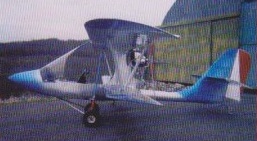
The Airland has a composite fuselage with wings of riveted sheet dural. The two seats are in tandem.
Engine: VW 1835, 63 hp
Wing span: 8.60 m
Wing area: 18 sq.m
MAUW: 450 kg
Empty weight: 190 kg
Fuel capacity: 45-60 lt
Max speed: 160 kph
Cruise speed: 120 kph
Minimum speed: 60 kph
Climb rate: 5 m/s
Seats: 2
Fuel consumption: 10-12 lt/hr
Price (1998): 150 000 Fttc
Kit price (1998): 100 000 Fttc
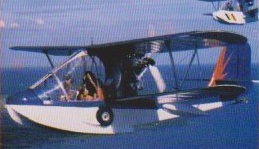
The tandem, two seat MD 03 amphibious pusher biplane has a fuselage of spaceframe and composites, while the wings are the same as on other Delpech models.
Engine: Rotax 582, 64 hp
Wing span: 8.60 m
Wing area: 18 sq.m
MAUW: 450 kg
Empty weight: 198 kg
Fuel capacity: 45-60 lt
Max speed: 160 kph
Cruise speed: 130 kph
Minimum speed: 60 kph
Climb rate: 5 m/s
Seats: 2
Fuel consumption: 9-14 lt/hr
Kit price (1998): 110 000 Fttc
1998:
La Cassagne
F-24120 Terrasson
France
UL builder

