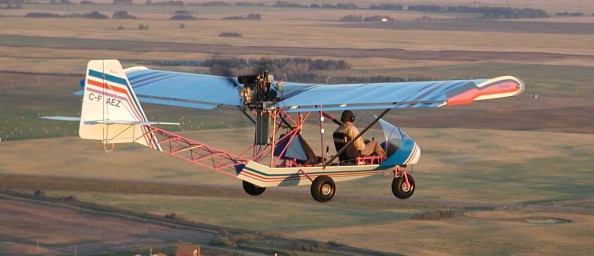
The two-place ultralight trainer EZ-Flyer was designed by Canadian Wayne Winters, using a lot of the Merlin’s wing and tail structure.
The LSA EZ-Flyer II has a chromoly steel tube fuselage structure. It is a predominantly triangulated structure. The engine is pusher mounted behind the wing and on top of the steel fuselage cage. It can handle all the bigger Rotax engines and Merlin indicates that the 80-hp Rotax 912 four-stroke engine.
It is a 4130 chromoly steel construct that is painted at the factory prior to shipping. The wing has an aluminum “D” cell, is Ceconite covered and strut braced, but sports a large wingtip “fence” at the end that was removed from factory ships for testing. The ailerons are not quite full-span but are hinged in a frise-type setup with no differential. There are no flaps, and the wing is a constant chord assembly.
The rudder tri-gear has a set of very heavy spring steel gear legs and 18 inch tundra tires. The EZ-Flyer II is 21 feet long, 6 feet high, and has a span of 30 feet. The wing has 165 sq. ft. of wing area, a 10 US gal fuel capacity, and is stressed to +4 and -2 Gs. With the standard Rotax 503, the 465-lb EZ-Flyer II has a max gross weight of 1000 lbs, leaving more than a 500 lbs payload.
The empty EZ-Flyer has a tendency to sit on its tail with the nose sticking skyward.
Dual controls come in the form of a long J-neck control stick, rudder pedals, and a single-lever braking system to the left of the pilot seat. The throttle is also on the left and is made prominent on the prototype by a small golf-ball-shaped handle that sits atop the lever. The front seat offers minimal protection from the elements with a small windscreen that does keep the worst of the breeze out of your face.
There is some notable down thrust evident in full-power operations that will require initiating a positive rotation until you get to a much higher than normal light-off speeds. Lift-off at about 35 mph and 350 feet.
Engine: Rotax 582, 65 hp
Max speed: 100mph
Cruise speed: 70 mph
Stall: 30 mph
ROC:700 fpm
Takeoff distance: 90 ft.
Landing dist: 150 ft
Fuel cap: 9 USG
Empty weight: 483 lb
Gross weight: 1050 lbs
Height: 6 ft
Length: 21 ft
Wing span: 26 ft
Wing area: 137 sq.ft.
Seats: 2
Undercarriage: tricycle
Blue Yonder EZ Flyer
Engine: Rotax 503, 52 hp
HP range: 50-74.
Speed max: 100 mph
Cruise: 65 mph.
Stall: 30 mph
ROC: 650 fpm.
Take-off dist: 90 ft
Landing dist: 150 ft.
Fuel cap: 9 USG
Weight empty: 469 lbs.
Gross: 1050 lbs
Height: 6 ft.
Length: 21 ft
Wing span: 26 ft.
Wing area: 137 sq.ft
Seats: 2 tandem.
Landing gear: nose wheel.
Blue Yonder EZ Flyer
Engine: Rotax 582, 65 hp
HP range: 50-130.
Cruise: 70 mph.
Stall: 35 mph
ROC: 700 fpm.
Take-off dist: 100 ft
Landing dist: 175 ft.
Fuel cap: 24 USG
Weight empty: 535 lbs.
Gross: 1300 lbs
Length: 21 ft
Wing span: 31 ft.
Wing area: 176 sq.ft
Seats: 2 tandem.
Landing gear: nose wheel.