Back to Messerschmitt Me 163 Komet


The Messerschmitt Me 163 Komet (comet) rocket interceptor stemmed from prolonged research by Dr Alex¬ander Lippisch over 15 years before the war. The heart of Projekt X was a rocket engine developed by Hellmuth Walter. Lippisch’s task was to design a tailless aircraft to go with it. Even he was not allowed to have blueprints of the power¬plant for the airframe he was designing. The result of this clandestine effort was a tailless rocket research craft designated the DFS 194 which began flight trials with a 400 kg (882 lb) thrust liquid fuel Walter rocket motor at the Baltic coast test site of Peenernfinde in August 1940. While test pilot Heini Dittmar flew this test bed, reaching 550 kph (341.8 mph) in level flight, Lippisch and his team pressed on with the next stage of Projekt X at the Messerschmitt Werke in Augsburg. The ultimate aim was to produce a rocket powered interceptor fighter.
In the mid 1930s the German Air Ministry were supporting the work of rocket engine designer Hellmuth Walter, issuing him a contract to develop a 400 kg / 882 lb thrust motor. In the mean time, Alexanderander Lippisch had been working at the German Institute for the Study of Sailplane Flight (DFS) and was given the order to produce a second prototype of his DFS 39 tail-less aircraft to test the potential of a rocket powered airframe. The work would see DFS build the wings and Heinkel build the fuselage.
Lippisch discovered the wing mounted rudders would likely cause unacceptable flutter, so he redesigned the airframe to include a large conventional central fin and rudder. Redesignated DFS 194 it was fitted with a small propeller engine and a landing skid. A takeoff dolly was mounted under the landing skid, it being jettisoned shortly after takeoff.
Dr Lippisch and his staff were transferred to Messerschmitt’s works at Augsburg in January 1939, with the partially completed DFS 194. The decision was also made to by-pass the prop driven version and move directly to rocket power.
The completed airframe was shipped to Peenemünde West in early 1940.
Messerschmitt Me 163 Komet Article
The Comet’s wooden, plywood-covered wings are of special swept-back design with a marked wash-out of incidence towards the tip. The fuselage is of metal construction. “Elevons” which serve both as elevators and ailerons are located outboard in the wings; there are no horizontal tail surfaces.
Three development prototypes of the DFS 194 were ordered by the RLM and the first two were completed by the spring of 1941, when unpowered gliding flights began from the factory airfield. The engineless Messerschmitt Me 163 attained a top speed of 850 kph (528 mph) in a dive test.
In early 1940 the DFS 194 was equipped with a rocket motor at Peenemünde. After test flights by Heini Dittmar had confirmed speeds of up to 550km/h on the power of a single 2.94kN Walter motor, there was sufficient interest to initiate development. In 1941 the first Me 163 prototype was being tested in gliding flight and shortly after was fitted with a 7.35kN Walter RII-203 rocket motor. On 2 October 1941 Heini Dittmar cast off from a Messerschmitt Bf 110 tow-plane at 4000 m (13,125 ft), fired the Me 163V-1’s rocket motor and accelerated rapidly reached 1004.5 kph (623.8mph); two months later the Me163B Komet was ordered into production.

Speeds of up to 915km/h were achieved (limited by the volume of liquid propellants carried) and to gain some idea of the speed potential, this aircraft was towed to a high altitude before being released. Flown under power, a speed of over 1,000km/h was attained before the engine had to be throttled back because the aircraft was becoming uncontrollable.
This success saw the development of the first production prototype, now designated Me 163. Flight testing began in the Spring of 1941. These were a series of unpowered flights before the Me 163 V1 was shipped to Peenemünde for installation of the improved Walter RII-203 engine.

On 2 October 1941, the Me 163 V1 piloted by Heini Dittmar set a new world speed record of 1004.5 kph / 623.8 mph. After this performance, the RLM instructed Lippisch to design an improved version around a more powerful motor under development. The resulted in the Me 163B. The first prototype, the Me 163 V3, was completed in April 1942, but it was not until early autumn that the first Walter 109-509A motors were ready for installation.
Plans proceeded during 1943 to equip the first operational units with the Me 163B-1a. Production Me 163Bs were po¬wered by Walter 109 509A2 rocket motors using T Stoff (hydrogen peroxide) and C Stoff (hydrazine hydrate, methyl alcohol and water) to give a thrust of 1700 kg (3,748 lb).
The new motor employed a ‘hot’ system in which the oxygen was ignited for additional thrust and better fuel efficiency. Flight testing of the first series of Me 163B-0 pre-production aircraft proceeded throughout 1942.
The fuselage of the Komet was made of metal but its wing was of wooden construction. The leading edge of the wing featured long slats in front of the elevons. Early Me 163B 0 aircraft were armed with a pair of 20 mm guns, but Me 163B 1 fighters carried two 30 mm weapons. The aircraft possessed no conventional landing gear, but took off from a trolley, which was jettisoned immediately after take off and at the end of the flight the Komet was landed on the skid. The small propeller on the nose served to drive a generator which supplied electrical power for the radio and instruments. Armour includes a nose cone constructed of 15-mm plate.
Laminated bullet-resisting glass gives the pilot added protection from frontal attack. Two triangular plates comprise the side cockpit armor. No provision is made for defense against attack from the rear except the plane’s high speed.
The production Me 163B’s 1500 kg (3307 1b) thrust Walter HWK 109-509 rocket motor was fuelled with a highly volatile mixture of C stoff (methyl alcohol, hydrazine hydrate and water) and T stoff (hydrogen peroxide with additional hydrocarbon stabilizers) which would explode at the least provocation. The Komet carried more than 2000 kg (4409 lb) of fuel and climbed to 12,000 m (39,370 ft) in 3 minutes 30 seconds. The Walter HWK 109-509A rocket motor made use of a steam generator that used calcium permanganate as a catalyst to produce steam when a small amount of T-Stoff was added via an electric starter motor, the resulting steam starting the turbine to begin pumping the two fuels to the rocket motor. The starter motor was switched off, and the rocket motor was throttled through its five positions until it reached maximum thrust.
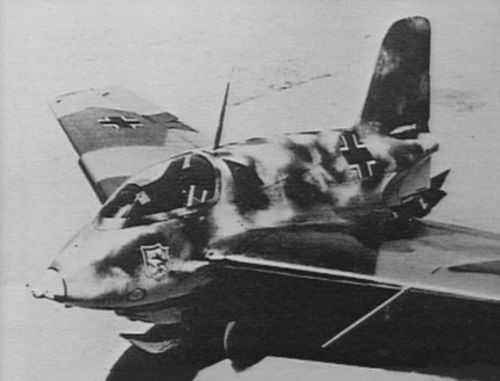
After rocket¬ing high, the Komet pilots would use their remaining fuel to dive at high speed through the ranks of bombers firing on them with the Me 163B’s two 20mm MG 151/120 or 30 mm MK 108 cannon, or with the SG 500 Yagdfaust (hunter’s fist) 50 mm (1.97 in) weapon system, which fired shells vertically upwards from the top surface of the Komet’s wing when a bomber’s shadow triggered its photo electric cell firing circuit.
Series production began at dispersed facilities by Klemm, but was later transferred to Junkers, as a result of quality control problems. An operational training unit, Erprobungskommando 16 (EK 16) was formed during July 1943 at Peenemünde West, but moved to Bad Zwischenahn before the first group of pilot trainees arrived. The unit received its first group of 36 pilot trainees in the summer of 1943 and by May 1944 the first operational Me 163 wing, Jagdgeschwader 400 (JG 400) was created under the command of Hauptmann Wolfgang Späte. The unit was ordered to defend the synthetic oil refineries at Leuna from its base at Brandis, near Merseburg. The same day several Me 163s over Wesermude attacked a formation of B-17s of the 3rd Air Division and shot down one. P-38 escorts of 479th FG tried in vain to intercept the fighters.
Two additional units fighter groups, II and III/JG 400 were formed before the end of the war, but only saw limited combat against single aircraft.
On 28 July 1944 the Luftwaffe deployed for the first time the Me 163B fighter. Seven Comets were flown by JG400, which had been formed in Wittmundhafen out of the 16th Test Unit.. JG400 was assigned to protect the synthetic fuel plants. That day the US 359th Mustang Fighter Group saw five Me 163s over Merseburg. “They cooly carried out a number of attacks on our unit”.
The same day several Me 163s over Wesermüde attacked a formation of B-17s of the 3rd Air Division and shot down one. P-38 escorts of 479th FG tried in vain to intercept the fighters.
JG 400 made interceptions of Allied bombers on 7th and 28th of July 1944, without success, but on 16 August Fw Siegfried Schubert scored the types first success. He scored three victories before his death in that October. The only other major USAAF interceptions were on 24 August (4 B-17s shot down by 1 Gruppe), 11th September, and 2nd November.
Although the aircraft’s two 30mm MK 108 cannons were capable of downing a four engined bomber with only a few hits, the Komet’s high speed, and the cannons’ slow rate of fire and short range, made effective gunnery nearly impossible. As a result, the Me 163 pilots recorded a total of only nine confirmed kills. (Schubert 3 kills, Kelb, Schiebeler, Ryll, Strasnicky, Glogner, & Bott one each). After completing an attack, the pilot had to glide back to base as the fighter only carried enough fuel for eight minutes of powered flight.
In response to combat reports, alternative weapons were including the SG 500 recoilless ‘Jägerfaust’. Five were mounted in either wing and fired by photocell trigger as the aircraft passed below.
Further combat sorties were curtailed by order by the end of 1944 due to pilot losses as high as 30%. On 14 April 1945, the remaining aircraft at Brandis were destroyed and the remaining personnel ordered to join the army. The official order to disband 1./ and II./JG 400 was issued on 20 April 1945.
An improved variant with greater endurance and a tricycle undercarriage, the Me 163 C was also produced in small numbers, but was not flown operationally. A few examples of a two seat trainer, the Me 163 S were also completed. The slightly larger Me 163C development – with aerodynamic refinements, pressurised cockpit and blister-type canopy, and more powerful Walter 109-509C rocket motor and auxiliary cruising jet – was built only in prototype and pre-production form. It did not enter service, although it was almost ready for delivery to Luftwaffe squadrons at the time of the German surrender. With this version, endurance was increased from eight-ten minutes to twelve minutes of powered flight. It was faster by 40 mph, weighing 11,280 pounds.
The Me 163D was developed in to the Me 263. The aircraft was briefly known as the Junkers Ju 248 V1.
Produced in only small numbers, about 360 examples were completed.
Official top speed of the Comet, contrary to Messerschmitt’s statement, is 550 mph at 20,000 feet and above. Armament consists of two 30-mm cannon, one in each wing root, firing a total of 120 rounds. Normal flying weight of the 163 is 9,500 pounds; wing span is just over 30 feet, length, slightly under 20.
The fuels in the Komet were highly corrosive and would dissolve organic material (such as the pilot). To avoid this, the pilots would wear special asbestos fibre suits. A bumpy landing sometimes caused unburned fuels to mix and ignite.

Replica:
Kurtz Me 163B
Me 163B Komet
Wing span: 30 ft 7 in (9.32 m)
Length: 18 ft 8 in (5.69 m)
Engines: 1 x Walter, 3300 lb
Max TO wt: 9042 lb (4110 kg)
Max level speed: 596 mph ( 960 kph)
Me 163B-la
Powerplant; 1 Walter HWK 509A-1 (or A-2), 3,748lb (1700kg) thrust
Fuel; C-stoff: 57% methyl alcohol, 30% hydrazine hydrate, 13% water – T-stoff: 80% hydrogen peroxide, 20% stabilisers
Max. speed: 559mph sea level to 39,400ft (12,000m)
Service Ceiling; 39,400ft (12,000m)
Climb: 1.48 minutes to 6,600ft (2,000m)
Climb: 2.02 minutes to 13,100ft (4,000m)
Climb: 2.27 minutes to 19,700ft (6,000m)
Climb: 3.45 minutes to 39,400ft (1 2,000m)
Endurance; 7min 30sec
Range; Approx 80 miles (130km)
Empty weight: 4,1901b (1900kg)
Max takeoff weight: 9,0521b (4310kg)
Wing span: 30ft 7in (9.40m)
Length: 19ft 2in (5.85m)
Height: 9ft (2.75m) on takeoff dolly
Wing area: 199.1 square feet (18.5sq.m)
Armament Two 30mm Rheinmetall – Borsig MK 108 cannon / 60 rpg


During the autumn of 1935, the considerable potential of the Fieseler Fi 156 project for the tasks of short range reconnaissance and aerial observation had prompted the RLM to draw up a requirement for an army co-operation and observation aircraft with its performance parameters. The requirement stipulated the use of the Argus As 10 or the Hirth HM 508 engine and placed emphasis on short field performance, maximum possible all-round view for the two crew members, and a wide range of speed. It was intended that the resultant aircraft, which the Siebel Si 201 was also designed to compete for, would be evaluated in competition with the Fi 156.
The Bf 163 followed closely the formula established by the Fi 156 in being a high-wing braced monoplane with a metal structure, automatic leading edge wing slots, double slotted flaps, and an exceptionally tall undercarriage. The aircraft’s most interesting feature was the provision for varying the incidence of the entire wing which swivelled on its mainspar, the bracing struts being attached to the fuselage by ball joints and changing their angle with movement of the wing. Construction of the sole prototype was entrusted to Weserflug Flugzeugbau GmbH, Bremen Lemwerder, though it retained the RLM prefix for BFW (Bf).
The plane normally carried a crew of two (three in an emergency). Its wings were foldable for rail transport. The structural design of the plane resembled that of the Bf 108 Taifun, in particular, as regards fuselage construction, engine mount and cowl, shape of horizontal tail surfaces etc.
Most information has been lost in time, but a weight breakdown table, originating from the Augsburg design office, proved extremely valuable in that it provided a clear picture of the equipment carried by the plane and of the weights of the various components, thus permitting a rough estimate of their dimensions. The list also proved of great value in a later phase of the reconstruction, when wing and landing gear positions were established by calculating the approximate centre of gravity location.
The next “find” was a couple of more precise dimensional figures (wing span and area). As the shape of the wing was known to have been rectangular, it was now a simple matter to provisionally establish the overall wing dimensions. With the length of the Argus As 10 C engine known, the overall length of the fuselage could be roughly determined.
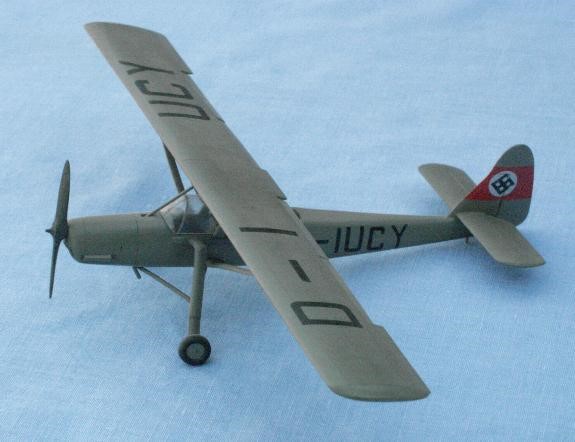
Various people had mentioned the incidence control system, but nobody seemed to remember clear¬ly just how it had worked and where the linkage had been at¬tached to wing and fuselage.
Questioning the pilot who had been in charge of testing the Bf 163 led to the dis¬covery of the plane’s registration, which in turn, enabled H. J. Ebert to identify the a/c in the back¬ground of two snapshots of the old Messerschmitt Archives. Un¬fortunately, the two photos were rather foggy and showed only part of the plane. Yet they supplied a wealth of most welcome informa¬tion, in particular, about the verti¬cal position of the tailplane and the true shape of fin and rudder.
H. J. Ebert found an elementary ¬view of a “Fieseler Storch like plane” in a 1944 issue of “Luft¬fahrt & Schule”. It depicted what must have been an early design sketch of the Bf 163, clearly showing the latter’s unique wing incidence control system, the posi¬tion of the main wing strut, the peculiar semi cantilever landing gear, but a different fuselage contour.
A report titled “A comparison of the amount of riveting opera¬tions for various aircraft types” detected shortly afterwards in the old WFG archives contained a diminutive schematic drawing: the basic outline of the outer panel of the Bf 163 wing. Using the data contained in this report (list of numbers of rivets, wing , slot and flap ribs etc.), it was now possible to re establish the structural design of the outer wing panels and using the available other wing data that of the entire wing.
First flown on 19 February 1938, the Bf 163 V1 proved to have similar performance characteristics to those of the Fi 156 but was more complex and expensive. Although some components for a second prototype were manufactured, the Bf 163 V2 was not completed and further work on the Bf 163 was terminated in favor of the Fieseler Fi 156.
The Ilmavoimat / Maavoimat evaluated the Bf 163 but considered that as the Germans had already ordered the Fi 156 Storch into production, while the Bf 163 was a good aircraft it was so similar in performance and capabilities to the Fi 156 that it probably wasn’t going anywhere. It remained under consideration but as an unlikely fallback option, given that Bayerische Flugzeugwerke (BFW) was unlikely to produce the aircraft only to meet a small Finnish order. License production was contemplated.
In a very rare decision, the RLM issued the airframe designation number 8-163 for the Me 163 Komet rocket-propelled interceptor, after having used the number for the Bf 163. The two aircraft are distinguished by the abbreviation: the earlier Bf 163, and the later Me 163. The new “Me” prefix was adopted for all new designs of Messerschmitt aircraft, after the company’s official name of Bayerische Flugzeugwerke (BFW) was changed to Messerschmitt AG in July of 1938.
With a Crew of 2, the Messerschmidt Bf 163 was powered by a single Argus As 10C 8-cylinder inverted-vee air cooled engine, 179 kW (240 hp) and had a maximum speed of 112mph. Performance characteristics overall were very similar to the Fi 156.
Engine: Argus As 10 C

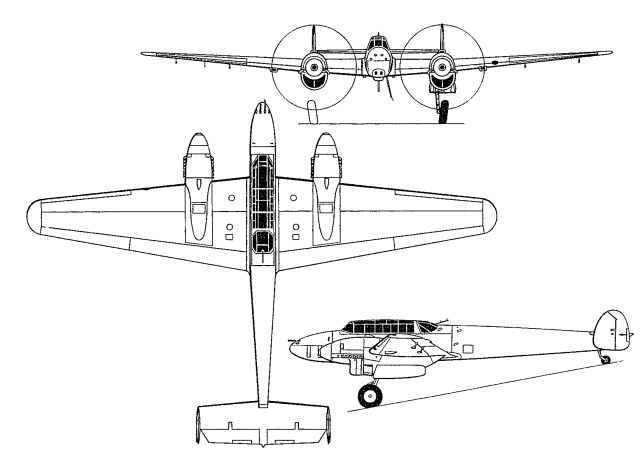
The Messerschmitt Bf162 was developed from the Bf110 Zerstorer (“Destroyer”) fighter but with few common parts. It was created to meet a requirement for a Schnellbomber or fast bomber. The type first flew in 1937. Unofficially named Jaguar, only three prototypes were built before the project was abandoned when the Junkers submission, the Ju88, won the contract.
Superficially resembling the Bf 110, but with a new fuselage, incorporating a glazed nose, initially 65 aircraft were ordered in the 1937/38 programme but due to Messerschmitt committment to the Bf109 and Bf110 programmes coupled with the superiority of th Ju88 this was reduced to 5 with only 3 being completed. The first two models V1 and V2 (werke no 817 and 818 reg. D-AIXE, D-AOBE) were powered by Daimler Benz DB600D and the third model V3 (werke no 819 D-AOVI) was powered by the DB601A. The first two aircraft flew in 1937 the third on the 7th July 1938. The first aircraft (V1) was dismantled after it’s initial flight trials, the second (V2) went to Rechlin and the third (V3) was used alongside the equally ill fated Me161 at Ausberg towing the Me163A.

Any parts left over including the incomplete V4 and V5 were used in Bf110 production.
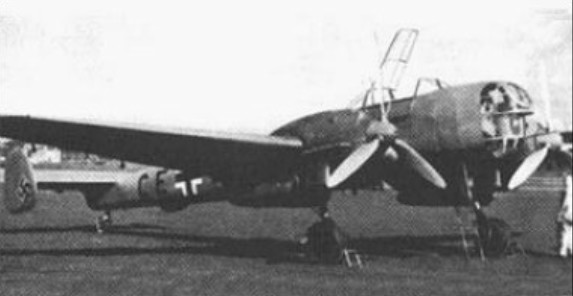
Reconnaissance version of the Bf 110, with a new nose. Development was abandoned when it was understood that much simpler modifications of the Bf 110 would do the job.
Two models built the V1 (D-ABBA) powered by 2 Jukers Jumo 210 engines, and the V2 (D-AOFI), powered by 2 Daimler-Benz 600A engines. The V1 went to Rechlin and the V2 went to Augsburg and later to Peenemunde West and was used for towing the Me163A.
Back to Messerschmitt Bf 110


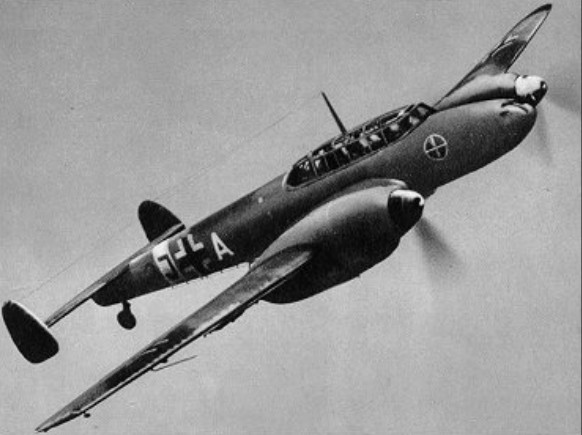
The Bf 110 originated from a Reichsluftfahrtministerium requirement of 1934 for a long-range escort fighter or heavily armed Zerstorer (destroyer). With a cantilever low-wing monoplane configuration, this two-seat fighter had an oval-section fuselage, long glazed canopy, high-mounted tailplane with endplate fins and rudders, retractable landing gear, and power plant was two Daimler-Benz DB 600 in-line engines.
The first prototype, the Bf 110 V1 powered by two 910 hp Daimler-Benz DB 600A engines, was flown for the first time on 25 May 1936 at Augsburg-Haunstetten by Dr-Ing Hermann Wurster. During an early test phase a speed of 314mph / 505 kph was clocked in level flight at 10,830 ft / 3300 m at a loaded weight of 11,025 lb / 5000 kg. For a relatively large, twin-engined aircraft it proved very agile and, in mock combat with a pre-series single-seat Bf 109B flown by Ernst Udet, the newly appointed Inspector of Fighter Pilots repeatedly failed to keep his larger opponent in his gun sight for sufficient time to render a hit likely, and experienced some difficulty in staying with the twin-engined fighter in steep turns.
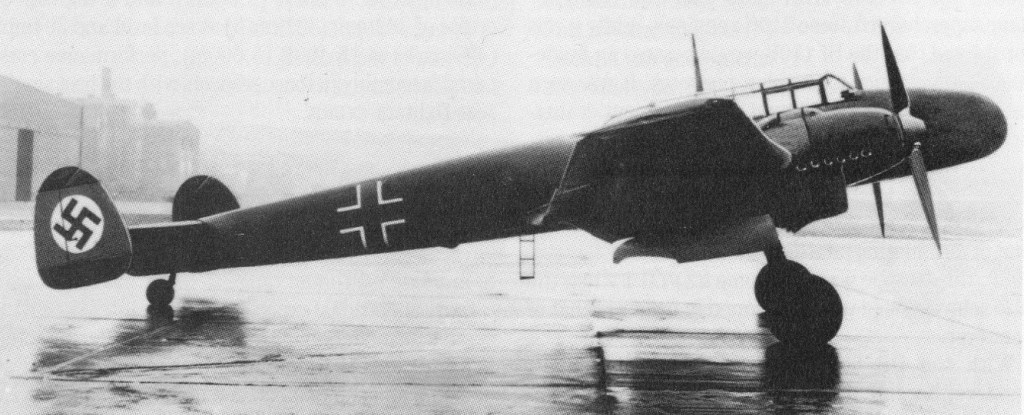
In January 1937, as a result of evaluation of a second prototype, the Bf 110 V2, at the Rechlin Erprobungsstelle, instructions were given that Messerschmitt should commence preparations for a pre-production series of aircraft. The proposed series model, the Bf 110A, was to be powered by a pair of DB 600Aa carburettor-equipped engines of 986 hp for take-off. By the time that the pre-series Bf 110A airframes had attained an advanced stage of construction the DB 600 engine was considered basically unsuited for fighter installation and was already being already phased out of production in favour of the direct-fuel-injection DB 601. The Reichsluftahrt-ministerium confidently expected that the DB 601 would be available by the Spring of 1938, when deliveries of the Bf 110 to the schweren (heavy) Jagdgruppen were expected to commence. Accordingly, instructions were issued to curtail the Bf 110A series, adapting the four airframes that had reached an advanced stage in assembly to take Junkers Jumo 210Da engines of 680 hp for take-off.
As it became obvious predictions for DB 601A engine delivery could not be met, the decision was taken to build an interim model, the Bf 110B with direct-injection two-stage supercharged Jumo 210Ga engines. While it was considered that the Bf 110B would possess an inadequate performance for combat purposes, it was seen as an ideal tool for equipment and armament evaluation, and the development of operational techniques.
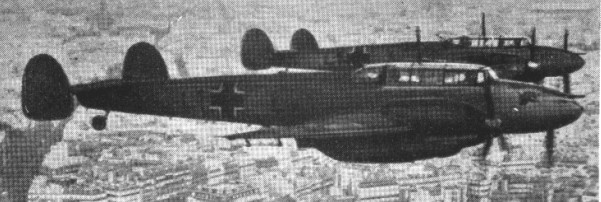
It was issued during late 1938 to I (Schweren Jagdruppe)/LG 1 of the Lehrdivision, or Instructional division, to formulate tactics and techniques. In January 1939 this Gruppe was to become I(Z)/LG 1 with the Zerstörer.
With the DB 601A engine, the Messerschmitt Zerstörer became the Bf 110C, a pre-series of 10 being delivered to the Luftwaffe early in January 1939, and acceptances of the initial production Bf 110C-1 by I(Z)/LG 1 began before the end of that month. Production of the Bf 110C-1 increased rapidly and by the early summer of 1939 Focke-Wulf and Gothaer Waggonfabrik had tooled up to supplement the output of Messerschmitt’s Ausburg-Haunstetten factory, and the MIAG at Braunschweig was preparing to phase into the programme.
By 31 August 1939 a total of 159 Bf 110C fighters had been accepted, although the Quartermaster-General’s strength returns for that date indicated that only 68 of these, plus 27 Bf 110Bs, had actually been taken into the inventory. Three Zerstörergruppen were to be included in the Order of Battle against Poland.
Output of the Bf 110C had risen to more than 30 per month, and another 156 were delivered during the first four months of hostilities when production rates rose. The average monthly production during 1940 was 102.6 aircraft.
Early operational experience had resulted in the successive introduction of the Bf 110C-2, differing solely in having FuG 10 HF radio in place of the original FuG 3aU R/T and the Bf 110C-3 which differed in having improved MG FF cannon. These now gave place to the Bf 110C-4 in which some attempt was to provide nominal armour protection for pilot and gunner, normal loaded weight rising 490 lb / 333 kg over that of the Bf 110C-1 to 13,779 lb / 6250 kg. Further escalation in weight resulted from a demand for adaptation of the aircraft for to Jagd-bomber (Jabo) mission, two ETC 250 racks being introduced beneath the fuselage centre section for a pair of 551 lb / 250 kg bombs.
The substantially increased overload weight necessitated more power for take-off and emergency use, and the Jabo Bf 110C-4/B was fitted with DB 601N engines which with increased compression and 96 octane fuel, had a maximum take-off output of 1200 hp with full boost for one minute.
Issued to the Erprobungsgruppe 210, the Bf 110C-4/B fighter-bombers of two staffeln of this unit were to operate throughout the ensuing Battle singly and in small groups.
The Bf 110C escorted the bomber units that devastated Poland at the beginning of World War II, and just before Christmas 1939, Bf 109 and 110 destroyed 12 of a force of 22 Wellingtons which were making a reconnaissance of Heligoland Bight.
A parallel development was the Bf 110C-5 which had a single Rb 50/30 reconnaissance camera in the cockpit floor, forward-firing armament being restricted to the quartet of machine guns. This sub-type was to reach the Aufklärungstaffeln, or reconnaissance squadrons, in time to participate in the Battle, initially in mixed units with the Do 17P and Do 17Z.
On 20 July 1940 a total of 278 Bf 110s were available to Luftflotten 2, 4 and 5, and of these 200 were serviceable.
Bf 110C and longer-range Bf 110D were launched against Britain in the summer of 1940, but even before the Battle of Britain had reached a peak, it was clear that the Bf 110 was no match for the RAF’s manoeuvrable single-seat fighters. Indeed it was so vulnerable that this ‘escort’ fighter was unable to operate in British airspace by daylight unless it was itself escorted.
The Bf 110D-0 was the pre-series of the Dackelbauch (Dachsund-belly) equipped version.
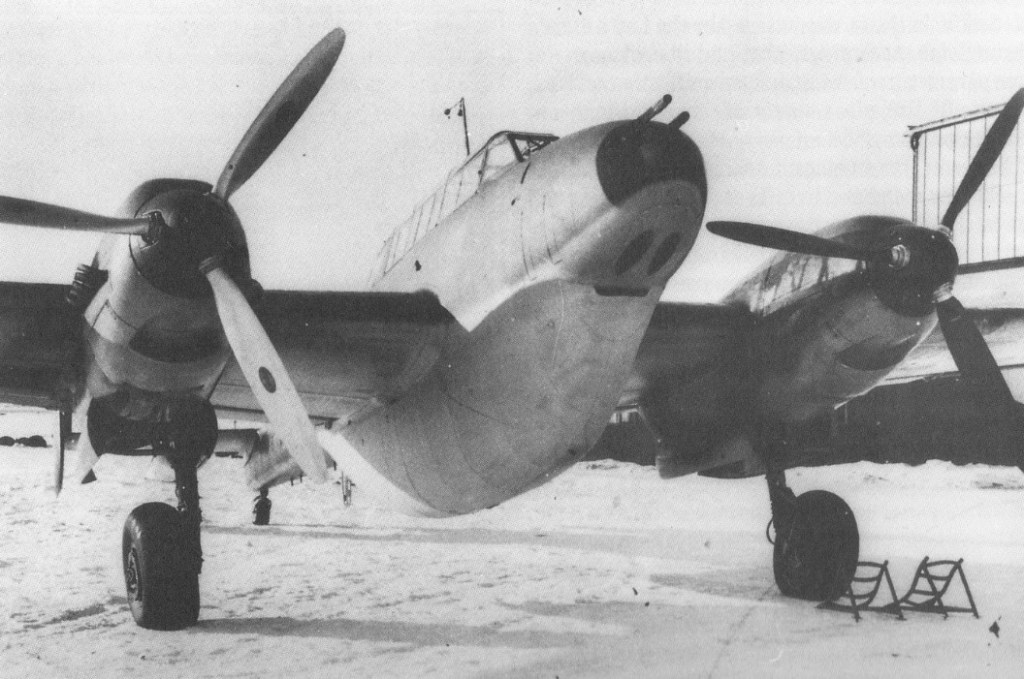
The Bf 110D-1 was a so-called langstrecken, or long-distance, Zestörer with a 264 ImpG / 1200 lt auxiliaet fuel tank made of plywood and dubbed a Dackelbauch (Dachsund-belly). It was found to ‘hang up’ under extremely low temperatures after its fuel had been exhausted, the fumes remaining in the tank tending to explode.
The Dackelbauch (Dachsund-belly) suffered disastrously on 15 August when flown by I/ZG 76. One-third of 21 participating aircraft were lost.
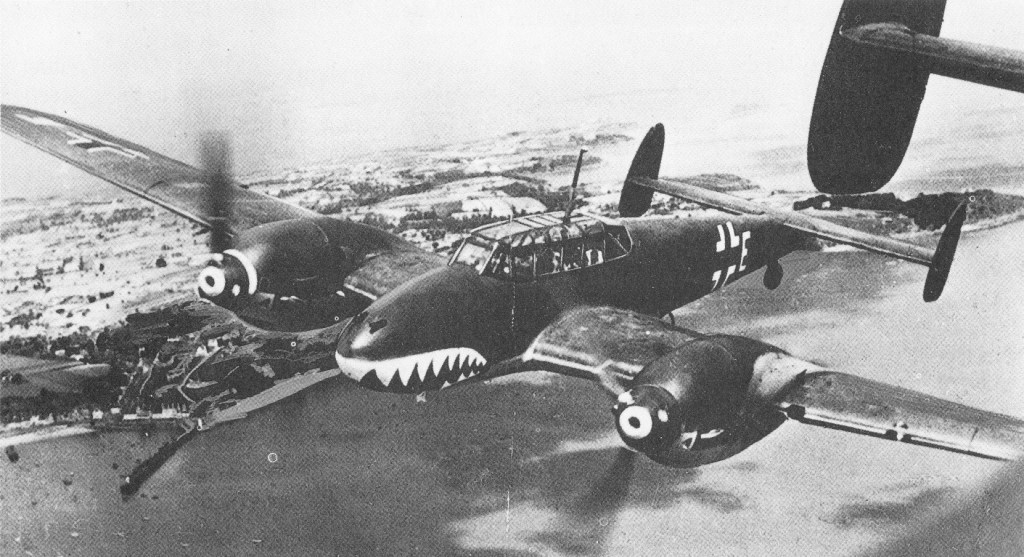
Despite its failure in this role, the Bf 110 was to prove a most valuable and successful night fighter until more advanced aircraft entered the scene in the latter stages of the war. Bf 110E with DB 601N engines and Bf 110F with DB 601E engines formed the nucleus of such operations. Considerable success was gained by these aircraft in conjunction with Wiirzburg radar, the pilots being directed by ground controllers into an interception position.
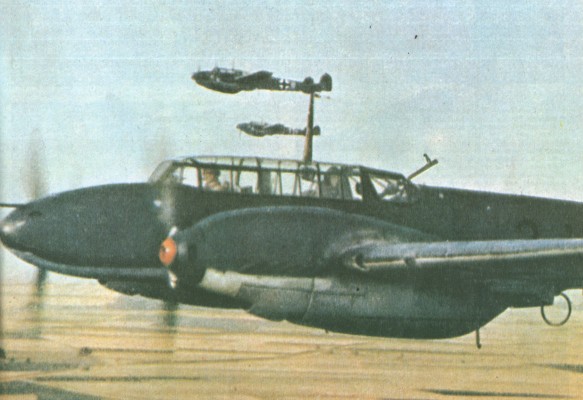
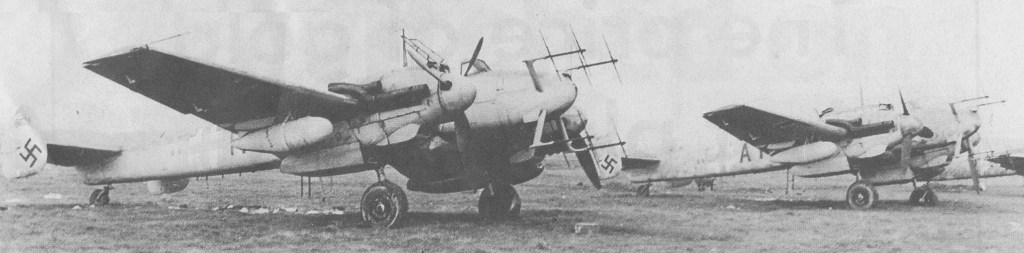
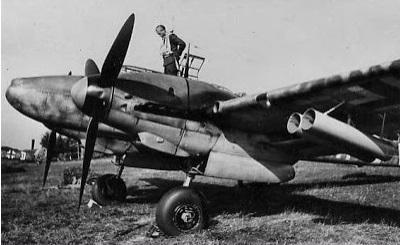
The three-seat night-fighter Bf 110F was followed into production by a series of Bf 110G with DB 605B engines, the early versions serving as fighter bombers. However the four-seat Bf 110G-4a, -4b, -4c, and -4d variants were provided with differing airborne radar installations for operation as night fighters. Final production version was the Bf 110H, generally similar to the Bf 110G but equipped with heavier armament. It is worth recording a significant factor in favour of the Bf 110, so often dismissed as a complete failure. During early 1944 almost 60% of the entire German night-fighter force was composed of variants of the Bf 110.
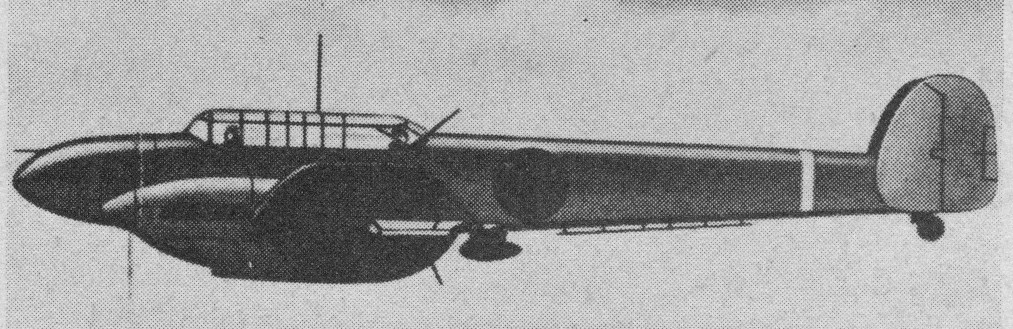
The spotting of modern twin-engined monoplanes in combat led to the belief that Japan was using imported German Me.110s. These were allocated the allied code name Doc, remaining in recognition manuals until the spring of 1943, and was then dropped.
A total of 6,050 of these aircraft was built before production ended in March 1945.
Bf 110C-1
Engines: 2 x DB 601A-1, 1050 hp
Armament: 2 x 20mm MG FF cannon, 180 rds / 4 x 7.9mm MG 17 mg, 1000 rds / 1 x 7.9mm MG 15, 750 rds
Max speed SL: 295 mph / 475 kph
Max speed 19,685ft / 6000m: 335 mph / 540 kph
High cruise SL: 262 mph / 422 kph
High cruise 16,400ft / 5000m: 304 mph / 490 kph
Economic cruise 13,780ft / 4200m: 217 mph / 350 kph
Range at Econ cruise: 680 mi / 1095 kph
Fuel, drop tanks: 121 Imp.Gal / 550 lt
Max range, max fuel: 876 mi / 1410 km
Bf.110-E2
Engines: 2 x Daimler Benz DB601A
Bf.110-F2
Engines: 2 x Daimler Benz DB601F.
Bf 110F-4a
Engines: 2 x Daimler-Benz DB601F, 1350 hp
Wingspan: 53 ft 4.75 in
Length: 39 ft 8.5 in
Height: 11 ft 6 in
Empty weight: 11,577 lb
Combat weight: 14,884 lb
External fuel: 66 Imp.Gal standard
Max speed: 311 mph at 14,760 ft
Cruise: 278 mph at SL
Service ceiling: 35,760 ft
Range: 745 mi
Armament: 2 x 20mm MG FF cannon / 5 x 7.9mm MG 17 machine guns
Radar: FuG Lichtenstein BC
Me 110 G Zerstörer
Engines: 2 x Daimler Benz DB 605 B-1, 1455 hp
Length: 42.815 ft / 13.05 m
Height: 13.714 ft / 4.18 m
Wingspan: 53.314 ft / 16.25 m
Wing area: 413.338 sq.ft / 38.400 sq.m
Max take off weight: 20705.0 lb / 9390.0 kg
Weight empty: 11232.3 lb / 5094.0 kg
Max. speed: 297 kts / 550 km/h
Landing speed: 81 kts / 150 km/h
Cruising speed: 275 kts / 510 km/h
Service ceiling: 26247 ft / 8000 m
Cruising altitude: 19619 ft / 5980 m
Wing loading: 50.23 lb/sq.ft / 245.0 kg/sq.m
Range: 486 nm / 900 km
Max range: 1305 miles
Crew: 3
Armament: 4x MG 151/20. 1x MG 81 Z
Bf 110G-2
Engines: 2 x DB-605, 1065kW
Max take-off weight: 7100 kg / 15653 lb
Empty weight: 5600 kg / 12346 lb
Wingspan: 16.2 m / 53 ft 2 in
Length: 12.3 m / 40 ft 4 in
Height: 4.1 m / 13 ft 5 in
Wing area: 38.5 sq.m / 414.41 sq ft
Max. speed: 595 km/h / 370 mph
Cruise speed: 450 km/h / 280 mph
Ceiling: 10000 m / 32800 ft
Range: 1200 km / 746 miles
Armament: 4 machine-guns, 5 cannons
Crew: 2
Bf 110G-4d/R3
Engines: 2 x Daimler-Benz DB605B-1, 1475 hp
Wingspan: 53 ft 4.75 in
Length: 41 ft 6/75 in
Height: 13 ft 1.5 in
Empty weight: 11,245 lb
Combat weight: 20,727 lb
Max speed: 342 mph at 22,967 ft
Cruise: 317 mph at 19,685 ft
Service ceiling: 26,248 ft
Range: 1305 mi
Armament: 2 x 30mm MK 108 cannon / 2 x 20mm MG 151 cannon / 2 x 7.9mm machine guns
Radar: FuG 220b Lichtenstein SN-2 and FuG 227/1 Flensburg
Back to Messerschmitt Bf.109


Ex-Battle of Britain movie


