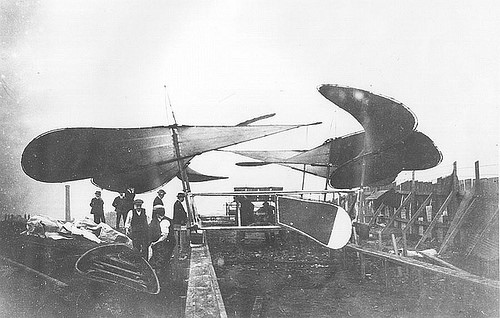
Mumford 1913 Aerodrome

In Glasgow, construction on Mumford’s second helicopter was started in 1913.

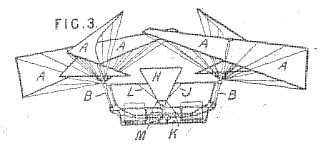
The patented Mumford machine was originally identified as the Mumford Aerodrome in a 1909 article published in “The Aero”, Vol. 1, No. 1.

The crew consisted of one pilot, no passengers.

The invention of Mumford was patented in Great Britain as improvements in or connected with Aerodromes or Flying Machines. In the USA a patent was also acquired by Mumford; Improvements in or connected with Aerodromes or Flying Machines.in France there were equivalent patents Aéroplanes ou machines volantes and Machines volantes.

Mumford 1908 Helicopter

In Glasgow, Mumford’s first machine was started in 1908, and after a rather long and active life for an early flying machine, was wrecked in 1912. In that time, it went through a number of improvements and alterations, as various flaws with the design were attended to. Construction on the second helicopter was started in 1913.

Muller Kites (Canada) Marauder

The Marauder combines high performance with good parachuting characteristics. Drag has been reduced by a deep scalloped trailing edge. The lifting gsurface along the leading edge has been increased by a floating batten four feet from the wingtip. A deflector blade and leading edge cables are standard equipment.

The airframe is made frm 6061-T6 1 5/8in x .058 clear anodised tubing. Spars are precision drilled with solid aluminium dowling. All spars are one piece construction, except the crossbr, which is in two pieces.

The rigging cable is 3/32in 7×7 vinyl coated stainless steel with all cable ends double nico pressed. Tangs, contro bar box and fingpost bracket are stainless steel. Nuts, bolts, turnbuckles and shackles are aircraft quality.

The sail is Howe & Bainbridge 3.8oz stabilised dacron. All seams are double zig-zag stitched with four stitches at the leading edge pockets. It was available in 11 colours.

A seated harness with full height adjustment of 3/8in poly rope with back support and speader bar was standard with an optional prone harness with full adjustment.

Leading edge: 20 ft
Keel length: 18 ft
Wing span: 32 ft
Wing area: 222 sq,ft
Aspect ratio: 4.6
Nose angle: 106˚
Sail billow: 2˚
Weight: 46 lb
Pilot weight: 120-200 lb
Takeoff speed: 12 mph
Stall speed: 13 mph
Max speed: 48 mph
Best glide ratio (L/D): 6-1
Best L/D speed: 24 mph
Min sink: 320 fpm

Muller Kites (Canada) Standard

The Muller Standard is suitable for beginners being stable, with easy takeoff and good stall characteristics.

The airframe was made from 6061-T6 1 5/8in x .058 clear anodised tubing. The spars were precision drilled with solid aluminium interior dowling. All spars were one piece construction. A deflector blade and leading edge cables were optional.

Cables were 3/32in 7×7 vinyl-coated stainless steel with all cable ends double nico pressed. Tangs, control bar box and kingpost bracket are stainless steel. Nuts, bolts, turnbuckles and shackles are aircraft quality. The Standard was fitted with a seated harness with full height adjustment of 3/8 poly rope with back support and spreader bar. An optional prone harness had full adjustment.

16×16
Leading edge: 16 ft
Keel length: 16 ft
Wing span: 22 ft
Wing area: 180 sq,ft
Aspect ratio: 2.75
Nose angle: 86˚
Sail billow: 3.5˚
Weight: 34 lb
Pilot weight: 80-110 lb
Takeoff speed: 12 mph
Stall speed: 16 mph
Max speed: 40 mph
Best glide ratio (L/D): 4-1
Best L/D speed: 25 mph
Min sink: 480 fpm
18×17
Leading edge: 18 ft
Keel length: 17 ft
Wing span: 24 ft
Wing area: 210 sq,ft
Aspect ratio: 2.75
Nose angle: 86˚
Sail billow: 3.5˚
Weight: 37 lb
Pilot weight: 110-160 lb
Takeoff speed: 12 mph
Stall speed: 16 mph
Max speed: 40 mph
Best glide ratio (L/D): 4-1
Best L/D speed: 25 mph
Min sink: 480 fpm

20×18
Leading edge: 20 ft
Keel length: 18 ft
Wing span: 27 ft
Wing area: 245 sq,ft
Aspect ratio: 2.97
Nose angle: 86˚
Sail billow: 2.5˚
Weight: 40 lb
Pilot weight: 140-200 lb
Takeoff speed: 12 mph
Stall speed: 16 mph
Max speed: 40 mph
Best glide ratio (L/D): 4-1
Best L/D speed: 25 mph
Min sink: 480 fpm

Muller

Boots und Flugzeugbau Gebr Muller
Germany
Brothers Jacob and Philipp Muller formed Boots und Flugzeugbau Gebr Muller at Darmstadt in 1908, manufacturing parts for Voisin aircraft being built under license by August Euler. After First World War developed several light aircraft, including GMG V two-seat cabin monoplane with Argus As.16 or BMW Xa engine.

Müller, Jacques V.

Jacques V. Müller was born in Luxembourg in 1881 and emigrated to the USA in 1900 to join his sister, who ran a farm there. He settled in Salina, Kansas, where he experimented with balloons and from 1909 reportedly built four airplanes. In 1914 he returned to Luxembourg, where he started a mine and a pigment factory.