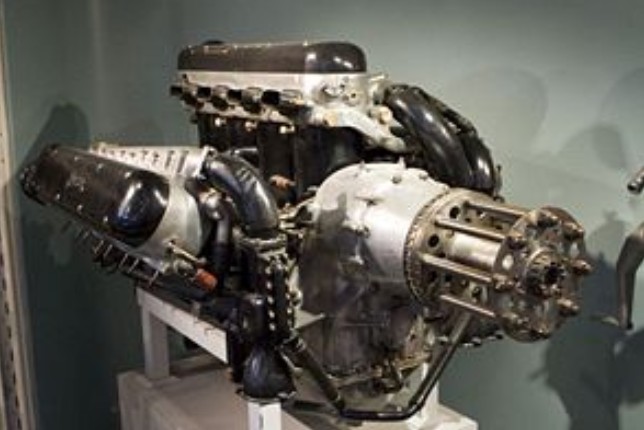
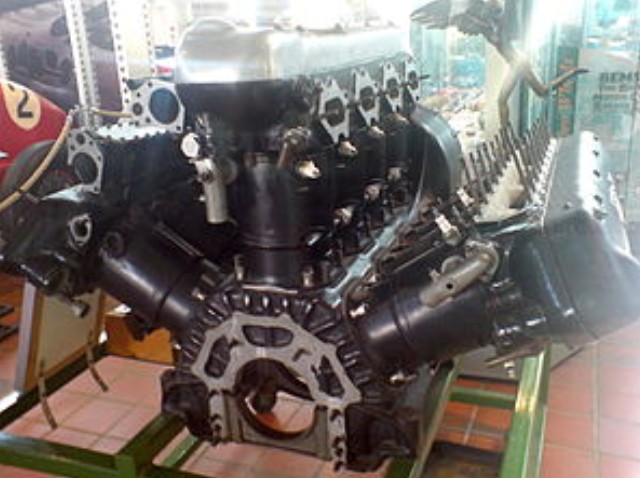
Early in the First World War Napier were contracted to build aero engines to designs from other companies: initially a Royal Aircraft Factory model and then Sunbeams. Both proved to be rather unreliable, and in 1916 Napier decided to design their own instead. Reasoning that the key design criteria were high power, light weight, and low frontal area, the engine was laid out with its 12 cylinders in what they called a “broad arrow”—three banks of four cylinders sharing a common crankcase. This suggested the design’s first name, the Triple-Four. These designs are sometimes referred to as a W-block, although that designation applies more correctly to an engine in which a common crankcase is shared by not merely three but in fact four rows of cylinders (since a “W” is made of four lines or bars). The engine was also advanced in form, the heads using four valves per cylinder with twin overhead camshafts on each bank of cylinders and a single block being milled from aluminium instead of the more common separate-cylinder steel construction used on almost all other designs.
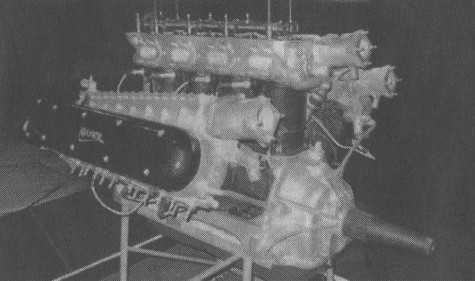
Under A. J. Rowledge, the design of the newly renamed Lion was completed in 1917, and the first hand-built prototypes ran later that year. It was fitted to a de Havilland built DH.9 in early 1918, proving to have many cooling problems. In addition the milled block turned out to be difficult to build with any accuracy and they reverted to separate cylinders, although they remained aluminium. Both of these problems were worked out by the middle of the year and the engine entered production in June 1918. The first Lion I versions delivered 450 hp (335 kW) from their 24 litres. As the most powerful engine available (particularly after a turbocharger became an option in 1922), the Lion went on to be a huge commercial success. Through the years between the wars Napier manufactured little else. Between the wars it powered over 160 different types of aircraft.
In highly-tuned racing versions the engine could reach 1,300 hp (970 kW), and it was used to break many world records: height, air speed, and distance in aircraft, boats, delivering 1,375 hp (1,025 kW) in a highly tuned Lion for a water speed record of 100 mph (160 km/h) in 1933. In land speed records, Lion engines powered many of Sir Malcolm Campbell’s record breakers including a record of over 250 mph (400 km/h) in 1932 and John Cobb’s 394 mph (634 km/h) Railton Mobil Special in 1947 – a record that came well after the Lion had passed its prime and stood until the 1960s. The record had been held by British drivers for 32 years. Lions powered successful entrants in air racing, the Schneider Cup, in 1922 and 1927, but were then dropped by Supermarine in favour of a new engine from Rolls-Royce, the Rolls-Royce R which had been especially designed for racing. It was a Lion that powered the Supermarine S5 that won the 1927 Schneider Trophy for seaplane speed racing.
It was still being fitted to planes in 1929 and it was still being put into boats in 1933.
During the 1930s a new generation of much larger and more powerful engines started to appear, and the Lion was clearly past its prime. Gradually, they fell further and further behind. By the time the Bristol Hercules and the Rolls-Royce Merlin arrived in the late 1930s, the Lion was too small and old-fashioned.
A marine version of the Lion, unsurprisingly called the Sea Lion, was used to power high speed air-sea rescue launches operated by the RAF.
Another adaptation for the Lion aero engine was propeller-driven motor sleighs, which were used for high-speed transport and SAR duties on sea ice by the Finnish Air Force and Navy.
Lion models:
Lion I
1918
450 bhp (340 kW) at 1,950 rpm
geared, also related IA and 1AY
Lion II
1919
Works No: E64
450 bhp (340 kW) at 2,000 rpm
Lion IIII
experimental geared
Gloster Gorcock
Lion V
470 bhp (350 kW) at 2,000 rpm
500 bhp (370 kW) at 2,250 rpm
VA had increased CR to 5.8
Mainstay engine of the RAF in the late 1920s, replaced by Lion XI
Lion VS
Works No: E79
Turbocharged, intercooled
Lion VIS
1927
Turbocharged
Application: Gloster Guan
Lion VII
1925
700 bhp (520 kW) (racing)
Application: Gloster III (Schneider Trophy entrant)
Supermarine S.4
Lion VIIA
1927
Works No: E86
900 bhp (670 kW) (racing)
Application: Golden Arrow
Blue Bird (1927)
Miss England I
Supermarine S.5
Gloster IV
Lion VIIB
1927
875 bhp (652 kW) (racing)
geared
Application: Supermarine S.5
Gloster IV
Lion VIID
1929
Works No: E91
1,350 bhp (1,010 kW) at 3,600 rpm (racing)
Supercharged, about 6-8 built
Application: Blue Bird (1931)
Fred H Stewarts Enterprise
Betty Carstairss Estelle V powerboat
Miss Britain III
Gloster VI (Schneider Trophy entrant)
Railton Special (John Cobb’s land speed record car)
Lion VIII
1927
direct drive
Gloster Gorcock
Lion XIA
1928
580 bhp (430 kW) at 2,585 rpm, 6:1 CR
RAF production model
Application: Napier-Railton
Lioness
Works No: E71
Inverted layout, for better visibility. At least some were built turbocharged, for racing.
Sea Lion
1933
500 and 600 bhp (370 and 450 kW)
Marine version of Lion XI
British Power Boat Company Type Two 63 ft HSL
Applications:
Aircraft
Alliance P.2 Seabird
Avro Bison
Blackburn Blackburn
Blackburn Dart
Blackburn Pellet
Blackburn Ripon
Blackburn Velos
Boulton Paul Atlantic
Boulton Paul Bodmin
Boulton Paul Bolton
English Electric Kingston flying boat (prototype)
Fairey III
Fairey Fawn
Fokker C.IV-W
Fokker C.V
Fokker D.C.I
Fokker D.XIII
Gloster Gorcock
Gloster Guan
Handley Page H.P.31 Harrow
Handley Page Hyderabad
Mitsubishi B1M
Parnall Pike
Parnall Possum
Parnall Puffin
Supermarine S.4
Supermarine S.5
Supermarine Seagull
Supermarine Southampton
Tarrant Tabor
Vickers Vernon
Vickers Valparaiso
Vickers Victoria
Vickers Virginia
Vickers Vixen
Westland Walrus
Other applications
British Power Boat Company Type Two 63 ft HSL
British Power Boat Company 60 ft 4 in
Specifications:
Lion II
Type: 12-cylinder water-cooled W-block (3 banks of 4 cylinders) aircraft piston engine
Bore: 5.5 in (139.7 mm)
Stroke: 5.125 in (130.17 mm)
Displacement: 1,461.6 cu.in (23.9 L)
Length: 57.5 in (1460 mm)
Width: 42.0 in (1067 mm)
Height: 43.5 in (1105 mm)
Dry weight: 960 lb (435 kg)
Valvetrain: Two intake and two exhaust valves per cylinder actuated via double overhead camshafts per cylinder block.
Cooling system: Water-cooled
Power output: 480 hp (358 kW) at 2,200 rpm at 5,000 ft
Specific power: 0.32 hp/cu.in (15.0 kW/L)
Compression ratio: 5.8:1
Power-to-weight ratio: 0.5 hp/lb (0.82 kW/kg)