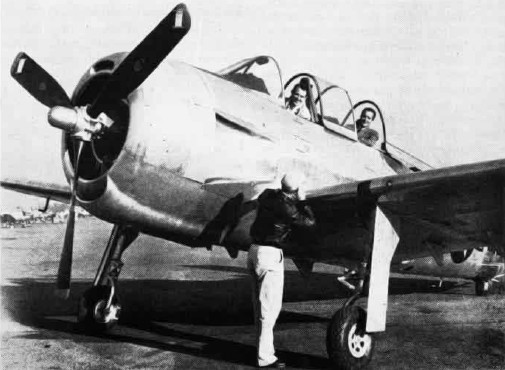
The North American XSN2J-1, also known by the company designation NA-142, was developed for the United States Navy by North American Aviation as a replacement for the SNJ Texan as an advanced scout-trainer.
Designed in competition with the Fairchild XNQ, the XSN2J-1 first flew on 15 February 1947, two aircraft being evaluated by the Navy (121449 and 121450) as XSN2J-1. Neither aircraft were considered satisfactory in evaluations; in addition, restrictions on the Navy’s budget meant that the aircraft could not be ordered at the time, and the program was cancelled in 1948.
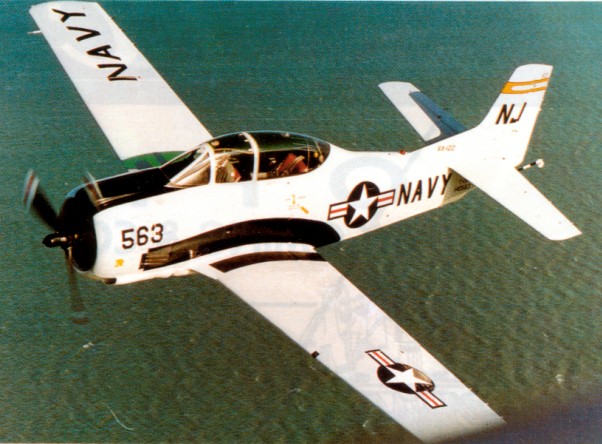
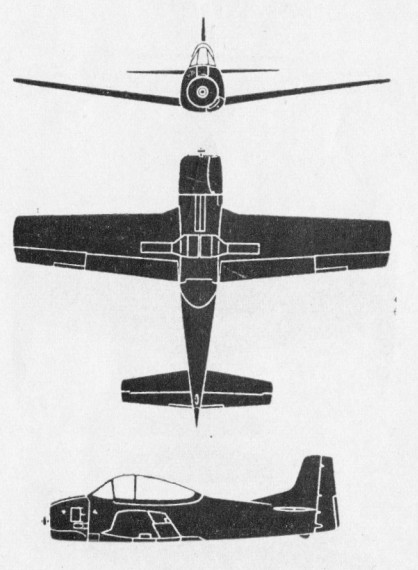
The similar T-28 Trojan would later be ordered to fill the Navy’s requirement for a new trainer.
Clambered over an SN2J in the junk pile behind Service Test at NAS Patuxent, MD in late ’49. Nice looking bird. John W. Bradford, Jr.
Engine: 1 × Wright R-1820-78 Cyclone, 1,100 hp (820 kW) Propeller: 3-bladed Wingspan: 41 ft (12 m) Wing area: 236 sq ft (21.9 sq.m) Length: 32 ft (9.8 m) Empty weight: 5,500 lb (2,495 kg) Gross weight: 7,500 lb (3,402 kg) Maximum speed: 270 mph (435 km/h; 235 kn) Cruise speed: 190 mph (306 km/h; 165 kn) Range: 1,600 mi (1,390 nmi; 2,575 km) Service ceiling: 30,000 ft (9,100 m) service Crew: Two (student and instructor)
Raven forward air controllers pose for a group photo in front of a T-28 in Long Tieng in 1970. This was after they were referred to as acting ‘like Mexican bandits’.
T-28B Trojan VH-NAW ex-USN BuAer 138278 – Australia’s first T-28
During and immediately following WWII, NAA developed the next generation, high performance, advanced trainer to serve as a successor to the NAA T-6/SNJ Texan. The result was the T-28 Trojan series.
First flown on 26 September 1949 as the XT 28A, the Trojan was put into production as the T-28A two-seat basic trainer for the USAF. Power was provided by a 596kW Wright R-1300-1 radial engine. 1,194 “A” models were built with the Aero Product 2-blade propeller. The Air Force used these aircraft for training and various other roles from 1950 to 1956. The “A” model also replaced the Mustang fighters in the reserve units until 1959.
Ordered into production by the USAF in 1950 as the T-28A, the US Navy evaluated the T 28A in 1952 and decided that the Wright Cyclone R1300, with 800 hp and a two bladed propellor left the aircraft under-powered for carrier operations.
In 1952, the Navy contracted with NAA to build 489 T 28Bs, an improved version. The T-28B was the initial US Navy version fitted with a 1425 hp / 1,062kW Wright R-1820-86 engine, Hamilton Standard 3-blade propeller, belly mounted speed brake, and a two-piece sliding canopy (as fitted to late production T-28A). 489 “B” models were built and used from the middle 50’s to the middle 80’s.
T-28B
The T-28C was built for the Navy starting in 1955. The T-28C is equipped with a tail hook, a smaller diameter propeller, and other minor changes to allow aircraft carrier landings. 299 “C” models were manufactured with production ending in 1957.
In 1958 many T-28As were declared surplus and North American designed a modification scheme to convert the into two-seat utility aircraft, under the name Nomad. The main change involved replacing the original 800 hp Wright R-1300 engine with the more powerful R-1820. Supplementary modifications were drawn up to convert the Nomad into a military light strike-reconnaissance aircraft.
In 1959, several hundred surplus “A” models were shipped to France and were modified with the 1,062kW R-1820-56S engine, structural improvements, and armament for combat use, by Sud Aviation for the French Air Force. Sud-Aviation were given a contract for 135 conversions of ex-USAF T-28As under licence to PacAero, who had taken over the Nomad conversion programme from North American. These aircraft are commonly referred as Fennec, T-28S (Sud), or T-28F. After success in combat in Algeria in the early sixties, they continued to serve France and several other countries for many years.
Sud-Aviation Fennec
Similar to the FENNEC but converted by various contractors in the U.S., the T-28D-5 also started as a surplus “A” model. Almost 250 “D” models were supplied to U.S. and other forces fighting in Southeast Asia. Additionally, “B” & “C” models, known as the T-28D-10, were also modified and used in combat.
During the early 1960s the United States Tactical Air Command (TAC) was directed to develop a counter-insurgency (COIN) force tailored to train friendly air forces to fight in limited wars against guerrilla forces. As a result of this directive TAC began evaluating existing aircraft types to find an available and inexpensive aircraft that could be modified for use as a COIN aircraft.
This decision resulted in the T-28D which was basically a rebuilt T-28A with a more powerful engine, six underwing hardpoints, and strengthened wings. The T-28D was powered by a 1425hp Wright Cyclone R-1820-56S nine cylinder air cooled radial engine, driving a three blade Hamilton Standard propeller. To allow the T-28D to perform in its intended role of tactical fighter-bomber, the wings were strengthened to enable the aircraft to carry a variety of under wing stores up to 4,000 pounds.
Between early 1961 to late 1969, North America received a total of thirteen production contracts covering conversion of a total of 321 T-28As to the AT-28D configuration.
By December 1963 the USAF had converted 700 T-28B’s to counter-insurgency roles.
The first T-28Ds to see action were assigned to the 4400 Combat Crew Training Squadron (CCTS). In October 1961 President Kennedy authorised deployment of a detachment from the 4400 CCTS to Vietnam under the code name Farm Gate. The detachment was to train South Vietnamese pilots in the T-28 and was authorised to fly combat missions, providing there was a South Vietnamese national in the rear cockpit.
The South Vietnamese Air Force (VNAF) found the T-28D to be well suited to their needs. The short field performance and ease of maintenance made the Trojan ideally suited for forward basing in small detachments, allowing a rapid response to enemy activities. The T-28D served with the VNAF until the increasing anti-aircraft capabilities of the Viet Cong made it necessary to replace the Trojan with a more powerful and faster fighter bomber.
Despite modifications to strengthen wings to carry up to 4000 lb bombload, at least three T-28 crashes in strikes against Viet Cong may have resulted from structural failure. This contributed to T-28 withdrawals from Vietnam.
After its withdrawal from combat in Vietnam during 1964, T-28Ds continued to serve with the USAF in Thailand until 1972. T-28Ds were assigned to the 60th Special Operations Squadron (SOS), 56th Special Operations Wing in the fighter-bomber role flying missions over Laos and Cambodia. T-28Ds were also supplied to the air forces of Thailand, Cambodia and Laos.
The T-28D proved itself in combat to be an excellent gun and bomb platform, and was able to withstand a surprising amount of battle damage. The Trojan was well liked equally by its pilots and hard working ground crews. As in all previous T-28s, maintenance crews appreciated the fact that the T-28 was rugged, easy to maintain and required very few maintenance hours per flight hour.
In 1964 William Driver of Piqua, O., claimed an altitude jump record for spot parachutists by leaving a T-28 at 33,400 ft, landing 18 ft from his target on Boulder Airport.
Many T 28Ds were operated in the Congo and Vietnam, and have equipped the Thai Air Force, with the French as the Fennec as well as with the Argentine Navy. T 28Ds served with the air forces of Bolivia, Ethiopia, Kampuchea, South Korea, Laos, Taiwan, Thailand, the United States and Zaire.
In civilian use, the T-28 continues to gain in popularity. It looks, sounds, and performs comparable to a WWII fighter at a fraction of the cost. With its two roomy cockpits, tricycle landing gear, huge flaps, and superb flying characteristics, general aviation pilots can learn how to operate this aircraft. In addition, maintenance and parts availability remains reasonable with plenty of technical support available.
With 2,450 hp Lycoming T55 turboprop, underwing attachments for 4,000 lb. of weapons, and a long range fuel tank in place of the rear crew member’s position, the YAT 28E was a conversion of the T 28 piston engined basic trainer.
In 1958 North American modified one T-28, as NA-260 Nomad, to a general-purpose prototype plane. Pacific Airmotive Corp converted surplus North American T-28 to the general-purpose Nomad in 1958.
NAA T-28A Engine: Wright R-1300-1, 7-cylinder radial, 800 hp Propeller: Aero Products 10′ 2-blade, constant speed Wing Span: 40′ 1″ (12.23 m) Length: 32 ft (9.76 m) Height: 12′ 8″ Wing area: 269.1 sq.ft / 25.0 sq.m Empty, 5,111 lb (2318 kg) Loaded weight, 7,463 lb (3642 kg) Fuel capacity: 125 USgallon G Loading: +4.5, -2 Normal cruise: 180 mph at 35 USgph Max speed, 285 mph (458 kph) at 5,800 ft (1768 m) Service ceiling: 36089 ft / 11000 m Initial climb, 2,030 fpm (10.3 m/sec) Range: 1,055 mls (1698 km) Controls: Dual
T-28B Engine: Wright Cyclone R-1820-¬86, 9-cylinder radial, 1425 hp / 1063kW Propeller: Hamilton Standard Hydromatic 3-blade, constant speed Wing Span: 40 ft 8 in (12.4m) Length: 32′ 9″ Height: 12′ 7″ Wing area: 24.90 sq.m / 268.02 sq ft Empty weight: 2914 kg / 6424 lb Normal Gross Weight: 8600 lbs. G Loading: +4.5, -2 Controls: Dual Max. speed: 552 km/h / 343 mph Ceiling: 10820 m / 35500 ft Range: 1706 km / 1060 miles Normal cruise: 235 mph at 50 Usgph Fuel capacity: 177 USgallon Endurance: 3 hr w/res Rate of climb: 3000+ fpm Crew: 2
T 28C Engine: Wright Cyclone R-1820, 9-cylinder radial, 1425 hp Propeller: Hamilton Standard Hydromatic 3-blade, constant speed Wing Span: 40 ft 8 in (12.4m) Length: 32′ 9″ Height: 12′ 7″ Normal Gross Weight: 8600 lbs. Empty weight: 6400 lb G Loading: +4.5, -2 Controls: Dual Normal cruise: 235 mph at 50 Usgph Fuel capacity: 177 USgallon Endurance: 3 hr w/res Rate of climb: 4,200 fpm Ceiling: 35,000 ft Maximum speed: 343 mph Range: 1060 miles Stall speed: 67 kts Hard points: 6
T-28D Trojan Engine: Wright R-1820-86A Cyclone 1,425hp Propeller: Hamilton Standard Hydromatic three blade constant speed Fuel: Aviation Gasoline 100 Octane Wingspan: 40′ 1″ / 12.19 m Length: 32′ 10″ / 10.0 m Wing Area: 271.2 sq. ft / 25.19 sq. m Height: 12′ 8″ / 3.86 m Empty weight: 6,251 lbs / 2.811 kg Normal Gross Weight: 8600 lbs. Armament: Up to 4,000lb (1,813kg) of external stores including gun pods Maximum Speed: 340 knots / 391 mph / 629 km/h Cruise Speed: 200 knots / 230 mph / 370 km/h BAS G Loading: +4.5, -2 Controls: Dual Normal cruise: 235 mph at 50 Usgph Fuel capacity: 177 USgallon Endurance: 3 hr w/res Rate of climb: 3000+ fpm Armament: 2 x 0.5in mg Hardpoints, wing: 6
Fennec Engine: Wright Cyclone R-1820, 9-cylinder radial, 1425 hp Propeller: Hamilton Standard Hydromatic 3-blade, constant speed Wing Span: 40 ft 8 in (12.4m) Length: 32′ 9″ Height: 12′ 7″ Wing area: 271 sq.ft Empty weight: 6615 lb Normal Gross Weight: 8600 lb MTOW: 9370 lb Fuel capacity: 177 USgallon Max speed: 340 mph at 18,000 ft Normal cruise: 235 mph at 50 USgph at 15,000 ft Endurance: 3 hr w/res Service ceiling: 36,480 ft Rate of climb: 3000+ fpmI Max range: 1180 mi Hardpoints: 2 Bombload: 4 x 300 lb G Loading: +4.5, -2 Controls: Dual
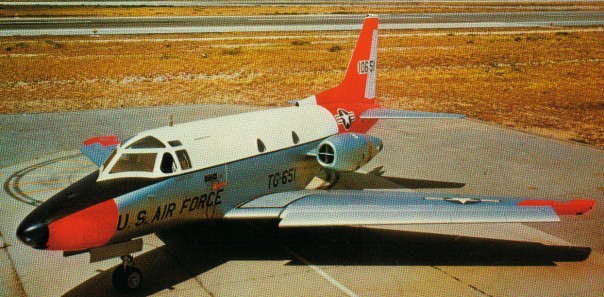
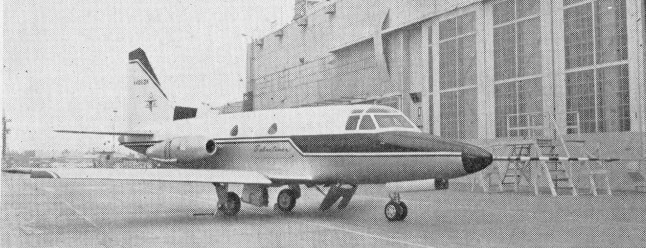
The NA-246 Sabreliner started its life as a private venture in the mid 1950s to meet the USAF’s UTX requirements for a combat readiness trainer and utility aircraft. Announced on 27 August 1956, It was laid out with a six-seat interior and to be flown by a two-man crew, the civil-registered prototype was completed in May 1958, although the lack of suitable engines delayed the first flight, which took place at Los Angeles, until 16 September, under the designation T 39. The initial powerplant comprised two 1134kg thrust General Electric YJ85 turbojets and, thus powered, the prototype completed its military evaluation programme at Edwards Air Force Base in December 1958.
In October 1958 the Sabreliner won its first order, for seven NA-265 or T-39A aircraft with 1361kg thrust Pratt & Whitney J60 engines. Production of the highly successful T 39 series commenced in 1958, and 213 were purchased by the Air Force and the Navy. All military models of the T-39 series were certificated to civil airworthiness standards, beginning with the T-39A on 23 March 1962.
The commercial version of the T 39, known as the NA-265-40 Sabreliner / Sabre 40, was type certificated on 17 April 1963 and was one of the first jets available to business aviation. It is larger and more rugged and powerful than jets that have been designed solely for civilian use. Its speed by jet standards is modest with a cruise of 489 knots. The aircraft maintained its popularity throughout the 1960s and 1970s as improvements were made to the airframe and powerplants.
In 1965 North American increased the Sabreliner’s gross weight by beefing up landing gear and re-qualifying wheels. The modification allows the twin-jet to carry full fuel with nine people and baggage aboard totalling 18,650 lb. The previous max was 17,760 lb. Changes were offered free to Sabreliner owners.
One of the unusual features that the Sabreliner was automatic leading edge slats. The slats added impressive low speed handling qualities to the bizjet.
Gone are the slats, however, from a Sabreliner 60. The stretched Sabre 60, introduced in 1969, is powered by two 3,300 pound thrust P&W JT12A 8 turbojets, the same engine that was used in the Dash 8 JetStar.
The Rockwell Sabreliner 65 is essentially a fanjet, supercritical wing version of the Sabre 60. Its engines are Garrett AiResearch TFE 731-3s, which the factory may also retrofit to Model 60s and the even earlier Sabre 40s. Its IFR range was just under 2,500 nautical miles. The first production lot of Sabre 65s was sold at an average equipped price of $3,250,000.
Both the 74 and 60 models were fitted with thrust reversers to aid in shorter landings and assist in braking on icy or wet runways.
75A
The Sabre 75A, with its expanded cabin height and higher gross weight, uses two General Elec¬tric CF700 2D2 turbofans identical to the 4,315 pound thrust powerplants employed on the Falcon 20. The 75A model features square windows, a ‘stand-up’ cabin and a long span tailplane.
In 1978 Rockwell International’s Sabreliner 80A made a first flight from St. Louis. The new business jet is a modified version of the Model 75A, with a supercritical wing.
Civil production of all models, including the final model, the Sabreliner 65A, totalled well over 600 aircraft when the last aircraft came off the line in 1981.
Rockewell International’s Sabreliner Division was acquired in 1983 by the specially formed Sabreliner Corporation of St Louis, Missouri to continue product support. Type Certificate A2WE was reissued to Saberliner Corp in 1983 to cover active Model 265s. At the end of 1990 the company completed the design of a new version of the Sabreliner designated the Model 85. This has a supercritical wing incorporating winglets, a fuselage stretch of 1.5m, and more powerful TFE731-5 turbofan engines, but further development would require a risk-sharing partner.
NA-246 Sabreliner / T-39 Engines: 2 x General Electric YJ85 turbojets 1134kg thrust
T-39 Engines: 2 x P&W Wing span: 44 ft 5 in (13.54 m) Length: 43 ft 9 in (13.34 m) Height: 16 ft 0 in (4.88 m) Max TO wt: 17,760 lb (8055 kg) Max level speed: 595 mph (958 kph)
NA 265-65 Sabreliner 65 Engines: 2 x Garrett TFE 731-3R-1D, 3700 lbs / 1678kg thrust Seats: 10 Length: 14.30 m / 46 ft 11 in Height: 4.88 m / 16 ft Wingspan: 15.37 m / 50.5 ft Wing area: 380 sq.ft Wing aspect ratio: 6.7 Maximum ramp weight: 24,000 lbs Maximum takeoff weight: 10886 kg / 24,000 lbs Standard empty weight: 13,350 lbs Maximum useful load: 10,650 lbs Zero-fuel weight: 16,250 lbs Maximum landing weight: 21,755 lbs Wing loading: 63.2 lbs/sq.ft Power loading: 3.2 lbs/lb Maximum usable fuel: 8644 lbs Best rate of climb: 3540 fpm Certificated ceiling: 13715 m / 45,000 ft Max pressurisation differential: 8.8 psi 8000 ft cabin alt @: 45,000 ft Maximum single-engine rate of climb: 950 fpm @ 127 kts Single-engine climb gradient: 452 ft/nm Single-engine ceiling: 25,000 ft Maximum speed: 513 kts Normal cruise @ 43,000ft: 430 kts Fuel flow @ normal cruise: 1090 pph Stalling speed clean: 117 kts Stalling speed gear/flaps down: 81 kts Turbulent-air penetration speed: 225 kts
Sabreliner 65A
Sabreliner 75A Engines: 2 x General Elec¬tric CF700-2D2, 4315 lb Seats: 8/10 Wing loading: 68.11 lb/sq.ft Pwr loading: 2.53 lb/lb Max TO wt: 22,800 lb Operating wt: 13,600 lb Equipped useful load: 9200 lb Payload max fuel: 1820 lb Zero fuel wt: 15,620 lb Range max fuel/cruise: 1985 nm/4.0 hr Range max fuel / range: 1897 nm/ 4.6 hr Service ceiling: 45,000 ft Max cruise: 489 kt Max range cruise: 417 kt Vmc: 92 kt Stall: 105-113 kt 1.3 Vso: 137 kt ROC: 4500 fpm SE ROC: 1050 fpm @ 190 kt SE Service ceiling: 24,000 ft Cabin press: 8.8 psi Fuel cap: 7380 lb Takeoff run (balanced) 4,420 ft Landing roll 2,525 ft
Developed to USAF General Operational Requirement 38 for an intercontinental bomber to replace the Boeing B-52.
At one time the order was cut back to a single prototype containing no military equipment. In 1960 the US Government decided to order 12 fully operational B-70s. In March 1961, the contract awarded on 4 October 1961 was again cut back to three aeroplanes, intended mainly for research, although the third was later cancelled.
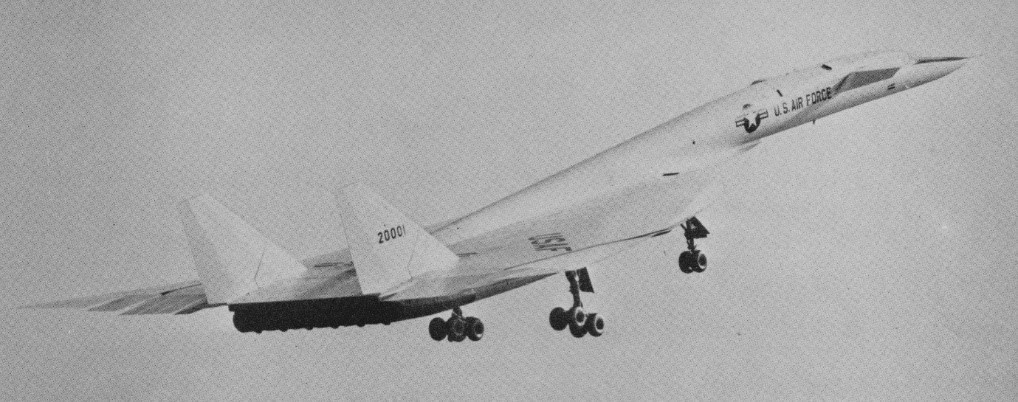
The North American XB-70 Valkyrie first flew in prototype form on 21 September 1964. When the first prototype flew it was simultaneously the longest (56.4 m/185 ft), fastest (Mach 3+), most powerful and costliest aircraft ever built, US$2000 million, and weighing 305 tonne (300 ton). Piloted by North American test pilot Alvin S. White and USAF Col. Joseph F. Cotton the first take-off took a 5000 ft ground roll and 30 seconds to get airborne. During the 65 min flight from Palmdale to Edwards Air Force Base the main wheels failed to retract and number three J93 GE engine over-revved. The aircraft flew to 16,000 ft and 375 mph. Locked rear wheels on the left main gear ground themselves down to metal on touch-down.
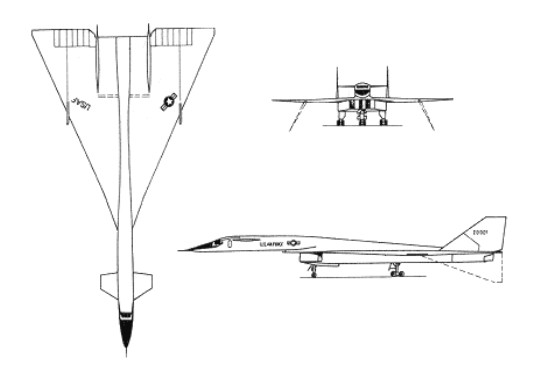
A delta-winged canard design, the airframe made extensive use of contemporary ‘exotic’ alloys to overcome the problems associated with kinetic heating. The wings were swept back at 65 degrees 34 minutes on the leading edge, and were covered with brazed stainless steel honeycomb panels welded together to produce an extremely strong yet heat-resistant whole. Similar construction was used for the huge rectangular moveable engine duct under the centreline, the twin vertical tail surfaces (30 ft high) and part of the fuselage. The advanced aerodynamics of this elegant yet menacing warplane were based on a large delta wing from whose centre grew a slim forward fuselage complete with canard foreplanes.
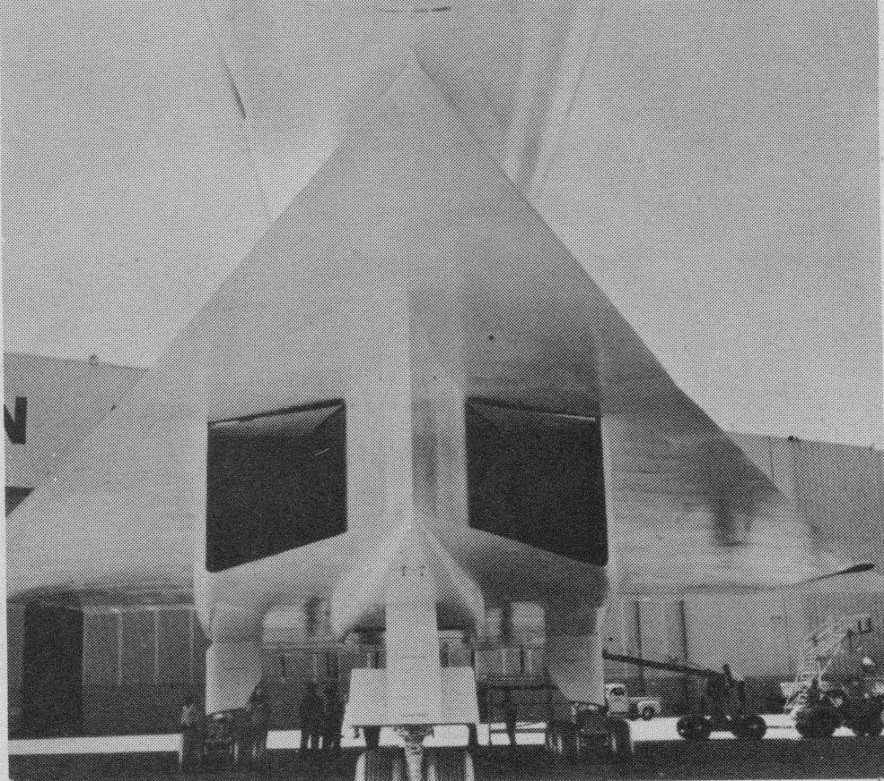
The powerplant comprised six 31,000-lb (14.062-kg) thrust General Electric YJ93-GE-3 afterburning turbojets in a 30 ft long ducted arrangement under virtually the full chord of the delta wing. To slow entering airstream from Mach 3 to less than Mach 1 the designers created a series of shock patterns which employ the vertical splitter, then additional breaks within the splitter duct. Finally hydraulically operated panels vary final throat area to meet varying conditions.
The wings outer portions were arranged to hinge downward in flight under hydraulic power to improve stability and maneuverability. An anhedral angle of 25 degrees was used for low-altitude supersonic flight, increasing to 65 degrees for high-altitude flight at Mach 3. Six power hinge actuators on each lower outer surfaces during high speed flight. Each hinge has hundreds of closely meshed gears of hard H-11 steel.
Control was provided by a combination of flaps on the canard foreplanes, no fewer than 12 wide-chord elevons across much of the trailing edge of the wings outboard of the variable-geometry engine exhausts, and large rudders on each of the vertical surfaces. The canard slab surfaces provide trim control while keeping drag low, their rear section deflecting down as flaps. Control of so complex an aerodynamic platform moving at high supersonic speeds was effected with the aid of a three-axis stability-augmentation system.
The landing gear consists of 2 tons of wheels, tires and brakes. A brake control device employs a fifth wheel on the main gear, comparing the amount of slippage between braked wheels and the fifth wheel with coefficient of friction between tires and runway surface, predicts skid point, and automatically regulates
The windshield moves along with a variable-position nose ramp. During subsonic operation the forward edge of the windshield can be lowered for better visibility. Dark spots above the cockpit area and on the canard surfaces are crane lift points.
The first prototype was flown by Alvin S. White and Colonel Joseph F. Cotton on 21 September 1964. The take-off from Palmdale runway required 5000 ft and less than 30 sec roll. During the flight the undercarriage failed to retract, one of the six engines failed, and a brake locked which burned out half of the left main gear supports. The flight was held to a maximum of 375 mph and 16,000 ft for the flight of just over one hour.
The first flight had been so long postponed and the entire project downgraded to only two prototypes. By the flight, the first US had spent $1.34 billion on its development. $92 million was then allocated to see the two prototypes through the flight program. Both XB-70’s were programmed for a 180 hr flight test schedule, including experiments for NASA. It first achieved its design speed of Mach 3 on 14 October 1965.
NASA’s Flight Research Center spent $2,000,000 on instrumentation on the No.1 aircraft. Areas of study included flutter of skin panels and internal noise levels; heating of structures in such areas as windshield, fuel tanks and crew compartment.
The improved second prototype flew on 17 July 1965, but was lost in a mid-air collision on 8 June 1966. The surviving aircraft carried out a number of test programmes, including work in connection with the US supersonic transport programme, but on 4 February 1969 it was flown to retirement at the US Air Force Museum, Wright Patterson AFB, Dayton, Ohio.
Even before the first prototype flew, however, technological developments in air defence had made the XB-70 obsolete. In 1963 the U.S. government ended the XB 70 development programme and turned the prototypes over for research purposes although one of the XB 70s was lost on 8 June 1966. The surviving XB 70 is now a museum piece.
Engines: 6 x General Electric YJ93-GE-3 afterburning turbojets, 31,000-lb (14.062-kg) Wing span: 105 ft 0 in (32 m) Length: 196 ft 0 in (59.74 m) Max TO wt: 530,000 lb (240,400 kg) Max level speed: M3 / 3218 km/h / 2000 mph Height: 9.1 m / 29 ft 10 in Wing area: 565.0 sq.m / 6081.60 sq ft Ceiling: 21336 m / 70000 ft Range w/max.fuel: 12000 km / 7457 miles Crew: 2