Northrop Gamma 2 / UC-100

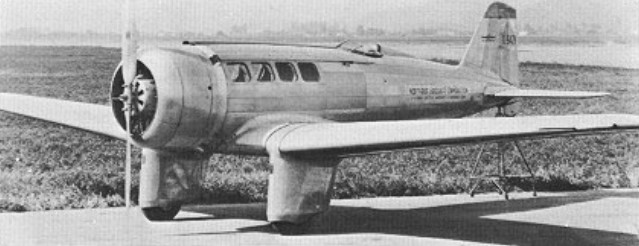
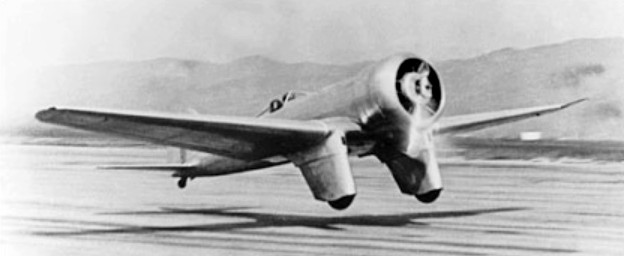
In January 1932 John Northrop and Donald Douglas formed the Northrop Corporation and the first aircraft from the new corporation was the Northrop Gamma, several of which were built to special order for record-breaking flights and research work. The first two aircraft, a Gamma 2A and a Gamma 2B, were powered respectively by a 585kW Wright and 373kW Pratt & Whitney Wasp radial. Both were delivered at the end of 1932, the first to Texaco who loaned it to Frank Hawks for record-breaking flights.

Gamma NR12265 was built for Lieutenant Commander Frank Hawks of the Texas Company, as a long-range, high speed mail transport in 14/2/33. Named Texaco Sky Chief, it was flown out to the Antarctic via South America to assist with the search for Lincoln Ellsworth when he and pilot Herbert Hollick-Kenyon were declared missing in late 1935. Later sold to “Gar’ Wood and renamed Kinjockety II, it exploded in midair during the 1936 Bendix Trans¬continental Race.

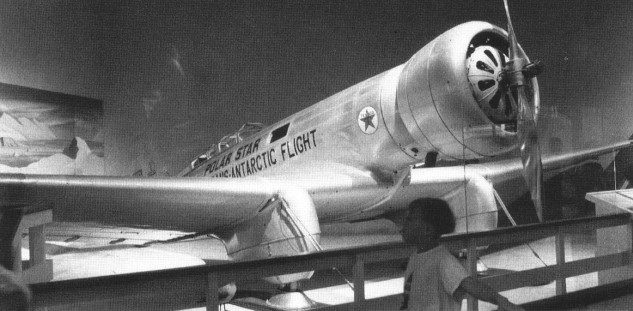
The second, 2B NR12269, being the first to fly after being completed in August 1932. Sold in early 1933 to millionair explorer Lincoln Ellsworth, it was shipped to the Antarctic in late 1933 and test flown on skis by Bernt Balchen before being damaged in an unseasonable ice breakup. The aircraft was back in Dunedin, New Zealand, on 28/1/34 for transshipment on to California for repairs. Returned to the United States after the successful trans polar cap flights between 23/11 and 9/12/35, the Gamma was presented to the Smithsonian on 25/4/36.
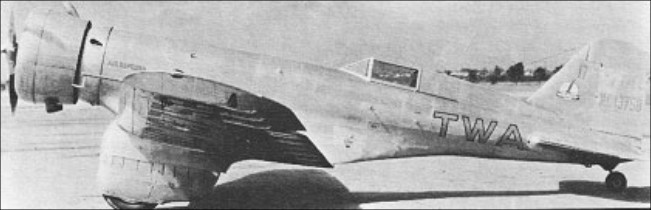
TWA bought three Gamma 2D aircraft with 529kW Wright Cyclone engines as single-seat mailplanes in 1934. The second was later re-engined with a 578kW Wright and was used by Texaco to test oil temperatures and flows before being sold to the US Army Air Corps, which designated it UC-100.

A number of Gammas were delivered to individual customers, including two to the UK, a 2E for the Aeroplane & Armament Experimental Establishment and a Gamma 2L, the last to be built, was used by the Bristol Aeroplane Co. as a test-bed for its Hercules engines.

The Chinese government ordered 24 Gamma 2E aircraft as light bombers, with 529kW Wright engines. They could carry a 726kg bombload and had four 7.62mm forward-firing machine-guns in the wings, and one rearward-firing in the rear cockpit. A further 25 Gamma 2Es were assembled in China from components provided by Northrop.

Engine: Pratt & Whitney Wasp, 500 hp
Seats: 2
Range: 2000 miles
Northrop Beta

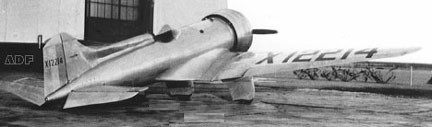
In 1931 Northrop built the prototype of an all-metal low-wing sporting monoplane X/NC12214, the Beta (ATC 2-401), a two-seater with a 119kW Menasco Buccaneer inline engine.

Designed by Don Berlin, a dorsal fairing and canopied cockpit were later added. An advertisement in Dec 1932 Aero Digest quoted a $5,000 sale price.

Stearman-Northrop Beta 3D with dorsal fairing NX12214

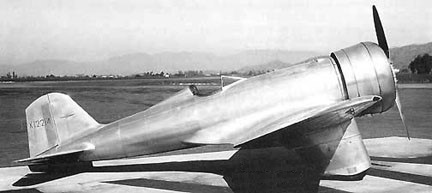
It was converted to single-seat high-speed mailplane configuration in 1933 and fitted with a 300 hp / 224kW Wright Whirlwind radial engine, in which form it became the first aircraft of such power to exceed 200mph / 322km/h. Reported speeds up to 212 mph were reached.

Damaged in a landing accident on 16 January 1933, it was rebuilt by Stearman for planned testing of various wing flaps, but destroyed in a crash on 5 June 1934.

Stearman-Northrop Beta 3D NX12214

Beta 3D
Engine: 300hp P&W Wasp Jr
Wing span: 32’0
Seats: 1

Northrop Alpha

Northrop’s first aircraft for his new company was known as the Flying Wing but of more immediate consequence was the next design, the Northrop Alpha, an all-metal seven-seat single-engine low-wing monoplane. In 1929 Avion Corporation became the Northrop Aircraft Corporation, a division of United Aircraft and Transport Corporation of which Boeing was also a part.

Northrop Alpha Article

First flown in 1930, Trans Continental and Western Air Inc, (later to become Trans World Airlines) ordered five Alphas with 313kW Pratt & Whitney Wasp engines and began services on 20 April 1931 from San Francisco to New York, with 13 intermediate stops, the journey taking just over 23 hours.

The Alphas were configured for three passengers and 211kg of mail and cargo, for mail flying was a plum contract at that time, but regularity and reliability was required. To achieve all-weather and night-flying capability, the Alphas had the most modern radio and navigation equipment, and for winter operations became the first commercial type to be fitted with Goodrich rubber de-icer boots on wing “and tail surface leading edges.

Thirteen of the 17 Alphas built saw service with TWA, and three were supplied for evaluation to the US Army Air Corps where, had production orders been given, they would have been designated C-19.

Various configurations carried the designations Alpha 2, Alpha 3, Alpha 4 and Alpha 4-A, and a number of changes were made between individual aircraft as late modifications were made retrospectively to earlier aircraft, including fitting of streamlined ‘trousers’ over the original rather utilitarian landing gear.

The 1931 Alpha 3 was certified under ATC 2-335. The 1931 Alpha 4 (ATC 451) prototype was built at Northrop, the rest at Wichita. Eleven were built, of which 7 were modified from Northrop Alpha 2 and 3. ATC 2-371 was for Alpha 4 NC127W powered by a 420hp Wasp installation.

The 1932 Alpha 4A (ATC 461) was a single-place cargo conversions of Alpha 4. Ten were built.

The last conversion was the Gamma 4-A, an all-cargo aircraft which could carry 567kg; the Gamma 4 and Gamma 4-A had a 336kW Wasp engine and most of the earlier aircraft were similarly retrofitted.

The last surviving Alpha, the third built, served with the US Assistant Secretary of Commerce for Aeronautics, the Ford Motor Company, National Air Transport (part of United Airlines) and TWA. It was re-acquired by the airline in 1975 and superbly restored before being placed in Washington’s Smithsonian Institution National Air and Space Museum.

Alpha 3
Engine: 420hp P&W Wasp
Seats: 3

Alpha 4
Engine: 450hp P&W Wasp
Wingspan:
43’10”
Length: 28’5″
Useful load: 1900 lb
Max speed: 177 mph
Cruise: 155 mph
Stall: 62 mph
Range: 650 mi

Alpha 4
Engine: 420hp P&W Wasp

Alpha 4A
Seats: 1
Useful load: 2450 lb
Max speed: 177 mph
Cruise: 155 mph
Stall: 62 mph
Range: 900 mi

Northrop Flying Wing

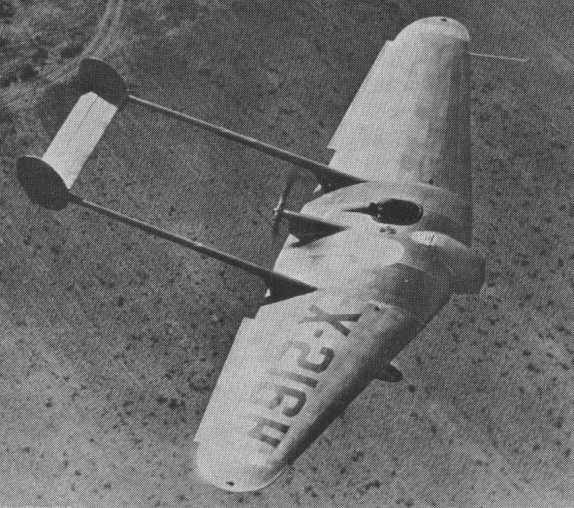
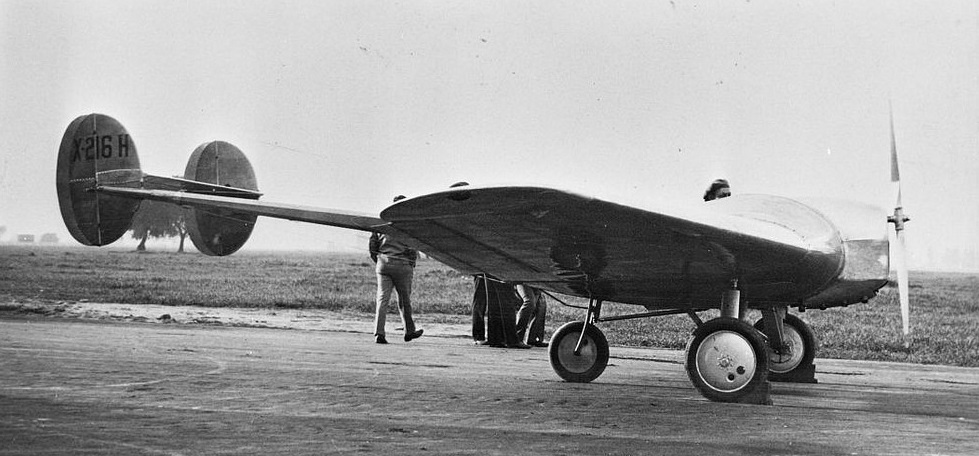
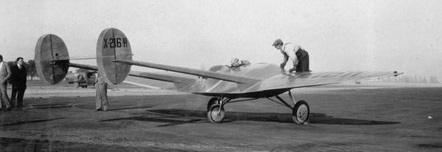
Jack Northrop in 1928 wanted to “do his own thing”, which was to start investigating all wing aircraft, He decided to keep a tail, for the time being. So the Northrop Flying Wing, with experimental registration X 216H, was intended to solve only some of the problems. The wing was a fairly conventional shape, apart from the thick centre section so that the pilot and passenger could sit comfortably inside it on each side of the centre line. The whole structure was a duralumin cellule with multiple spars and a stressed skin. To the rear projected an extremely, light pair of duralumin monocoque tail booms carrying a twin finned tail, the whole assembly weighing less than half as much as a conventional rear fuselage and tail. The main wheels were well forward under the leading edge, and under the trailing edge was a large steerable tailwheel.

The 90 hp / 67kW Menasco Pirate engine was carried just ahead of the leading edge, with cooling air ducted to an outlet near the trailing edge. Northrop was deeply concerned to secure smooth airflow over his flying wings and never again put a propeller in front of one.

The aircraft, built by Northrop’s newly formed Avion Corporation (later the Northrop Aircraft Corporation), initially driving a pusher propeller but modified later to tractor configuration.

Courtesy John Frazer

X 216H flew perfectly well. Reports say it flew well and was 25% faster than anything else in its class. It had conventional controls, and Northrop wanted to explore alternative arrangements and ultimately take the giant step of removing the tail, but he was prevented by financial and business difficulties.

Courtesy John Frazer

Northrop

In 1916, while working for the Loughead Aircraft Company (later Lockheed), he co-invented a process for making monoplane fuselages and helped design the F-1 flying boat. He became chief engineer at Lockheed in 1927 and built the Vega monoplane. With the help of designer Jack Northrop, Lockheed built the F1, but it was turned down by the Navy. In 1923 Northrop left to take a job with Donald Douglas, and later founded his own corporation.

Jack Northrop (1895-1981) was employed by United Aircraft and Transport Corporation. All went well until United decided Northrop should leave Burbank and join another United division. He remained in California to form a new company. In July 1929 Jack Northrop formed Northrop Aircraft Corp, as a division of United Aircraft and Transport Corporation and built the Alpha (first flown 1930), first all-metal stressed skin airplane, followed by the Beta 300 hp aircraft of 1931, first to exceed 200mph (322kmh).

New Northrop Corporation founded after split with United Aircraft and Transport Corporation, with Douglas Aircraft holding a majority shareholding.

Producing the Gamma high-speed mailplane in 1933 and other types. Northrop Corporation absorbed into Douglas 1937, and new independent Northrop Aircraft Inc established 1939 to concentrate on military projects, including the A-17 attack-bomber and P-61 Black Widow three-seat, twin-boom night fighter, first aircraft in this category to be ordered by USAAF. Northrop experiments with the tailless XP-56 interceptor led to a number of postwar flying-wing projects, culminating in eight jet engined YB-49 flying-wing bomber of 1947. The F-89 Scorpion all-weather fighter entered production two years later, serving USAF and Air National Guard Units until 1963.

Extending its activities into other fields, the company changed its name to Northrop Corporation in the year 1959. In May 1994 Grumman and Northrop merged to form Northrop Grumman Corporation.
Northrop’s final pre-merger production aircraft included the F-5E/F Tiger II lightweight tactical jet fighter/fighter trainer, developed with U.S. Government funding mainly for export as International Fighter Aircraft (first F-5E flown August 1972), derived from the 1959 N-156 prototype and early production F-5A/B Freedom Fighters built for supply under Military Assistance Programs. The T-38 Talon two-seat advanced trainer variant of N-156 for the USAF (first flown April 1959) went out of production in 1972 after 1,187 had been built, but these are being modernized to T-38C standard for redelivery from 1999 by Northrop Grumman. Northrop developed the YF-17 Cobra for competition against the Lockheed YF-16 for the USAF’s Lightweight Fighter Program, but lost and became principal subcontractor to McDonnell Douglas on a proposed carrier borne naval fighter derivative. This eventually entered production as the carrier- and land-based F/A-18 Hornet. Finally developed the B-2 Spirit subsonic strategic stealth bomber (first flown July 1989) for the USAF.
Two of the five main divisions of Northrop Grumman Corporation were Commercial Aircraft, to construct aerostructures and components for the commercial aircraft of other companies and engines, and Military Aircraft Systems, working on B-2 and all other Northrop Grumman aircraft production and modernization programs, and principal subcontractor to Boeing on Hornet. Delivered 21 B-2A Spirit stealth bombers, achieving initial operational capability with the USAF in April 1997 and full capability with the 715th Bomb Squadron in 1999. Undertakes F-5/T-38 modernization, F-14 work, EA-6B Prowler remanufacturing, production of E-2C Hawkeye in latest Hawkeye 2000 form (first flown April 1998; see Grumman entry for earlier development and production of E-2), and production of E-8C Joint STARS as joint USAF and U.S. Army co-operation program for an airborne surveillance and target acquisition system (first flown August 1995 for first production E-8C).

In 2000, Northrop Grumman is to sell its commercial aerostructures arm to the Carlyle Group for $1.2bn. NG was planning to specialise in the defence electronics and IT industries and its aerostructures business, which manufactures subassemblies for Boeing commercial aircraft, the C-17 and Gulfstream V, no longer fits the bill. Carlyle will rename the Dallas, Texas-based company Vought Aircraft and NG will reorganise its Integrated Systems and Aerostructures sector into the Integrated Systems Sector. NG, which recently acquired Comptek Reseach, has also cited expected decline in Boeing production schedules as one of the reasons for the sale. The Carlyle Group, however, has been active in the aero-manufacturing sector having purchased Textron’s aerostructures unit four years previous and buying out Gemini Air Cargo in 1999.

Northern Technologies Skycycle

Single seat/side by side two seat single en¬gined flex wing aircraft with weight shift control. Rogallo wing. Pilot suspended below wing in trike unit, using bar to control pitch and yaw/roll by altering relative positions of trike unit and wing. Undercarriage has three wheels in tricycle formation; glass fibre suspension on main wheels. Nosewheel steering independent from yaw control. Aluminium-¬tube trike unit, without pod. Engine mounted below wing driving pusher propeller. Alumi¬nium tubing to US 6061T6 specification, ano¬dized. AN bolts.

It does feature the inclusion of a clutch in its reduction drive, which uses gears rather than the normal belts. Engine is the Lloyd LS400 with electric start, battery and charging system and the trike unit is designed to accommodate either single or side by side dual seat.

Engine: Lloyd LS400
Main wheels diameter overall 20 inch, 51 cm
Seats: 1-2

Northern Aircraft Inc.

USA
Northern Aircraft Inc purchased from Bellanca all rights, jigs and tooling for the Bellanca 14-19 Cruisemaster four-seat lightplane. The Bellanca Model 14 was one of the classic lightplane designs, since built by several manufacturers. First production of the Northern Cruisemaster started in October 1956. Northern also supplied spares, support and modification kits for Republic Seabee amphibians after a merger with the American Aviation Corporation. Became Downer Aircraft Industries Inc.