Alef Aeronautics eVTOL A

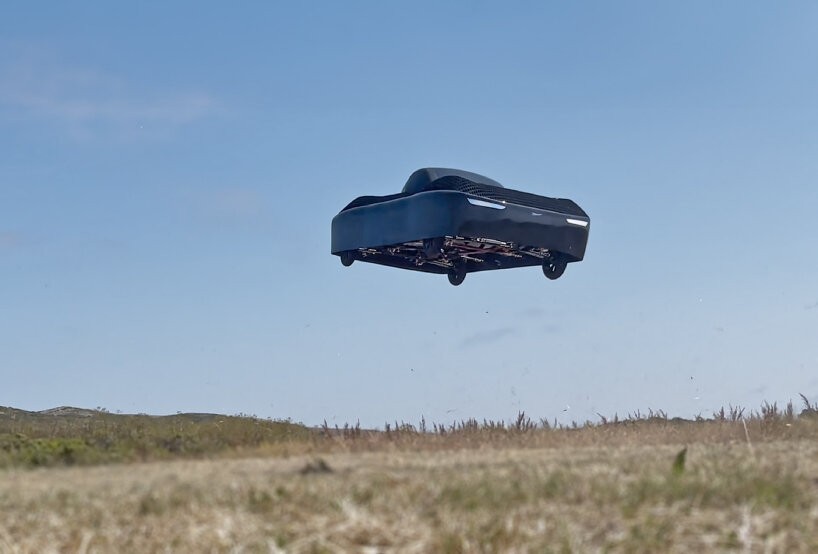
Alef Aeronautics offers its own eVTOL A flying car, a concept flying car that would have a driving range of 200 miles and a flight range of 110 miles.

The design has a car-like exterior, and does not have any exposed propellers for added safety and to drown the loud whirring sounds and also save space. The Alef flying car is all-electric and anchor key components such as Distributed Electric Propulsion (DEP) – which helps the airflow be evenly distributed – triple to octuple redundancy of all key components, real-time and pre-flight diagnostics to always keep the drivers informed of their drive or flight, glide landing, and even a full-vehicle parachute in case of emergencies.

Alef Aeronautics shares in the release that the 300,000 USD (2025) Alef flying car would be developed using the latest hardware and software technology and end up being lightweight packs with long-lasting components, software simulators and analysis, and rigorous flight testing. The team is planning to begin production and deliver the first batch in 2025.

Alef Aeronautics’ drivable flying car takes its maiden flight in a city field. On February 19th, 2025, its test model takes off, even flying over another vehicle. In a LinkedIn post, Alef Aeronautics CEO Jim Dukhovny writes that the video showcasing the flight is ‘the first documented, verifiable flight of a flying car (an actual car, with vertical takeoff, non-tethered).’

Maiden flight on February 19th, 2025

The vehicle comes with a gimbaled cabin design to keep it stable as it moves through the air as well as an elevon system to control the vertical and horizontal movement of the Alef Aeronautics flying car and its tilting.

Presently, the Alef Aeronautics flying car is the first vehicle with vertical takeoff to receive FAA permission to fly in the US (FAA Special Airworthiness Certificate).

While the Alef Model A is the commercial version, the test model is the Alef Model Zero. It is solely used for research and development in the hopes of becoming the actual Alef Model A.

Gallery

Archer Midnight eVTOL

The company’s Midnight flagship air taxi broke cover in November 2022, sporting 12 rotors mounted along its wings – six dual-blade types at the rear locked in upward configuration plus six five-blade versions to the front capable of tilting for forward flight. Archer was aiming for top speeds of 150 mph (241 km/h) and a per-charge range of 100 miles (161 km).

By early 2023, a Midnight prototype was built and ready start test flights, which began in October. Its first transition from vertical hover to forward flight followed in July of last year, but May 2025 the pilot seat has been empty.

Archer’s five-seat Midnight air taxi rose vertically from the tarmac in the latter half of 2023, following years of testing and tweaking of prototypes like the two-seat Maker demonstrator.

In May 2025 Archer was testing the piloted conventional take-off and landing (CTOL) capabilities of its Midnight aircraft. Archer has released video footage of the first flight of its Midnight eVTOL with a pilot at the controls, though the aircraft rolled down a runway to take off rather than using its rotors to lift it vertically.

With chief test pilot Jeff Greenwood in the cockpit taking the aircraft prototype down a runway and up into the air to “demonstrate the robustness of Midnight’s landing gear” during conventional take-off and landing operations.

Chief Test Pilot Jeff Greenwood at the controls of the Midnight aircraft

The pilot managed to get the eVTOL in CTOL testing mode up to 125 mph (over 200 km/h) and reached a maximum altitude of more than 1,500 ft (~460 m) above ground level.

Bell V-280 / MV-75 Valor

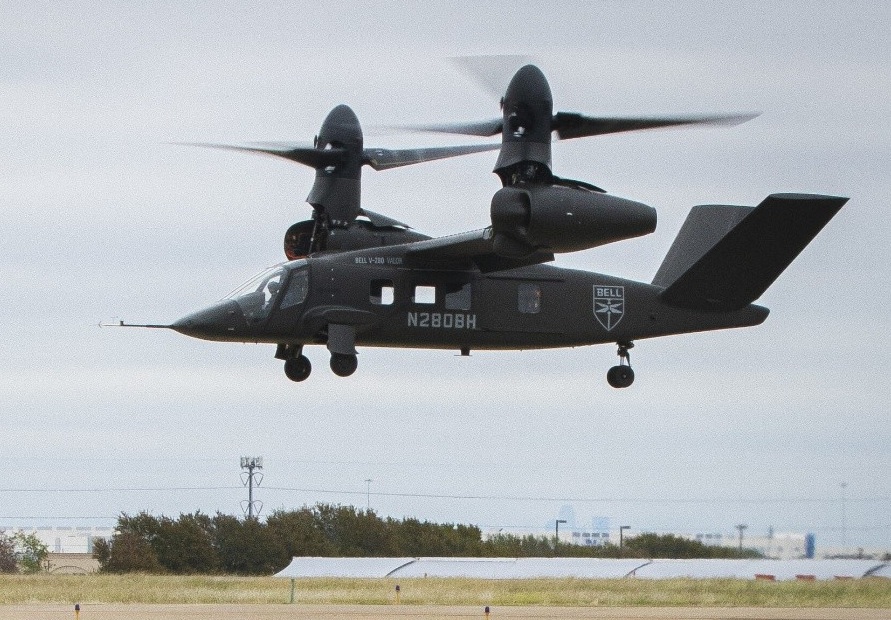
The V-280 Valor first took to the sky in 2017, and logged over 200 hours of flight time before the prototype was grounded in 2021. Bell has claimed that the aircraft is capable of top speeds of up to 280 knots with a range of up to 800 nautical miles, double the top speed and operational range of the Black Hawk. The Valor can also reportedly carry 23% more troops and 25% more cargo than the Black Hawk.

The biggest difference between the Black Hawk and the Valor is, of course, the tiltrotors. While it looks similar to the V-22 Osprey, the Valor works somewhat differently. The engines remain in place in nacelles, streamlined containers, on the wing — it’s the rotors themselves that tilt up and down. They’re also what give the aircraft its high speed, which is more than 100 miles per hour faster than the Black Hawk’s top speed of 222 miles per hour.

With a crew of four, along with up to 14 passengers, the Valor would replace the Black Hawk in its myriad of missions, from carrying supplies to air assault missions to medical evacuation. The more than three years of flight testing, which included Army test pilots, with the Valor prototype demonstrated its flight capabilities, survivability, and sling loading ability, according to Bell.

The Valor has a wider footprint than the Black Hawk, but is 20% shorter, which Bell said gives it greater flexibility in landing.

U.S. Special Operations Command said that the V-280 was changed in development to allow it to carry more weight, with the intention of making it more easily convertible for use by special operations units. The Army’s 160th Special Operations Aviation Regiment currently uses MH-60M variants of Black Hawks, which require extensive modifications to be mission ready.

Bell’s V-280 Valor, was selected in 2022 as the winner of the Army’s Future Long-Range Assault Aircraft competition. The vertical take off and landing craft has two engines and is designed for both assault and transport purposes. The newly designated MV-75 is meant to eventually replace the Army’s H-60 Black Hawk helicopters, including in special operations missions.

The initial contract, for $232 million, is to continue development of the aircraft, but then expands to $1.2 billion and then perhaps as much as $7 billion to begin building the new fleet of Valor aircraft that will begin replacing the Black Hawk in the mid-2030s. The Army operates roughly 2,000 Black Hawk helicopters, which have been in use since the 1970s. The Army previously said it expects to field the MV-75 by 2030. The MV-75 designation is an homage to the year 1775, the birth year of the U.S. Army.

The initial testing by the 101st Airborne Division will be used to shape MV-75 tactics and doctrine.

Yakolev Yak-141

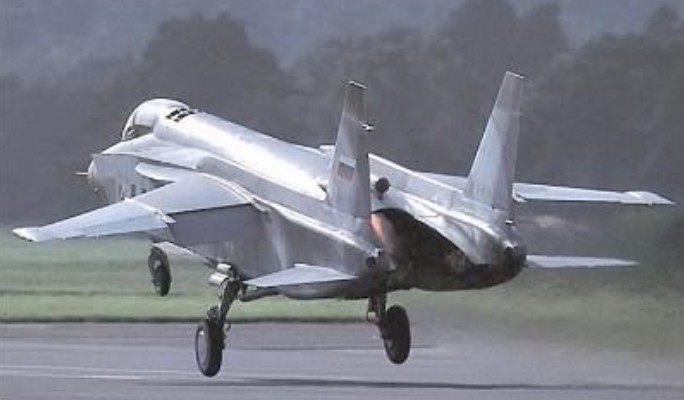
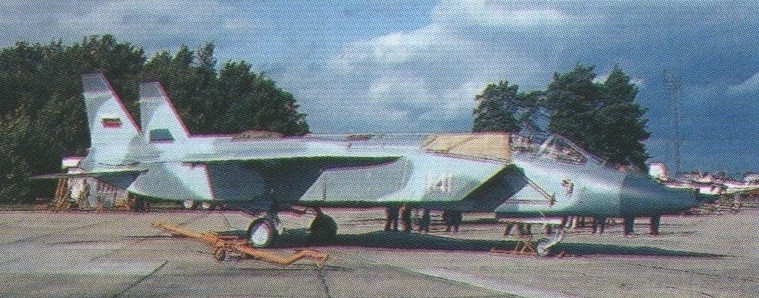
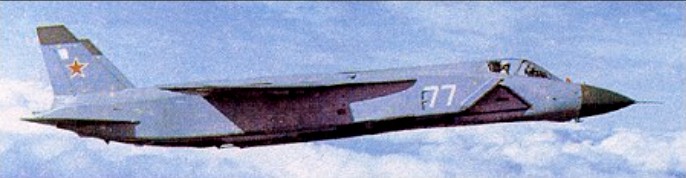
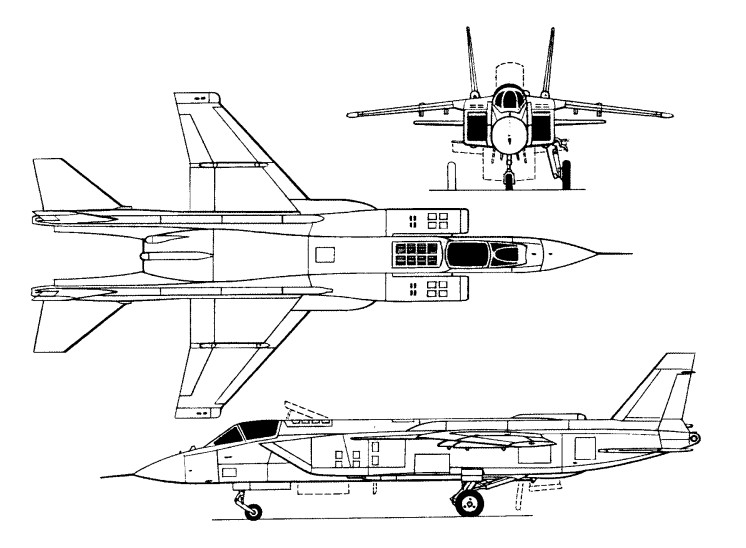
The Yak-141, being the world’s first supersonic STOVL (short take-off/vertical landing) aircraft, has three engines: one lift-cruise R-79 with a thrust of 15500kg and two small-sized RD-41 of 4100kg each. The powerplant allows the plane to lift off vertically with a weight of up to 15,800kg. Alternatively, the Yak-141 can perform short take-offs (60-120m) with a weight of up to 19,500kg. In the latter case the combat radius increases by 1.5-2 times and patrol time in the combat zone by two times. The pilot can use afterburner even when the nozzles are deflected. The Yak-141’s integral flight-control system sets power and deflection of the nozzles so as to optimise making vertical/short take-offs and landings.

The Yak-141 first flew in March 1989, piloted by Andrei Sinitsin.

The Yak-141M was meant primarily for ground-basing. Introduction of new flight regimes, as well as new take-off/landing techniques, has entailed changes in the airframe, leading to a new design, the Yak-141M.

Engine: 1 x R-79V-300, 152.0 kN , 2 x RD-41, 41.8 kN
Max take-off weight: 19500 kg / 42990 lb
Empty weight: 11650 kg / 25684 lb
Wingspan: 10.1 m / 33 ft 2 in
Length: 18.3 m / 60 ft 0 in
Height: 5.0 m / 16 ft 5 in
Wing area: 31.7 sq.m / 341.22 sq ft
Max. speed: 1850 km/h / 1150 mph
Ceiling: 15500 m / 50850 ft
Range w/max.fuel: 2100 km / 1305 miles
Range w/max.payload: 1400 km / 870 miles
Crew: 1
Armament: 1 x 30mm cannon, 1000kg (VTOL) or 2650kg (STOL)
Hardpoints: six

Yakolev Yak-141

Yakolev Yak-38

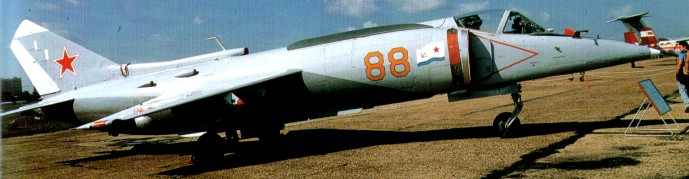
Flown in prototype form in 1971, the Yak-38 was developed under the design leadership of S Mordovin for the primary tasks of fleet air defence against shadowing maritime surveillance aircraft, reconnaissance and anti-ship strike. Power plant combined a Yu Gusev-developed Tumansky R-27V thrust-vectoring turbojet with two Rybinsk (Koliesov) RD-36-35 vertical-lift turbojets designed by a team led by A Dynkin. Hydraulic drives synchronised by a transverse shaft rotated the thrust-vectoring nozzles aft of the wing, their output in vertical take-off and landing operations being balanced during hover and transition by the paired lift engines mounted in tandem immediately aft of the cockpit and inclined forward 13 degrees from the vertical.

Yakolev Yak-38 Article

Yak-38A


Shipboard trials with the Yak-38 began aboard the Moskva half-deck anti-submarine cruiser in 1972, and, in the following year, the decision was taken to build a pre-series of Yak-38 fighters for service evaluation, the first two of these landing aboard the carrier-cruiser Kiev in 1975. An evaluation squadron comprising 12 single-seat Yak-38s and two two-seat Yak-36Us embarked aboard the Kiev in the summer of 1976, the aircraft being confined to vertical take-off with conversion following at 5-6m above the deck. During 1976, production was initiated of a much improved version of the basic design as the Yak-38.

Yak-38 aboard Kiev

Externally similar to the Yak-36M, apart from substantial strakes either side of the intake for the lift engines, the Yak-38 possessed a full weapons system and an automatic control system permitting a short roll leading into vertical take-off as distinct from an orthodox short take-off benefiting from wing-induced lift. Although intended only for vertical take-offs and landings, the ‘Forger’ had double-slotted flaps and a braking parachute.
The Yak-38 entered service with the Soviet Navy in 1978, and, during 1980, was evaluated under operational conditions in Afghanistan. Progressive development resulted in the Yak-38M, which, with 1000kg more engine thrust, a steerable nosewheel and provision for paired 600-litre underwing auxiliary tanks, entered production in succession to the Yak-38. The Yak-38M had a 6940kg R-27V-300 thrust-vectoring turbojet and two vertical-lift RD-38 turbojets each rated at 3250kg. Two wing stations immediately inboard of vertically-folding panels provided for two gun pods each containing a twin-barrel 23mm GSh-23 cannon, rocket packs or bombs weighing up to 500kg each, two R-60 IR-homing AAMs or short-range ASMs. The tuitional version, the Yak-38UM, had vertically-staggered tandem seats, a plug being inserted in the aft fuselage to compensate for a lengthened nose. Each of the four Soviet Navy Kiev-class carrier cruisers received a 14-aircraft squadron of Yak-38s or -38Ms (each including two two-seaters), and production was completed by 1987 with a total of 231 Yak-38s (all versions) built.
The ‘Forger’ had a system to automaticaliy eject the pilot if the engine stopped while the thrust was angled below the horizontal. On one occasion this occurred in full view of a British carrier, who rescued the pilot.
Production of the Yak-38 Forger subsonic V/Stol shipborne fighter continued in 1987, to equip four Kiev-Class aircraft carriers. Each vessel carries 12 Forger As and two two-seat Forger Bs, which lack the ranging radar of the single-seat aircraft. Some 70 Yak-38s had been built by mid-1986.
Photographs of Forger As executing rolling take-offs from the deck of a carrier appeared in 1984, ending all speculation that the aircraft was only capable of Vtol operations. Short take-off techniques will improve the Forger’s payload/range performance. The Yak-38 has no internal armament, but carries gun and rocket pods on four underwing hardpoints to a maximum load of approximately 3,600kg.

Yak-38 aboard Minsk

Yak-38 Forger A
Engine: 1 x Lyuika AL-21F, 8160 kg / 17,989 lb thrust
Lift engines: 2 x Koliesov ZM, 3750 kg / 7870 lb thrust
Installed thrust (dry): 80 kN
Span: 7.32 m / 24 ft 8.25 in
Length: 15.50 m / 50 ft 10.5 in
Height: 4.37 m / 14 ft 4 in
Wing area: 18.50 sq.m / 199.14 sq ft
Empty wt: 7385 kg / 16,281 lb
MTOW VTOL: 11,700 kg / 25,794 lb
MTOL STOL: 13,000 kg / 28,660 lb
Warload: 1350 kg
Max speed: Mach 0.95 / 1110 kph / 627 mph
Initial ROC: 4500 m / min
Ceiling: 12,000 m / 39,370 ft
T/O run: VTOL
Ldg run: VTOL
Range: 740 km / 460 mi
Combat radius: 370 km
Fuel internal: 2900 lt
Air refuel: No
Hard points: 4
Bombload: 3600 kg / 7937 lb
Seats: 1

Yak-38M
Max take-off weight: 11700 kg / 25794 lb
Wingspan: 7.32 m / 24 ft 0 in
Length: 15.5 m / 51 ft 10 in
Height: 4.37 m / 14 ft 4 in
Wing area: 18.50 sq.m / 199.13 sq ft
Max. speed: 1010 km/h / 628 mph

Yakolev Yak-38

Yakolev Yak-36

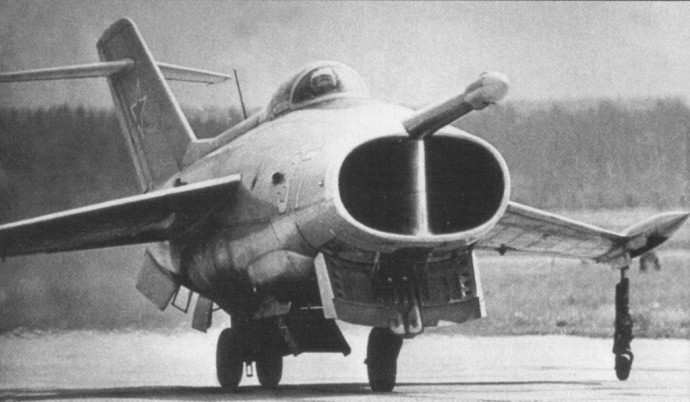
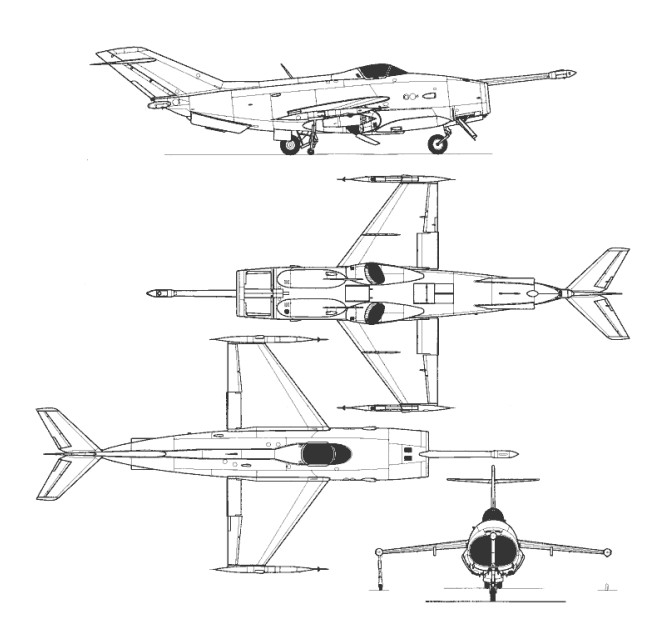
In 1962 the Yakolev bureau was chosen to produce the first Soviet vertical take-off and landing aeroplane for the Soviet navy’s new ‘Kiev’ class of aircraft-carriers. Initial consideration was given to a composite arrangement of lift jets and a cruise engine, but it was finally decided to use two 36.78kN Koliesov engines with vectoring nozzles on the centre of gravity to provide direct lift or forward thrust as required. The airframe designed for the new Yak-36 was necessarily broad to accommodate the side-by-side engines, used the now-standard arrangement of tandem main units on the centreline together with stabilizing outriggers at the wingtips, and was completely conventional as only high subsonic speeds were envisaged. Hovering control was provided by reaction jets in the wingtip pods, the tail and the long nose boom. The type first flew in the mid-1960s, and trials with at least 12 such prototypes paved the way for the Yak-38 VTOL naval aeroplane, which has a composite powerplant with one vectored thrust turbojet in the rear fuselage, and two lift turbojets in the forward fuselage.
Displayed publicly at the Domodedovo, Moscow, flying display in July 1967, this single seater appeared to be powered by two turbojets installed side by side in the belly, each discharging through a louvred and gridded swivelling nozzle. The nose was occupied by large lateral air ducts from a bifurcated pitot inlet. Freehand had no lift jets, and pipes from the main engine served reaction control nozzles at the tips of the wing, at the tail and on the end of an outsize nose boom. The wing was mounted in the mid position directly above the engine nozzles. The vertical tail was sharply swept, and two ventral fins were fitted under the rear fuselage. A large surface under the nose, double hinged to function as an airbrake, was also hinged at the rear, and was judged to reduce reingestion of hot gas in the low level hovering mode.
Two Freehands took part at Domodedovo, one No 37 and the other No 38, the latter carrying two UV 16 57 rocket pods. Fitting the latter was considered chiefly a public relations exercise. There is no evidence to suggest that it was ever an operational type, though at least eight were built, and one went aboard the helicopter ASW cruiser Moskva where it conducted flying trials from an elevated platform not quite the same as those often used by Ka 25 helicopters.

Engines: 2 x RD-27-300, 53.0kN
Max take-off weight: 8900 kg / 19621 lb
Wingspan: 10.5 m / 34 ft 5 in
Length: 17.0 m / 56 ft 9 in
Height: 4.5 m / 15 ft 9 in
Max. speed: 1010 km/h / 628 mph
Ceiling: 12000 m / 39350 ft
Hardpoints: 2
Crew: 1

Yakolev Yak-36

Williams Research WASP / X-Jet

In the mid-1960s, engine manufacturer Williams Research developed a light turbofan engine, the “WR19”, with a thrust of 1.91 kN (195 kgp / 430 lbf), which was used in a “flying belt” that could be strapped on somebody’s back to allow flights of up to 20 minutes. It was a sexy toy but of no particular usefulness, and it was canceled in 1969.

Williams continued to tinker with the idea, coming up with a one-man flying platform powered by the WR19 or a derivative engine, known as the “WASP”, which was later renamed the “X-Jet”. This machine looked something like a flying trashcan on skids, and could carry a pilot directing the machine with two grip-type controls. It was evaluated in the 1980s; videos of its flight suggest it performed very nicely and was easy to handle. Noises were made about a more capable successor, but apparently its endurance was too limited and, as was the case with most of the other one-person flying machines, it was hard to understand that it offered any utility proportional to its expense and complexity.

One X-Jet is now on display at the USAF Museum in Ohio, while another is on display at the Seattle Museum of Flight. The WR19 and its descendants did prove to be useful powerplants for long-range cruise missiles.

Vertol 76 / VZ-2

Vertol began involvement with Tilt-Wing investigations in the 1950s with work on its company-designated Model 76 program. The research would be affirmed with a joint Army/Navy contract, signed on April 15, 1956, for a tilt wing convertiplane, defined as the VZ-2A program. The design and development contract was for $850,000.

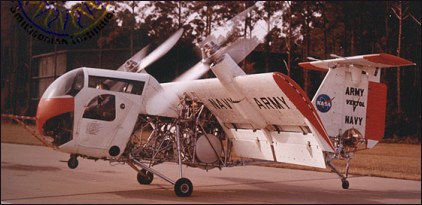
This VTOL configuration had not previously been tested in flight and the object of the programme was to build a test bed as quickly and as simply as possible. This was achieved by using available parts for several components – ¬a Bell helicopter canopy, wing actuators from the Piasecki XH 16, Piasecki HUP helicopter tail oleo struts as main undercarriage legs on the test bed and a number of parts from the Piasecki H 21. The Vertol Model 76, as the VZ 2 was known, was ready for flight in less than a year from the contract being placed.

The principal advantage of the tilt wing type of convertiplane is that it can be in most respects a conventional aircraft for cruising flight and therefore has good performance. In this respect it is similar to the tilting rotor type such as the Bell XV 3, there being some advantage in having the rotor/propeller assembly solid with the wing and tilting the whole component.

The vehicle, with much of the fuselage being of open-tubular construction, had a cockpit located far forward of the wing pivot point and featuring side-by-side seating for the two-man crew.

There were dual controls which could move control surfaces on the vertical stabilizer topped with a flat horizontal “T” configuration. The complexity of the concept was increased with the addition of a pair of ducted fans for pitch and yaw control, both being located in the tail.

A 660 horsepower Lycoming YT53-L-1 turboshaft was mounted by struts above the fuselage. The exhaust was vented outward to the left side of the rear stabilizer. Since the propellers were not attached to actual engines, the units that transferred the power from the fuselage-mounted engine resulted in considerably smaller wing units.
A portion of the turbine power was also transmitted through shafting to two ducted fans, one in the vertical and the other in the horizontal stabilizer. These fans, through a pitch-changing mechanism, were used for pitch and yaw control of the craft during hovering and transition flight.

Through a complex system which incorporated a cross shaft arrangement, the power was transferred to the pair of wing-mounted rotors which were located close to the center point of each wing. The rotors were large in diameter, at nine and one-half feet in span, and each carried three blades. The variable-pitch rotors, in addition to their primary power requirement, also provided supplemental roll control.

The craft proved to be extremely maneuverable, but was extremely slow with a maximum speed of only 215km/h. For safety purposes, the propellers were interconnected.

For aerodynamic reasons, the rear fuselage of the plane would later be skinned for smoother air flow.

Vertol test pilot Leonard La Vassar made the first flight in the VZ 2 (single example produced 56 6943) on April 13th, 1957, with the wings fixed for vertical flight. On January 7th, 1958, he made the first flight with wings horizontal and then set about ‘closing the gap’ to achieve a full transition in flight. This he did on July 15th, 1958.

Between then and September 23rd, 1959, Vertol completed 30 hours’ flying and then delivered the VZ 2 to N.A.S.A. at Langley Research Center. The first stage of N.A.S.A. testing involved another 20 hours’ flying in the next year. In this period, several modifications were introduced. A Martin Baker ejection seat was fitted changing the contours of the cockpit the rear fuselage was covered in and additional dorsal and ventral fin area was fitted.

N.A.S.A. also fitted a droop snoot leading edge to the wing. This was designed to delay the stall of the wing, which occurred initially at an incidence of 25 30 degrees, causing buffeting and control difficulties. In May 1961, Vertol was granted a new contract covering further modifications, including fitting of trailing edge flaps on the wing, which was originally flapless. With flaps, the aircraft has some characteristics of the deflected slipstream types and the stalling characteristics of the wing are further improved.

Another modification in the 1961 programme was to increase the rating of the Lycoming to 700 h.p. After testing by Vertol, the VZ 2A was returned to Langley Field. At the time the contract was placed, 448 flights had been made in the 50 hours, and 34 full and 239 partial conversions had been made.

Upon its retirement, the VZ-2A was given a place at the Smithsonian Institution.

Gallery

VZ-2A
Engine: Lycoming YT-53-L-1, 630kW / 860-shp
Rotor diameter: 2.90m
Wingspan: 7.60m
Fuselage length: 8.2m
Height: 3.15m
Take-off weight: 1443kg
Empty weight: 1128kg