
Pegasus Aviation XL-R
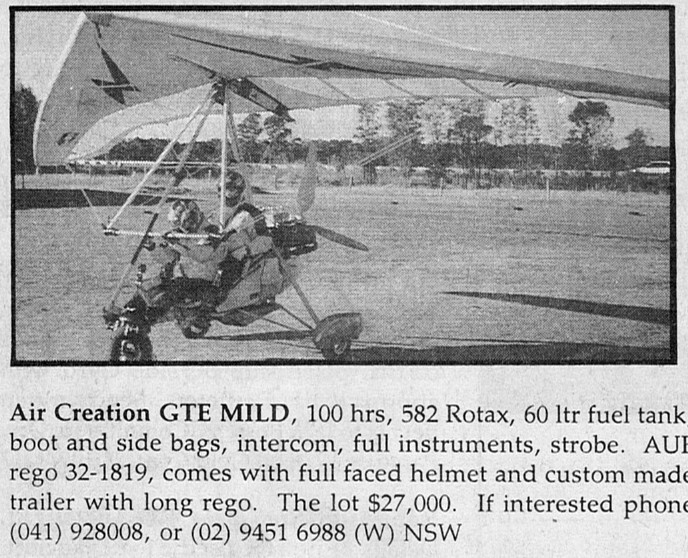

Czechoslovakian engineering student Ivo Zdarsky escaped into Austria in a homemade ‘ultralight’ aircraft powered by a 2-cylinder car engine.
In 1984 the plane was confiscated by police but he bribed the police and got it back.
The student, wearing a bright yellow crash helmet, flew the craft only about 100 to 200 yards above the ground for the entire trip. He parked his homemade, 3-wheeled craft with a basket-like seat outside an Austrian Airlines hangar used for DC-9 jets and sat there until airport employees spotted him.
Police said the man took off from the town of Lozorno, about 6 miles inside Czechoslovakia, at 3 a.m. and landed at Vienna’s Schwechat airport about 4:45 a.m., a 25-mile trip. Police said the student told them he had planned his escape for a year, making secret test flights of the ultralight aircraft.
A witness said the student’s plane was powered by a 600-cubic centimeter, 2-cylinder engine and had a fuel tank taken from a Czechoslovak-made Java motorcycle. Ultralights are prohibited in Austria because of noise and environmental regulations.
The 24-year-old Ivo Zdarsky spoke fluent English and asked for political asylum and wanted to emigrate to the United States or Australia, police said.
Zdarsky was able to sell his plane to Checkpoint Charlie German museum that housed escape vehicles. Afterwards he moved to Los Angeles where he started his own company, called Ivoprop, which produced propellers of his own design.


After being denied an exit visa, Zdarsky decided to take matters into his own hands and build his own plane; a hang glider with a 2-cylinder engine. In August of 1984, he set off at 3 a.m. and made his escape to Vienna where he requested political asylum.
Zdarsky was able to sell his plane to a German museum that housed escape vehicles. Afterwards he moved to Los Angeles where he started his own company, called Ivoprop, which produced propellers of his own design. Ivoprop Corporation, founded in 1984 by Ivo Zdarsky, is an American manufacturer of composite propellers for homebuilt and ultralight aircraft, as well as airboats. The company’s headquarters are in Long Beach, California.
Zdarsky started the company after carving his own propeller for a homebuilt ultralight trike that he flew from Cold War Czechoslovakia, over the Iron Curtain to Vienna in 1984. Ivoprop has sold more than 20,000 propellers since then.
The company’s propellers are built from carbon-fiber-reinforced polymer and feature a stainless steel leading edge.
In 1997 Zdarsky decided to move somewhere close to a runway where he could develop his design for an aircraft that could function as both helicopter and airplane. He came across 400 acres in the Utah desert and purchased it for just $99,000.

The Y2Fly Seahawk is an American amphibious flying boat ultralight trike that was designed and produced by Y2Fly of Point Harbor, North Carolina.
The Seahawk features a cable-braced hang glider-style high wing, weight-shift controls, a two-seats-in-tandem, open cockpit, a trimaran hull and a single engine in pusher configuration.
The aircraft hull is made from fiberglass, with stainless steel fittings. The wing and its supporting structure are made from bolted-together aluminum tubing, with the single surface wing covered in Dacron sailcloth and supported by a single tube-type kingpost. The Seahawk uses an “A” frame control bar for weight-shift control. The hull was carefully designed to account for the inherent lack of pitch control that trikes have while on the water. It was designed to reduce porpoising and water spray being thrown into the crew seats and propeller. The hull also provides lift in flight and allows flight at reduced power and fuel consumption. The retractable landing gear is of tricycle configuration and is mechanically retracted by a lever located next to the pilot. The nosewheel retracts in front of the bow of the hull, while the main landing gear retracts beside the tri-hull. The standard powerplant supplied was the twin cylinder, two-stroke, liquid-cooled 64 hp (48 kW) Rotax 582 aircraft engine.
A clutch system is standard on the 582 Rotax using an E box. This allows pilots to safely taxi in the water, without having the prop pushing the craft along. Another feature is a full time water rudder located at the rear and center of the craft. The unit is equipped with all three wheels retractable, actuated by one manual lever.
The “trimaran float design” uses spray rails, and splash pans. “Dive planes” help bring the nose of the craft up in case of slight nose down landing, or taxing in rough water. The use of fiberglass and stainless steel components allow the Sea Hawk to be used in salt water.
The Sea Hawk uses a 16.8 meter, certified Wizard wing to give the best performance for take-off and cruise. With two on board the craft stalls at 30 mph and cruises along at 55 mph.
The empty weight of this amphibious trike without wing is 341-363 lbs. depending on what engine is chosen. The aircraft was supplied as a completed aircraft but production has ended.
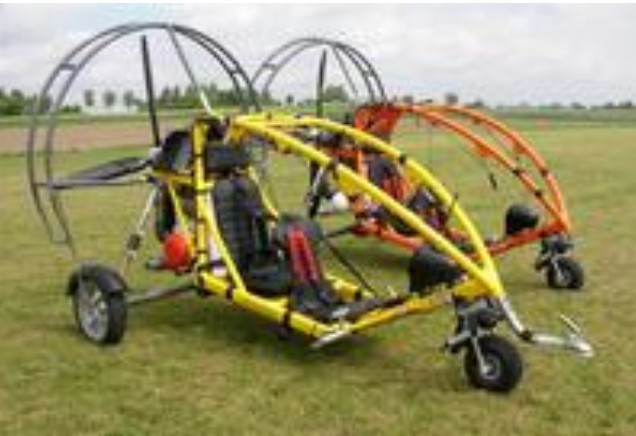
2009 Price: 28000 EURO
UL
Cruise: 61 kt / 70 mph / 113 kmh
MTOW Weight: 368 kg / 811 lbs
Climb Ratio: 3 ft/min /
Take-off distance (50ft obstacle): 80 ft / 24 m
Landing distance (50ft obstacle): 110 ft / 35 m
Single seat single engined flex wing aircraft with weight shift control. Rogallo wing. Pilot suspended below wing in trike unit, using bar to control pitch and yaw/roll by altering relative positions of trike unit and wing. Undercarriage has three wheels in tricycle formation. Push right go left nosewheel steering independent from yaw control. Aluminium tube trike unit, with optional pod. Engine mounted below wing driving pusher propeller.
The WAT the title stands for Wolfe Aviation Trike. In concept it is simple enough a monopole trike using a 2 inch (5cm) square section aluminium pole, adjustable in height to suit various Rogallo wings. Wolfe offers a variety of engines, with or without reduction drive, various seat options and also a selection of undercarriage designs. One of these undercarriages is unique as far as trikes are concerned in that it has retract¬able main wheels which fold behind the power pack to reduce drag. The WAT is also available with a double nosewheel. Another drag reducing option is a fabric pod.
To make the WAT as versatile as possible, the hang point uses a clamping arrangement, the idea being that the glider can be attached without drilling holes through the keel tube.
Standard engine is the Cuyuna 215 cc unit with reduction drive but among the engine options is a Cuyuna ULII-02. Price of the trike unit with 215 cc engine and reduction drive was $1690.
Engine: Cuyuna 215, 22hp at 6000rpm
Propeller diameter and pitch 50 x 20 inch, 1.27 x 0.51 m
V belt reduction, ratio 2.0/1
Max static thrust 160 lb, 73kg
Fuel capacity 2.0 US gal, 1.7 Imp gal, 7.6 litre
Length overall (Trike unit only) 5.0ft, 1.52m
Height overall (Trike unit only) 7.0 ft, 2.13 m
Empty weight (Trike unit only) 110 lb, 50kg
1983: PO. Box 59 Elyria, OH 44036, USA.
Trike builder
A powered trike with a Spectrum hang glider wing.
Registration ZK-FKW to RJ Ward cancelled on 2 December 1997 as withdrawn.
The Sylphe Bi is a two seat version of the Sylphe. The Bi can be used as a single seater without any modification. Flying controls are the same as a normal paraglider.
Empty weight: 100 kg
Wingspan: 11.75 m
Wing area: 40 sq.m
Fuel capacity: 30 lt
Engine: Rotax 503, 52 hp
Seats: 2
Max speed: 55 kph
Cruise speed: 40 kph
Min speed: 25 kph
ROC: 2.5 m/sec
Fuel burn: 15 lt/hr
Price (1998): 78 000 Fttc
 All Aero