Walther Boffin Coffin

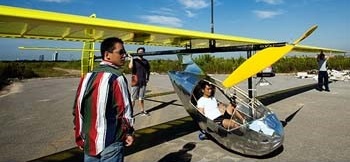
The Boffin Coffin during early testing at Wigram, NZ

The Boffin Coffin was a man-powered aircraft designed by Mr Donald Walther of Christchurch, New Zealand, to be an entrant in the man-powered aircraft competition announced by British Industrialist, Henry Kremer, for the first human-powered aircraft to complete a figure-of-eight course covering a distance of 1.6 km (1 mile), the course to include a 3.048 m (10 ft) pole that the aircraft had to fly over at the beginning and conclusion of the flight.

Work commenced in 1982 and it soon became known as the Boffin Coffin. Construction was of resin-laminated aluminium-alloy sheet and EPS, covered with Melinex. The undercarriage was quite tall, being 0.91 m (3 ft) long. The pilot was in a prone position, head first, operating pedals driving a propeller. The aircraft had a shock absorber in the drive between the rear-wheel and the propeller.

Flight trials commenced at RNZAF Base Wigram near Christchurch by a motor-vehicle towing the machine, Mr Walther initially being the pilot. Early testing was successful, Mr Walther stating “when I took my eyes off the tiller and looked down I was looking down on the roof of the car. The aircraft came down very lightly, but I could hardly call it a controlled flight. It is a mystery just how much control there is with these ailerons on the front wing, how much they contributed to my safe landing and how much was pure luck”. Although the first flight was successful, the aircraft suffered some damage on its second flight when it landed tail-first.

In 1987 testing began with pilots Steven Preest and Trent Hiles, at this time the aircraft being fitted with pedals for the pilot to operate. However, it was found the easterly breezes over the military airbase became unsuitable for human-powered flight. In fact, even in the hangar when stored the aircraft was blown into the hangar wall, causing considerable damage. It also received damage in the hangar by people unaware of the delicate nature of the aircraft.

In July 1988 work on the project was abandoned and it was placed in storage.

Wingspan: 13.7 m (45 ft)
Forward wing area: 13 sq.m (140 sq ft)
Rear wing area: 11 m² (120 sq ft)
Weight: 57 kg (126 lb)

Yiqing Mozi

This superlight (84 pound) pedal-powered aircraft is built using techniques common to RC aircraft builders. It represents one of several projects taking to Chinese skies in a Do-It-Yourself movement.

A Chinese DIYer named Mao Yiqing has designed and built the human-powered aircraft, which he calls Mozi (after the 5th century inventor of the kite), using his skills running Oxai, a company that builds RC planes. Mozi was built using many of the same techniques and materials — balsa wood, styrofoam and carbon fiber — as his model planes.

Yiqing was preparing his plane, which weighs 84 pounds and has a wingspan of 81 feet, for a 4-mile flight across Dianshan Lake near Shanghai.

Wright Mk.I

Peter Wright started the construction of a man powered aircraft in January 1971 at Melton Mowbray, UK. Similar to the ‘Puffin’ but differing in having a three unit undercarriage and swept forward wings.

The Mk.I first flew in February 1972 for 120 yards. After several flights it was decided a better test site was needed and that a Mk.II should be built.

Mk.I
Aspect ratio: 10:1

Woodford MPAG MPA

The Woodford MPAG man-powered aircraft has a tapered high-set wing, with a pusher propeller, pylon mounted, over the centre section. From the Puffin, it had a four-unit tail and a large enclosed canopy.

Construction was of metal tube and balsa, with Mellinex covering. It had a boom fuselage.

It was damaged by fire in June 1969 and not flown. The remains went to Halton where they emerged as ‘Jupiter’.

Wingspan: 78.09 ft

Wing area: 356 sq.ft
Aspect ratio: 18:1
Empty weight: 119 lb

Wilms Dinosaur

Les Wilms, of 2142 Dayton Street, Chicago, had been experimenting in airship construction and navigation since 1895. His 1910 flying machine, besides framework and a seat for the operator, consisted of a canvas sustainer overhead, flails of canvas and a rudder of like material. The hand-propelled flails, the inventor said, acted on the principle of the feathers in a bird’s wings. The aircraft, which was named “Dinosaur,” was launched into space with the aid of an incline. Trial trips conducted privately northwest of Ravenswood manor were said to have been successful.

Weybridge Man Powered Aircraft Group Dumbo

Financed by the Royal Aeronautical Society, the Weybridge Man Powered Aircraft Group’s Dumbo, which took 10,000 man hours to build and had wings which spanned 36.6 m (120 ft) and drooped down at rest. It has a structure of metal tube covered in see-through ‘Melinex’. All the flying surfaces are capable of being warped to act as control surfaces.

The aircraft has a bullet-shaped fuselage with a four-unit tailplane mounted at the extreme ear with a pusher propeller behind that. The pilot sits in the nose.

The wing is internally braced and set low on the fuselage.

It first flew at Weybridge on 18 September 1971.

Wingspan: 120.00 ft
Wing area: 480 sq.ft
Aspect ratio: 30-1
Empty weight: 125 lb

Watkinson CG-4

The CG-4 was the third manpowered ‘cyclogyroplane’ built by Mr. Herbert Watkinson of Bexhill in his effort to win the $50,000 Kremer prize for man powered flight. By March 1977 the CG-4 was nearing completion, and permission to carry out flight trials at Lydd Airport in Kent had been granted. Then in 1977, Mr. Watkinson was diagnosed as terminally ill and died at Bexhill in October 1977. After going into storage, this machine, together with all the surviving documentation and photographs of the cyclogyroplane story, were donated to the Helicopter Museum for preservation as a tribute to one man’s attempt to fly with the birds.

Twining Ornithopter

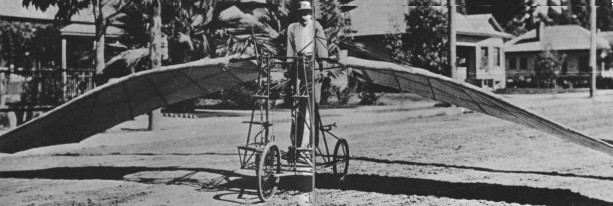
American Harry LaVerne Twining built himself a man powered ornithopter, likely with the assistance of Warren Samuel Eaton. Completed around the summer of 1909 and first appearing in the October 1909 issue of Aeronautics it was tested late in 1909.

It consisted of a tricycle to which articulated 8.2 m (27 ft) wings, operated by foot stirrups, were attached. The Los Angeles Daily Times dubbed it ‘Twining’s Flip Flop’ and assured worried readers that Twining did not intend to rise far from the ground at first, which was just as well because the flip flop was a complete flop, flapping furiously along a Los Angeles street but barely rising an inch.

As President of the Aero Club of California, Twining entered his second ornithopter into the 1910 Los Angeles International Air Meet at Dominguez Field.