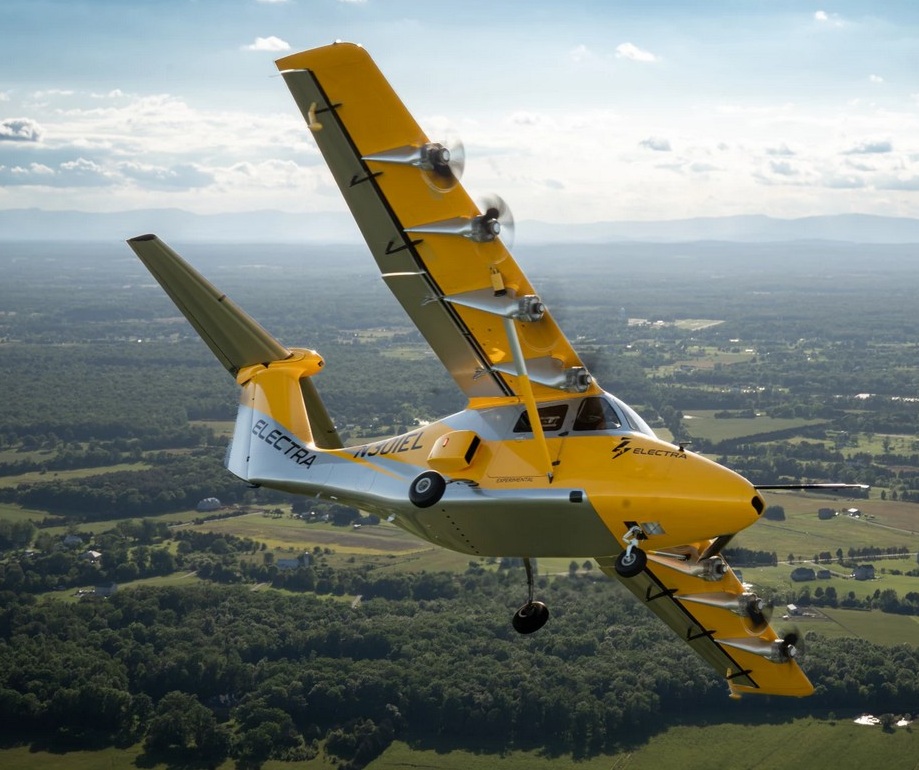
The Electra STOL (short take-off and landing) aircraft features eight electric props along the front edge of its wings. To help achieve the blown lift effect – which results in lift off at relatively low speeds of 35 mph (56 km/h) along a short runway – the aircraft sports large flaps at the rear edge of the wings.
The eight small-diameter, five-bladed propellers along its wing run on quiet electric motors, fed by a big enough lithium battery pack to allow fully-electric takeoff and landing, and quiet flight over populated areas. Electra promises just 75 decibels at a distance of 300 ft (91 m).
In August 2025 Electra demonstrated at Virginia Tech take off and land using an airfield that’s one-tenth the size of a standard runway demonstrating “blown lift” aero and hybrid-electric propulsion capabilities. Power for take-off is provided by onboard batteries, with the system switching to a small turbogenerator for cruising or topping up the batteries while in the air.
The company has been test flying the two-seat EL2 prototype since at least May 2024, but the flights at Virginia Tech – in partnership with Surf Air Mobility – represent the first series of public demonstrations.
Though the prototype did take-off and land utilizing a 300 x 75-ft (91 x 23-m) paved surface at the expansive Blacksburg campus, the EL2 showed off its flexibility by tackling other surfaces too. These included an access road in cooperation with Virginia’s Department of Transportation, and a grass field at the university’s Corporate Research Center.
The company has notched up more than 2,200 orders from over 60 operators around the globe, and is looking to start commercial flights of the EL9 Ultra Short nine-passenger aircraft by 2029.
The Alia-250 was inspired by an Arctic tern and features a 50-foot (15-m) wingspan and an in-house-built electric propulsion system powered by high-density lithium batteries. Beta estimates a 250-mile (402-km) range and top speed of 138 mph (222 km/h).
In 2021 Beta Technologies received the very first military airworthiness approval for manned electric aircraft flight, meaning the Air Force was confident enough to put its own pilot in the seat and take flight. A few months ago, Beta delivered the Alia platform (in conventional takeoff and landing/CTOL form) to the US Air Force at Florida’s Eglin Air Force Base.
Beta completed a full transition from VTOL hover to wing-borne cruise, and then back to hovering for landing, becoming the first company ever to demonstrate that feat with a pilot on board. Beta test pilot Nate Moyer took the helm at New York’s Plattsburgh International Airport, guiding the Alia-250 straight upward off the ground via its four horizontal electric propellers in April 2024.
Once it was high enough, the rear propeller kicked in, and as the aircraft gained enough speed for the wing to take over, the wing-top propellers slowed to a stop for a short cruise flight. Shortly thereafter, it turned around, the four propellers flipped back on, and it glided down toward the airstrip before coming to a mid-air halt and gently dropping straight down for the landing.
Alia-250
This ALIA CX300 electric conventional take-off and landing aircraft has kicked off Norway’s Test Arena for Zero & Low Emission Aviation after completing a weeks-long tour of major European countries in 2025.
ALIA CX300
In 2025 BETA Technologies has delivered its ALIA CX300 electric CTOL to the company’s first customer. The short-hop passenger aircraft will now be used to evaluate use cases and possible routes for zero-emission operation in the Nordic region.
Unlike its electric vertical take-off and landing counterpart – the A250 – the ALIA CX300 gets in the air and lands using a runway. It’s designed to carry five passengers plus a pilot over short distances between airports, and features an electric motor driving a single five-blade prop to its rear. According to the spec sheet, its onboard batteries should be good for more than 300 nautical miles between one-hour top-ups.
ALIA CX300
The aircraft’s very first passenger pioneers were flown from Long Island to the John F. Kennedy International Airport, staying in the air for 45 minutes. Now the first ALIA CX300 has been delivered to Bristow Norway AS, a subsidiary of US helicopter operator, the Bristow Group.
The delivery to Stavanger Airport in Western Norway’s Rogaland county also marks the end of a weeks-long 6.976-km (4,335 mile) demonstration tour of seven EU countries by the aircraft, which began in Ireland and closed in Norway. It also signals the start of operations for Norway’s Test Arena for Zero & Low Emission Aviation.
The first test flight by a BETA-trained Bristow pilot was also undertaken at the launch event, following on-site instruction at BETA’s Vermont headquarters recently. Bristow pilots and aircraft maintenance personnel will now undertake further demonstration flights over the next six months, in cooperation with Avinor and the Civil Aviation Authority of Norway, as part of a “six-month regulatory sandbox evaluation project.”
BETA ALIA CX300
The battery-electric aircraft, manufactured by BETA, seats two crew and up to 5.6 cubic metres of cargo on missions for up to approximately 398km.
The ALIA CX300 first took off in New Zealand on 17 October 2025, flying in New Zealand from Tauranga to Hamilton after a sunrise blessing ceremony.
Aviation history was made by Banbury based Skyfly Technologies in 2025, when its Axe aircraft travel from Turweston Aerodrome in Northamptonshire to Bicester Airfield in Oxfordshire, and back again. Europe’s first airfield-to-airfield flight of a fully electric vertical take-off and landing (eVTOL) aircraft. Skyfly’s chief technical officer and test pilot, Dr William Brooks, piloted the prototype craft for the test flight. The outbound journey took 12 minutes and the return took eight minutes and Mr Brooks said the aircraft “performed very well”. He added: “It has a gentle feel in turbulence, giving the impression of more span because of the motor masses at the tips. “The comfort, outstanding view and lack of noise make for enjoyable flying.” The aircraft can take off and land both vertically and conventionally and received the necessary UK Civil Aviation Authority clearance for flying in 2024. The Axe features eight electric motors – two on each wingtip enclosed in a single nacelle – powered by high-capacity lithium batteries housed within the fuselage. These batteries are swappable and removable for convenient charging. The prototype has now been readied for a trip to the United States at the end of July, where it will appear at EAA AirVenture in Oshkosh – an event for experimental aircrafts.
Specifications:
Aircraft type: eVTOL passenger aircraft (and has a hybrid-electric VTOL option)
Piloting: 1 pilot
Capacity: 1 pilot and 1 passenger (or 2 passengers when the aircraft becomes autonomous)
Cruise speed: 161 km/h (100 mph)
Range (batteries): 161 km (100 miles)
Range (with generator, a range extender): 322 km (200 miles)
Flight time: Unknown
Empty Weight: 182 kg (401 lb)
Maximum payload: 172 kg (379 lb)
Maximum takeoff weight: 600 kg (1,323 lb)
Propellers: 4 propellers
Electric motors: 8 electric motors
Power source: Batteries or batteries with a generator to produce electricity
Fuselage: Carbon fiber composite
Window: Canopy over cockpit
Wings: Canard wings (2 wings)
Tail: 1 rudder
Landing gear: Fixed tricycle wheeled landing
The company’s Midnight flagship air taxi broke cover in November 2022, sporting 12 rotors mounted along its wings – six dual-blade types at the rear locked in upward configuration plus six five-blade versions to the front capable of tilting for forward flight. Archer was aiming for top speeds of 150 mph (241 km/h) and a per-charge range of 100 miles (161 km).
By early 2023, a Midnight prototype was built and ready start test flights, which began in October. Its first transition from vertical hover to forward flight followed in July of last year, but May 2025 the pilot seat has been empty.
Archer’s five-seat Midnight air taxi rose vertically from the tarmac in the latter half of 2023, following years of testing and tweaking of prototypes like the two-seat Maker demonstrator.
In May 2025 Archer was testing the piloted conventional take-off and landing (CTOL) capabilities of its Midnight aircraft. Archer has released video footage of the first flight of its Midnight eVTOL with a pilot at the controls, though the aircraft rolled down a runway to take off rather than using its rotors to lift it vertically.
With chief test pilot Jeff Greenwood in the cockpit taking the aircraft prototype down a runway and up into the air to “demonstrate the robustness of Midnight’s landing gear” during conventional take-off and landing operations.
Chief Test Pilot Jeff Greenwood at the controls of the Midnight aircraft
The pilot managed to get the eVTOL in CTOL testing mode up to 125 mph (over 200 km/h) and reached a maximum altitude of more than 1,500 ft (~460 m) above ground level.
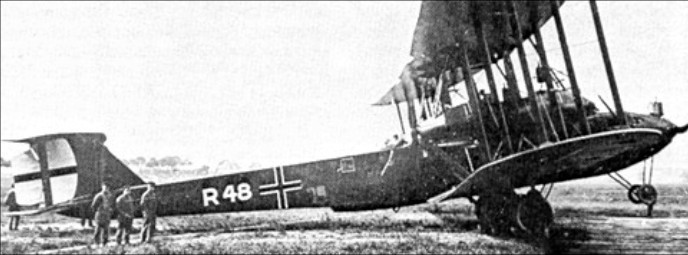
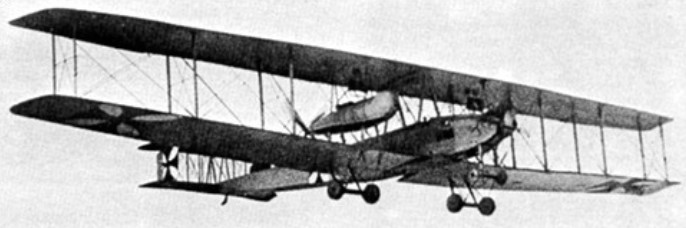
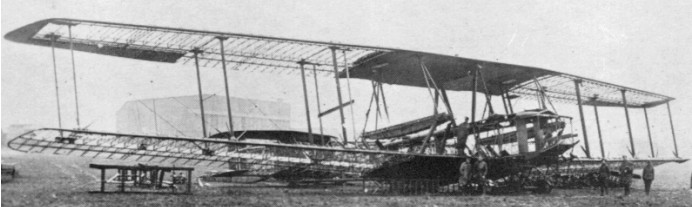
R.XV Engines: 5 x Maybach Mb.IV Max take-off weight: 14450 kg / 31857 lb Wingspan: 42.2 m / 138 ft 5 in Max. speed: 130 km/h / 81 mph Armament: 6 machine-guns
The company’s first product, the Rs I multi-engined flying-boat, was wrecked before its first flight, but three differing examples were developed progressively, the Rs IV prototype flying in 1917.
The R.VI which was built by Automobil and Aviatik, Ostdeutsche Albatros Werke and Luftfahrzeugbau Schütte-Lanz and carried out successful raids against Allied territory, dropping bombs as large as 1,000kg.
The R.VI had four engines, 4-7 machine-guns, eighteen wheel landing gear, and the capability of carrying eighteen 220 lb bombs internally. With a maximum take-off weight of just over 11.25 tons, it was used to make attacks on both France and Britain.
R.IV Engine: 4 x Benz Bz.IV, 164kW + 2 x Mercedes D.III, 119kW Max take-off weight: 13035 kg / 28737 lb Wingspan: 42.2 m / 138 ft 5 in Max. speed: 125 kmh / 78 mph Armament: 6-7 x 7.92mm machine-guns
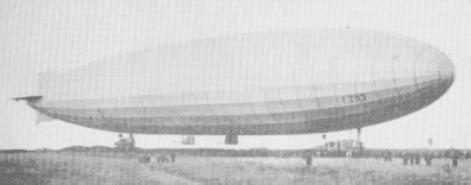
The L70 (company designation LZ112) represented the final type of military Zeppelin (Zeppelin Typ X), and was conceived around the importance of making an entry to the Atlantic round the north of Scotland and having swift climb characteristics, the emphasis therefore being put on fuel capacity and a lightened structure.
Four airships of this type were planned, of which L70 was the prototype, and the only one to be powered by seven engines, unique among naval lighter-than-air craft. It was work over the Dogger Bank that found L70 on its first operation, a routine patrol during which units of the British fleet were reported. Despite the heavy cloud, course was altered and the targets identified, 10 bombs being dropped on the ships despite concentrated anti-aircraft fire, an example of the type of action in which lighter-borne interceptors would have been of use.
Zeppelins of this type were not planned for patrol work alone however, and despite the fact that by 1918 aeroplanes were exhibiting much greater usufulness for attacks on targets in the British Isles, the day of the airship was not completely over. Thus the L70 was committed to a raid on 5 August, an attack that some thought foolhardy since it was planned to take place before it had grown completely dark. This is the action which cost the lives of not only the entire crew, including the commander Kapitänleutnant von Lossnitzer who had been responsible for the attack on the naval vessels, but also Peter Strasser.
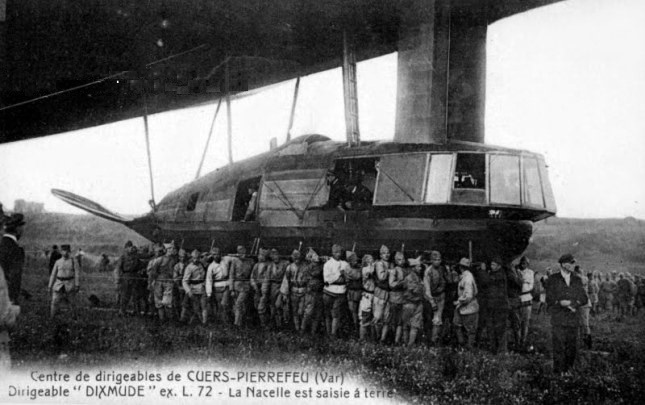
Of the planned four units of the Typ X variants, only two others were built, though only one was commissioned into the Germany navy. This was the L71 (LZ113) later handed over to the UK. The L72 (LZ114) was completed after the Armistice as the Dixmude and was delivered to France as part of war reparations. These vessels differed from the L70 in having six Mb IVa engines and a volume of 68500 m3 (2,419,059 cu ft) in a hull lengthened to 226.5 m (743 ft 1.3 in).
LZ113
The French ex-German LZ114/L 72, renamed Dixmude, was lost with all hands (44-man crew) between Sicily and Tunisia on December 21, 1923.
French Navy airship Dixmude
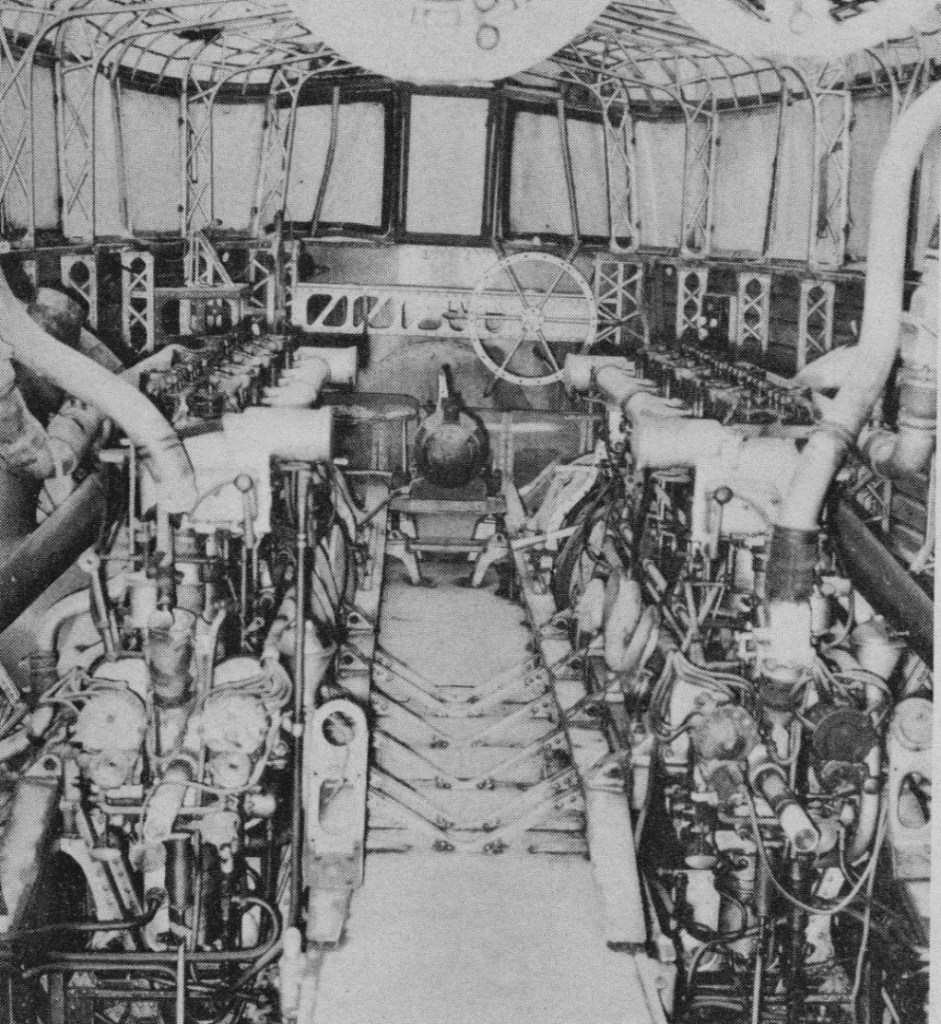
The rear nacelle of the L- 71 (LZ 113) “X” Class Super Zeppelin was given the France in 1920 and located at the Musee de L’Air,
L- 71 (LZ 113)
L70 (Zeppelin LZ112) Type: strategic bomber and patrol airship Powerplant: seven 193.9-kW (260-hp) Maybach Mb IVa six-cylinder water¬cooled piston Maximum speed 130 km/h (81 mph) Service ceiling 7000 m (22,9660 ft) Range 6000 km (3728 miles) Empty weight 28260 kg (62,303 lb) Useful lift 43500 kg (95,901 lb) Diameter 23.95 m (78 ft 6.9 in) Length 211.50 m (693 ft 10.8 in) Volume 62200 cu.m (2,196,576 cu ft) Armament: up to 10 7.92-mm (0.312-in) Maxim machine-guns on free mountings above hull, plus bombs
L- 71 / LZ 113 Engines: 7 x H.S.L.U. Maybach, 240 hp Length: 693 ft Diameter: 79 ft
While being built as a Zeppelin Typ V, the L59 (LZ 104) was hurriedly leng¬thened as the second Zeppelin Typ W. This was to replace the L57 which had been chosen for a special mission in November 1917 and, as the LZ102, con¬verted from a Typ V to the first Typ W before being damaged in a storm in October. L57 was intended to fly to German East Africa to aid General von Lettow-Vorbecks forces in the theatre by flying out a sizeable quantity of sup¬plies; the vessel was thereafter to be used as a bomber. Together with the best men of his crew (the cream of each usually moved with the commander) Kapitän¬leutnant Ludwig Bockholt from L57 took charge of L59 without delay, and such was the urgency of the mission that when a member of the crew was discovered to have sold a large part of the rations and made up the cases with the equivalent weight, there was no time to re-provision and the deficit had to be made up with emergency self-heating foods. Although crews for bombing mis¬sions were sometimes reduced to 15 to allow an enlarged offensive load, the full complement of 21 was carried when the vessel set out in November. However, the airship was forced to turn back twice, on the second occa¬sion as a result of damage caused by rifle fire from Turkish railway guards, so that a 32-hour return journey re¬sulted in the next attempt being de¬layed until suitable weather on 20 November. In point of fact a large portion of von Lettow-Vorbecks forces had been forced to surrender on the same day, the commander escaping with a small party to continue the fight after captur¬ing Portuguese supplies, but the recall by radio failed to be picked up in L59. Instead course was set across the Libyan desert where the heat made the vessel difficult to control after gas had been lost through the automatic valves; soon after this one engine began to give trouble. The vessel was beyond the Nile when one of the recall signals was finally heard and the long return trip began. The tropically-kitted crewmen were by now not only exhausted but suffering from the cold at the height where the flight was taking place, but the finaf leg of the journey was suc¬cessfully completed and rightly hailed as a triumph by the German Naval Airship Service, which was still re¬garded as experimental with the officers and men undergoing ‘on the ]job’ training. The problem remained what to do with the vessel and after a lengthy dis¬cussion it was decided to rebuild her for attacks against targets in the Mid¬dle East and Italy, and for these she was back at Jamboli (from which the African trips had begun) in February 1918. It was flying from here on 7 April 1918 that L59 mysteriously blew up not far from the heel of Italy.
L59 (Zeppelin LZ104) Type: strategic bomber and patrol airship Powerplant: five l79-kW (240-hp) Maybach HSLu six-cylinder water¬cooled piston Maximum speed 108 km/h (67 mph) Service ceiling 8200 m (26,903 ft) Range 8000 km (4,971 miles) Empty weight 27625 kg (60,903 lb) Useful lift 52100 kg (114,861 lb) Diameter 23.95 m (78 ft 6.9 in) Length 226.50 m (743 ft 1.3 in) Volume 68500 cu.m (2,419,059 cu ft) Armament: provision for up to 107.92-mm (0.312-in) Maxim machine-guns above hull, plus bombs
Apart from the historical factors surrounding the last operation carried out by L53, this Zeppelin Type V airship was also of some technical prominence. This lay in the fact that her construction embodied an increased spacing of her main frames, which were now 15 in (49 ft 2.5 in) apart compared with the previous norm of 10 in (32 ft 9.7 in). Measures such as these served to lighten the L53, contributing to the fact that her useful lift was some 62.7 per cent of the total, so that on her maiden raid an altitude of 6300 in (20,670 ft) was attained. Alternatively known by the works designation LZ100, this airship made its first flight on 18 August 1917 from Friedrichshafen where she had been built, and became the command of one of Peter Strasser’s most senior officers, Kapitanleutnant der Reserve Eduard Proelss. He first brought his new charge over the British Isles on the night of 24/25 September 1917 when raids were directed against targets in the Midlands and north east, 17 months after his first bombing sortie in L13, his previous command. However, it would be wrong to give the impression that Zeppelins were entirely directed to bombing missions against land targets. L53 is an illustra¬tion of this fact since of the 23 operational sorties made by this vessel be¬tween her commissioning date on 21 August 1917 and her fiery end on 11 August of the following year, only four were bombing attacks. The remainder were scouting missions over the North Sea where the endurance of lighter-than-air craft made them superior to any conventional aeroplane of the day Small wonder therefore that L53 and her nine sister craft (L55/LZ101, L56/ LZ103, L58/LZ105, L60/LZ108, L61/ LZ 106, L62/LZ 107, L63/LZ 110, L64/ LZ109 and L65/LZ111) were regarded as a standard scout type. All after L56 were fitted with Maybach motors of the supercharged Mb IVa type.
On 21 June 1921, returning from another trial flight, Beadmore R36 suffered damage during landing. The release of emergency ballast caused a sharp pitching up, straining the ship against the mooring line. The nearest unoccupied sheds were at Howden in Yorkshire since the Pulham sheds were holding German Zeppelins handed over as war reparations. The wind increased and it was decided that the LZ 109 (L 64) would have to be sacrificed to save the R36. Within 4 hours L 64 had been cut into pieces and cleared to give enough room for R36. Even then she was damaged by a gust of wind during the manoeuvre into the shed.
L53 (Zeppelin LZ100) Type: strategic bomber and patrol airship Powerplant: five 179-kW (240-hp) Maybach HSLu six-cylinder water-cooled piston Maximum speed 106 km/h (66 mph) Service ceiling 6400 m (20997 ft) Range 4680 km (2908 miles) Empty weight 24500 kg (54013 lb) Useful lift 40460 kg (89,199 lb) Diameter 2390 m (78 ft 4.9 in) Length 196.495 m (644 ft8 in) Volume 55990 cu.m (1,977,271 cu ft) Armament: two 7.92-mm (0.312-in) Maxim machine-guns on free mountings in single position above forward hull, plus bombs
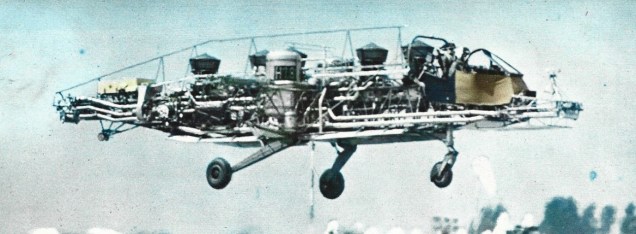
The German VFW SG 1262 Schwebegestell (hover rig) was designed and built in 1965 by Vereinigte Flugtechnische Werke (VFW) as an experimental aircraft to assist with the development of several vertical takeoff and landing (VTOL) military aircraft types that included the VFW VAK 191B, the EWR VJ 101 and the Dornier Do 31 transport. The 1262 designation relates to the initial numbering of the VAK 191B project by Focke-Wulf.
As part of the development of the VFW-Fokker VAK 191B vertical take-off aircraft, it was necessary to configure and test the monitoring of its flight control system. In order to minimise costs and risks during the development of the 191B the SG 1262 rig was designed and built in 1966 to simulate essential functions. Of high importance was the necessity to test the fly-by-wire flight control system, a redundant flight controller and a self-diagnosis system. A total of approximately 650 hours of simulation time, 2,000 hours of test runs on system test benches and 6,900 hours of wind tunnel tests were documented during the design phase of the project.
The aircraft was based on a trapezoidal frame without any skin panels. Deviating from the vectored thrust engine concept of the VAK 191B, five Rolls-Royce RB.108 turbojet lift engines with 9 kN (2,000 lbf) thrust each were mounted vertically. In addition to extensive sensor equipment, the rig used an auxiliary gas turbine for autonomous electrical power supply supply, it was also fitted with a Martin-Baker ejection seat.
The aircraft was based on a trapezoidal frame without any skin panels. Deviating from the vectored thrust engine concept of the VAK 191B, five Rolls-Royce RB.108 turbojet lift engines with 9 kN (2,000 lbf) thrust each were mounted vertically. In addition to extensive sensor equipment, the rig used an auxiliary gas turbine for autonomous electrical power supply supply, it was also fitted with a Martin-Baker ejection seat.
The control commands were transmitted via an electrical control (fly-by-wire) system with mechanical feedback. The flight control system had triple redundancy and double electro-hydraulic servo units with integrated self-monitoring. The control commands for the three axes were accomplished with compressed air nozzles that were actuated by a 280 bar (4,000 psi) high-pressure hydraulic system, movement of the main engines for control purposes was deliberately omitted. A direct mechanical back up of the compressed air control system was provided for emergencies.
40 tethered flights were initially carried out using a fixed telescopic apparatus before the aircraft flew in free flight for the first time on 5 August 1966. 150 free flights were made during the 18-month test program, including a demonstration flight at the 1968 Hanover Air Show at Hanover-Langenhagen.
Despite the discontinuation of all German vertical take-off programs the findings from experiments with the SG 1262 and experience gained from the VAK 191B project were used by German engineers during the development of the Multi Role Combat Aircraft (MRCA) project which became the Panavia Tornado.
The SG 1262 is preserved and on display at the Bundeswehr Museum of German Defense Technology in Koblenz.
Powerplant: 5 × Rolls-Royce RB.108 turbojet, 9 kN (2,000 lbf) thrust each Gross weight: 3,900 kg (8,598 lb) Fuel capacity: 800 kg Maximum speed: 75 km/h (47 mph, 40 kn) Endurance: 12 minutes Service ceiling: 200 m (660 ft) Thrust/weight: 1.15 Crew: 1









 All Aero