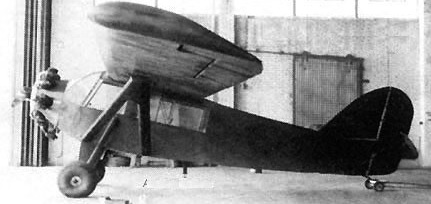
The 1930 Barling B-6 / A-1 (ATC 2-410) was designed by Walter Barling. A six-place monoplane priced at $4,995, it was powered by a 165hp Continental A-70 engine and capable of 125 mph.

Only the one, NX958N, was built.
The 1930 Barling B-6 / A-1 (ATC 2-410) was designed by Walter Barling. A six-place monoplane priced at $4,995, it was powered by a 165hp Continental A-70 engine and capable of 125 mph.
Only the one, NX958N, was built.
The 1930 Barling A was one of the first low-wing lightplanes of that time. It had an open cockpit and a single Continental engine, fixed gear and, no wing struts. It was a fabric-covered, colored a bright red orange, and apparently it flew like a homesick angel.
The 1931 Barkley-Warwick BW-1, designed by A S Barkley, was a two-place, open cockpit low wing monoplane with tandem cockpits; metal wing; twin-boom, and twin-tail empennage.
Powered by a 165hp Continental A-70 engine and registered NX11300, it crashed on a test flight, but proved the wing’s integrity by sustaining little damage.
Only the one was built.
Built in 1933 by S H Barnes, the Barnes BGX-1 N12763 c/n 1 single-place open cockpit high wing monoplane powered by a 40hp Salmson AD-9 engine, was reported as in storage in 1940.
The registration was cancelled in 1 April 1948.
The 1913 Daimler-Lutskoy No. 3 monoplane was designed by B. G. Luskoy (Russian) Built by Daimler
Speed: 85 mph

The Boffin Coffin was a man-powered aircraft designed by Mr Donald Walther of Christchurch, New Zealand, to be an entrant in the man-powered aircraft competition announced by British Industrialist, Henry Kremer, for the first human-powered aircraft to complete a figure-of-eight course covering a distance of 1.6 km (1 mile), the course to include a 3.048 m (10 ft) pole that the aircraft had to fly over at the beginning and conclusion of the flight.
Work commenced in 1982 and it soon became known as the Boffin Coffin. Construction was of resin-laminated aluminium-alloy sheet and EPS, covered with Melinex. The undercarriage was quite tall, being 0.91 m (3 ft) long. The pilot was in a prone position, head first, operating pedals driving a propeller. The aircraft had a shock absorber in the drive between the rear-wheel and the propeller.
Flight trials commenced at RNZAF Base Wigram near Christchurch by a motor-vehicle towing the machine, Mr Walther initially being the pilot. Early testing was successful, Mr Walther stating “when I took my eyes off the tiller and looked down I was looking down on the roof of the car. The aircraft came down very lightly, but I could hardly call it a controlled flight. It is a mystery just how much control there is with these ailerons on the front wing, how much they contributed to my safe landing and how much was pure luck”. Although the first flight was successful, the aircraft suffered some damage on its second flight when it landed tail-first.
In 1987 testing began with pilots Steven Preest and Trent Hiles, at this time the aircraft being fitted with pedals for the pilot to operate. However, it was found the easterly breezes over the military airbase became unsuitable for human-powered flight. In fact, even in the hangar when stored the aircraft was blown into the hangar wall, causing considerable damage. It also received damage in the hangar by people unaware of the delicate nature of the aircraft.
In July 1988 work on the project was abandoned and it was placed in storage.
Wingspan: 13.7 m (45 ft)
Forward wing area: 13 sq.m (140 sq ft)
Rear wing area: 11 m² (120 sq ft)
Weight: 57 kg (126 lb)
The 1933 Barclay Monoplane was a two-place open cockpit powered by a 65hp LeBlond engine and registered N13602 c/n 2001.

The Shenyang HU-1 Seagull is a Chinese powered glider built by the Shenyang Sailplane Factory at Shenyang.
The Seagull is a two-seat powered glider made from aluminium alloy with parts also made of wood, glassfibre and fabric. It has an overwing mounted 116 hp (87 kW) Lycoming O-235-N2A engine.
Wing Span: 17 m
Length: 7.6 m
Height: 1.7 m
MTOW: 1000 kg
Maximum Range: 480 Nm
Take Off Distance: 180 m
Absolute Ceiling: 15,000 ft
Optimum Ceiling: 10,000 ft
Maximum Speed: 121 kts
Optimum Speed: 86 kts
Maximum Climb Rate: 780 ft/min
Seats: 2
The 1977 Ball-Bartoe JW-1 Jetwing research aircraft was a single-place mid wing monoplane, registered NX27BB, first flew on 11 July 1977, piloted by Herman “Fish” Salmon.
The Jetwing features retractable undercarriage.
Engine: P&W JT15D-1, 2200 lb
Wingspan: 21’9″
Length: 28’7″
Useful load: 820 lb
Max speed: 399 mph
Stall: 68 mph
Seats: 1
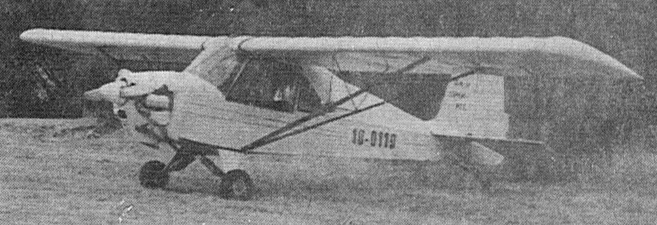
This was an ultra-light aircraft which was allotted the registration 19-1309 (c/n 2) by Recreation Aviation Australia (RAA) and appeared on the register from 17 October 1991 to 3 December 2008. It was designed and built by Andrew Shay and was fitted with a Jabiru 1600 four-cylinder engine.

 All Aero