Back to Guimbal Cabri G2
Guimbal Cabri G2 Review: 2025
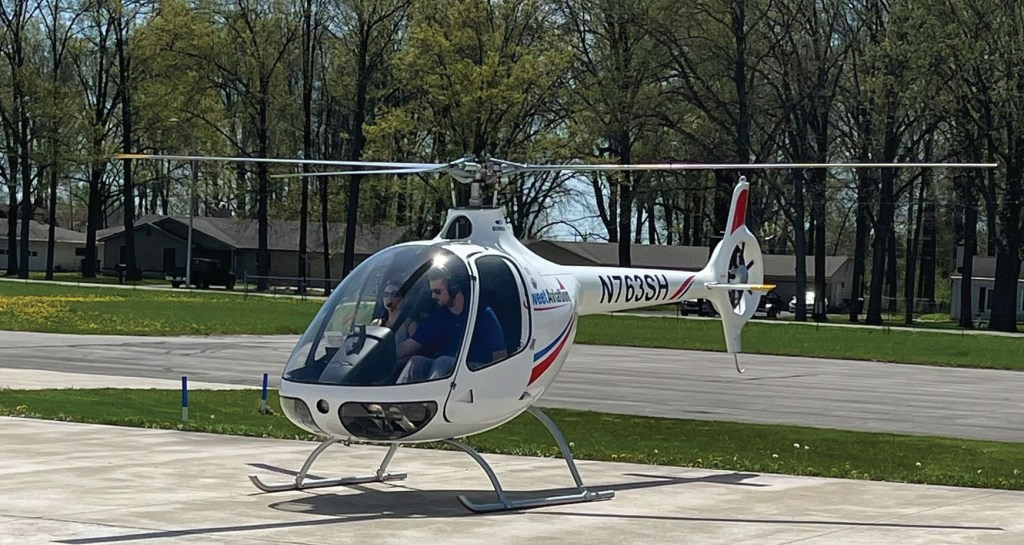
What weighs 945 pounds, is a little over 20 feet long, stands just under 8 feet tall, has room for two, and costs about $600 a pound? That would be a new Guimbal Cabri G2 helicopter.
The little helicopter was brought to market in 2008 after gaining regulatory approval after decades of development beginning in the 1980s.
According to Sarah Brazel, manager of North American operations for the U.S. Guimbal distributor, Precision Support Services, when former Eurocopter engineer Bruno Guimbal went about engineering and designing the personal helicopter, he wanted to make sure that it was the safest, easiest-to-fly-and-maintain helicopter, providing long-term value to the private owner, or the helicopter flight school operator.
By most accounts, Guimbal has succeeded at that goal—one he started cultivating during his years working at Eurocopter, the forerunner to Airbus.
As the years progressed, he began integrating safety-related technologies and advancing the design, culminating in the aircraft we now see sitting proudly on airport ramps across the country and the world.
But for those who are uninitiated, the likely words when they first set eyes on the Cabri G2 will be, “It’s so tiny!” And at first glance, they would be right.
Some say it’s small but mighty, a mini-me version with DNA of the Eurocopter EC120 or AS365 Dauphin. They wouldn’t be wrong with the fully articulating three-bladed rotor system, Fenestron tail rotor, and instrument panel replicating those of its bigger brothers.
And none of this is by coincidence.
Michael Neese, operations manager and certified helicopter flight instructor for Sweet Aviation in Fort Wayne, Indiana, said one of the significant advantages of the Guimbal Cabri G2 is that it was designed with safety in mind.
“[We protect] the pilot and the aircraft with systems in place for the instructor, such as the high-inertia rotor system, which allows the student to make safe mistakes, with plenty of time for the instructor to react,” Neese said.
Since many students learning to fly helicopters do so to become commercial rated and part of that workforce, the transition from the Cabri to a larger turbine helicopter is smooth and intuitive, according to those who have done it. With that in mind, students may find that the instrument layout, including the full glass panel, along with placement of the engine controls and related switches, replicate that of a helicopter that they might find themselves flying in the right seat for a commercial operator.
“The long-term value, low operating cost, and lower depreciation of the Cabri G2 makes good business sense,” Brazel said, “along with the exceptional peace of mind of the factory warranty that comes with every new [one].”
But what about the seemingly small stature of the ship?
I had an opportunity to fly the G2 with the folks at Sweet Aviation, and after spending time with it on the ground and in the air, I can tell you that looks are deceiving.
The interior is roomy for its class, with a cabin width of 49 inches across. And while you won’t be putting two linebackers from the Philadelphia Eagles in the cockpit, you certainly could fit two FAA standard occupants and not have to worry if one of you ate a big lunch, putting you over gross weight.
Speaking of which, the gross weight of the G2 is 1,543 pounds, with a payload of 595. It comes standard with a 45-gallon fuel tank that feeds the 180 hp Lycoming O-360 J2A piston engine, burning 100LL fuel at approximately 10 gph.
With most of my helicopter flight time spent in the popular Robinson R22, I was eager to compare the flight characteristics between the G2 and R22.
As I strapped myself into the right seat and buckled up with the four-point shoulder harness, CFI Neese joined me in the left seat. We began the checklist for getting this bird in the air.
I immediately noticed the modern cockpit with full glass instrumentation, complete engine monitoring, and electronic CDI ignition. Automatic carb heat was another warm touch. In addition, easy pedal adjustments rounded out the modern cockpit, and soon the Lycoming engine was coming to life.

Once the engine stabilized at 75 percent, it was time to engage the rotor system. This is a manual process on some older helicopters like the Enstrom. On the G2, calling it simple is an understatement. You simply turn on the clutch switch, and the centrifugal clutch will gradually increase the rotor rpm. Easy.
After oil pressure and cylinder head temperatures warm up, it’s time to increase the rotor rpm to 100 percent, utilizing a very effective throttle governor. This is not your father’s Bell 47. Throttle control is almost as smooth and easy as a turbine.
As I increased collective and felt the helicopter get light on the skids, I was reminded that this ship utilizes a Fenestron tail rotor system.
For those that don’t know, the Fenestron is an enclosed helicopter tail rotor that operates like a ducted fan. It was first developed for the Aerospatiale Gazelle, and in the 1990s a third-generation Fenestron was produced by Eurocopter and fitted on the company’s EC series helicopters. Bystander safety and a quieter design are just a few advantages of a Fenestron.
However, pilots, especially students, must be mindful that they may feel a “sticky spot” when applying right pedal, where they believe they have run out of pedal movement. They haven’t. They just need to keep pushing and use everything available.
However, because some students were not using everything available for pedal movement, Guimbal in 2019 sent CFIs from around the world to France to partake in an instructor factory training course. There they addressed how the Fenestron reacted and learned about and provided guidance to those instructors that were seeing the “sticky spot” that got some of their students in trouble.
“There is plenty of pedal authority in the G2,” Neese said. “You just have to know how to recognize it and use all of it.”
I found that true and had no issues with pedal authority on my flight. As we transitioned from hover to forward flight, I found the controls responsive, without being twitchy. Beginning our cruise at 1,000 feet agl, the fully articulating rotor head was like wrinkles to Botox—it smoothed out everything and provided a nice, comfortable ride.
Like most helicopters, visibility is superb. The G2 is no exception. The noise level is what you would expect in a helicopter, although I took off my ANR headset and listened. Compared to other piston helicopters I have flown, I would say the G2 is quieter. I am told the Fenestron might be a contributing factor to that as well. I wouldn’t ditch your ANRs, but for those in the cockpit or on the ground, it would seem to have a quieter foot-print than most copters.
Regarding comfort, ventilation was superb—once you got some forward movement. On those really hot days, the G2 is approved for flight with doors off. In addition, you can fly it with the door cracked open a few inches for additional ventilation, utilizing a factory-approved bungee strap.
There are now over 375 G2s flying across the globe (2025). Over 70 of those are in the United States.
There have only been three fatal accidents in the fleet. Two were midair collisions, and the remaining one in the U.S. was a controlled flight into terrain (CFIT) instance, VFR into IFR conditions. None of those three were attributed in accident reports to the aircraft itself.
There are only four-time life components on the helicopter— the engine at 2,000 hours, the main and tail rotor gearboxes that require overhaul at 2,200 hours (with no life/ years limit), and the swashplate for an overhaul every 6,000. Those are the only life-limited components.
The estimated operating costs (2025) for the G2 range from $200-$300 per hour, based on 100-500 hours per year. A reasonable amount includes fixed costs, reserves, insurance (for private users estimated at $18,000-$25,000 annually), and other ancillary costs.
——————————-
 All Aero