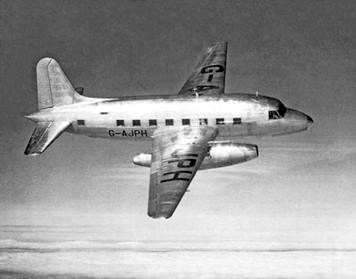
The Ministry of Aircraft Production Air Ministry Specification 17/44 from Vickers-Armstrongs Limited. The specification was for a peacetime requirement for an interim short-medium haul passenger aircraft. To speed development the aircraft used the wing and undercarriage design from the Wellington but the fuselage was new. Although the original contract referred to Wellington Transport Aircraft, on completion, the name Viking was chosen.
The initial 19 production aircraft (later designated the Viking 1A) carried 21 passengers, they had metal fuselages and – except for the wing inboard of the nacelles – fabric-clad geodetic wings and tail units. Following feedback from customers, the next 14 examples, known as, featured stressed-metal wings and tail units. The next variant, the Viking 1B, was 28 in (71 cm) longer than the Viking 1, carrying 24 passengers with up-rated Bristol Hercules piston engines, achieved a production run of 115.
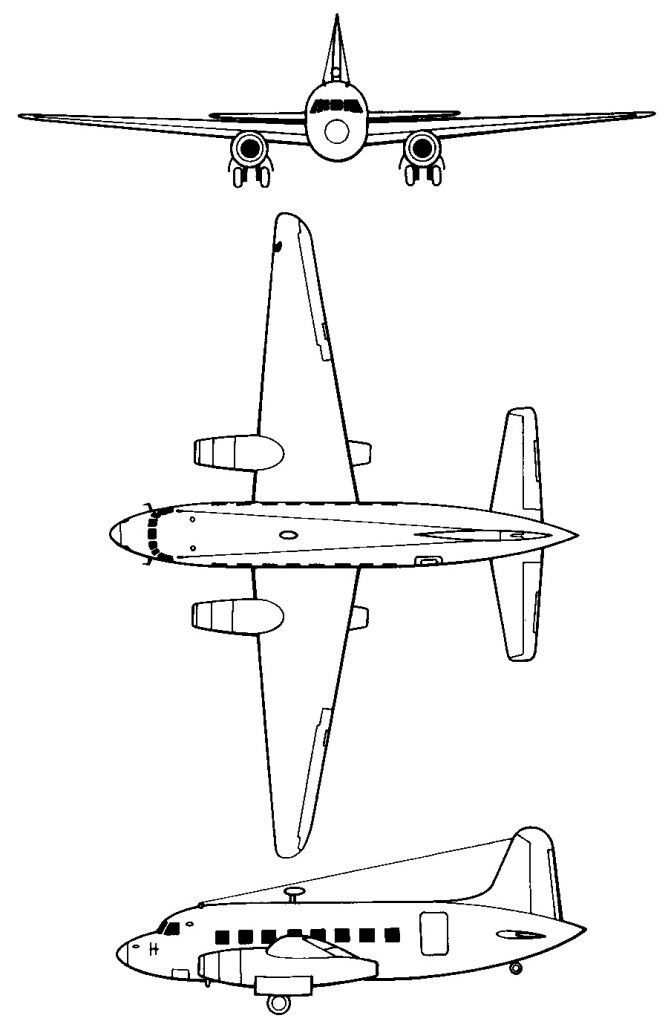
The 107th airframe on the Weybridge production line was set aside, and the existing nacelles were replaced by completely new jet pods each housing a Rolls-Royce Nene, with the trailing edge of the wing extended at the rear to fair smoothly into the top of the pod. The Vickers main landing gears were of a totally new type, designed only for this aircraft, with four separate short legs each carrying a wheel which retracted to lie on each side of the jet pipe inside the nacelle. Unlike other Vikings the elevators were skinned with metal, and the metal skin on the wings and tailplane was made thicker than normal. There were also changes to the cockpit, fuel system and other items.
Chief test pilot J ‘Mutt’ Summers flew the Type 618 Nene-Viking from Wisley on April 6, 1948. At different times it bore civil registration G-AJPH and Ministry serial VX856.
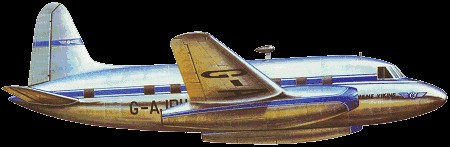
On 25 July 1948, on the 39th anniversary of Blériot’s crossing of the English Channel, the Type 618 Nene-Viking flew Heathrow–Paris (Villacoublay) in the morning carrying letters to Bleriot’s widow and son (secretary of the FAI), who met it at the airport. The flight of 222 miles (357 km) took only 34 minutes. It then flew back to London in the afternoon. It obtained a maximum speed of 415 mph (668 km/h) at 12,000 ft (3,700 m) and averaged 394 mph (634 km/h). In 1954 it was bought from the Ministry of Supply and underwent the substantial conversion to Hercules 634 piston engines by Eagle Aviation to join their fleet as Lord Dundonald on September 24, 1954.
Engines: 2 x 2268kg Rolls-Royce Nene I turbojets
Wingspan: 27.2 m / 89 ft 3 in
Wing area: 81.93 m2 / 881.89 sq ft
Length: 19.86 m / 65 ft 2 in
Height: 5.94 m / 20 ft 6 in
Empty weight: 9548 kg / 21050 lb
Take-off weight: 15196 kg / 33502 lb
Max. speed: 753 km/h / 468 mph
Cruise speed: 632 km/h / 393 mph
Range: 555 km / 345 miles
Crew: 4
 All Aero