In August 1943, the second Allied air front gained increasing importance. This consisted of Allied planes operating out of North African bases against German-occupied Europe.

At dawn on Sunday 1 August, 178 B-24 Liberator bombers of the US 9th Air Force took off from Bengasi airstrip, Libya. One B-24 suffered machine damage at take-off and collided with a concrete pole. The others formed up to fly across the Mediterranean and hit the Rumanian oil region of Ploesti.
Each Liberator bomber carried a 2-ton bombload load and needed more than 9 tons of fuel to complete its outbound and return flights, a total distance of approximately 2100 miles. The plan was for the formation to fly under the German radar screen and attack the target at treetop level. This low-level raiding would enable the bombers to attack individual refineries with extreme precision.
An event unique in the history of World War 2 occurred in July 1943 when the allies succeeded in breaking the Luftwaffe’s weather code and used a decoded German radio message to decide on the ideal date for the raid on Ploesti. The German codes were routinely changed every month, so August 1 was the last day when the Allies could learn about weather conditions at Ploesti by intercepting a German message. But what the US planners of the raid did not know was that German General Gerstenberg, in charge of air defence at this strategically important target, had turned the oil centre into the most strongly defended installation in Europe.
Just one hour after take-off, the German defence at Ploesti already knew that a large formation of US bombers was flying across the Mediterranean headed northeast. They knew this because the Germans had decoded a US radio message addressed to all the Allied air defence zones between Bengasi and Ploesti, informing them of the route to be taken by the bombers and warning the Allied air defence not to fire on the bombers by mistake.
Ten of the bombers crashed due to engine damage during the three-hour flight over the Mediterranean and another grave incident occurred just before the formation reached the Albanian coast, when the aircraft carrying the operation’s chief navigator suddenly went into a spin, flipped over and crashed into the sea. The bomber carrying the deputy navigator made a vain search for survivors and while doing so lost contact with the formation and was forced to head for home. Now that both leaders were missing, a young and inexperienced officer assumed command. The bombers ran into a dense wall of cloud over Yugoslavia. The two forward groups climbed high to fly above the clouds; the three stayed just high enough to avoid the mountain tops. The first two groups were caught in a powerful tail wind and rapidly increased their distance from the groups following. When the B-24s emerged from the mountains into the Danube Valley, the formation was widely dispersed.
To ease navigation the Americans had selected three cities to use as control points; but these looked much alike and the ground fog made it hard to identify them. Shortly before reaching the target, the two leader groups made a disastrous mistake. They took a wrong turn and instead of flying to Ploesti, ended up at the Rumanian capital of Bucharest about 30 miles away, where they strayed into the densest flak belt. The Rumanians discovered the bombers making their low-level run, and this gave the air defences at Ploesti enough time to prepare for the raid.
When the two leader groups noted their mistake, they turned to approach Ploesti, but from the opposite direction from what they planned. Their new heading led them to cross the paths of the three groups that had been left behind over the mountains. Now the bombers were in a state of chaos over the target, and concentrated flak fire greeted them from all directions.
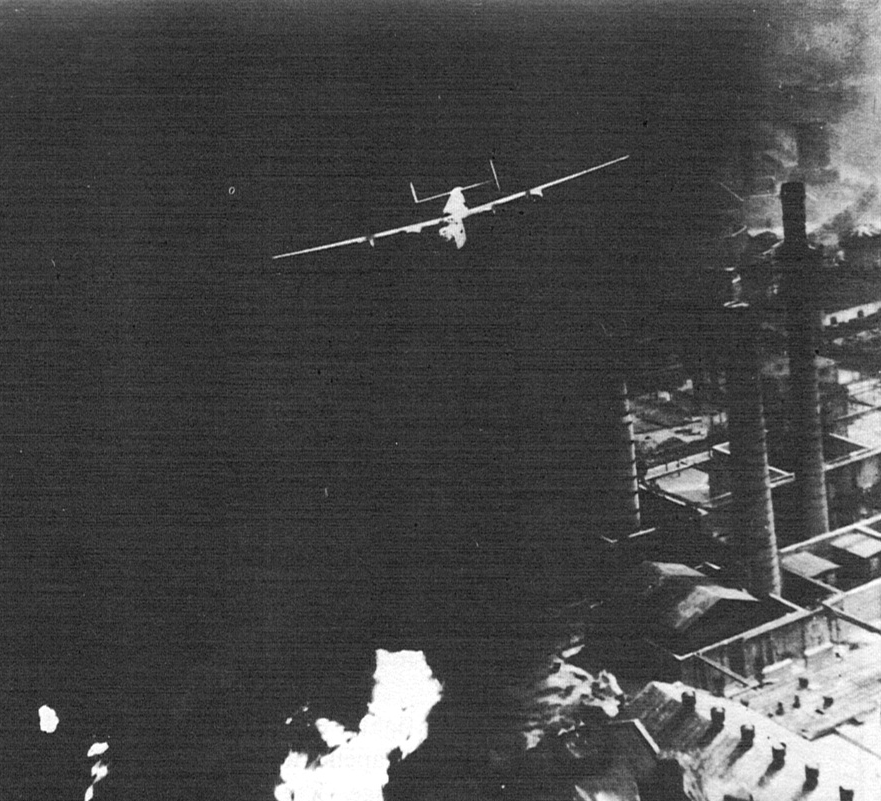
The bombers swayed under the impact of exploding missiles. One B-24 crashed into a flak battery in flames. The B-24 ‘Hell’s Wench’ severed a barrage balloon cable, was hit by 5 flak projectiles and caught fire, but went on to lead its group to the target before it crashed over the refineries. Large numbers of bombers spun into the city streets; one fell into a women’s prison in Ploesti burying many of the inmates under the debris.
While one bomber group scattered to locate its targets, two groups approached from the opposite direction. Seconds later the three groups were weaving in and out of each other’s ranks desperately trying to avoid collisions. Meanwhile they were under non-stop attack from German and Rumanian fighter planes.
The rope of a barrage balloon tore off the wing of a Liberator. Another B-24 rammed into a chimney;
Another could not nose up in time and ran into an oil tank. “We pulled through the gates of Hell” one of the pilots said later.
The raid on Ploesti was over in 27 minutes. The remaining Liberators set out on the long journey flight back to Bengasi, some flying in formation, some alone. Half were damaged and most had dead or wounded on board. Several bombers managed to reach Allied-occupied Mediterranean islands. “We landed on a highway in the mountains of Cyprus,” one pilot reported. “I pulled over looking for a place to park, and there was a truck crashing straight into us.” Another Liberator just managed with its last gasp to reach an airfield in Sicily and crashed into 7 American P-40 fighters at the end of the runway. “No one was hurt, but our crew got a very cool reception.” Two Liberators had to make emergency sea landings when they ran out of fuel; two others collided in the air over Bulgaria.
Not until late afternoon did the first bombers begin to arrive back at Bengasi. Mos of the airmen were too numb and exhausted to report on their missions. The last Liberator to arrive, had been airborne for 16 hours.
Of the 178 bombers that had taken off, only11 returned to Bengasi; 54 had been shot down by flak over Rumania and three over the sea, others crashed during the outbound and return flights; 7 landed in Turkey. Five hundred and thirty-two flying personnel were lost. The positive consequences of the raid were that oil production at Ploesti was reduced by 40% for a period of two months.
 All Aero