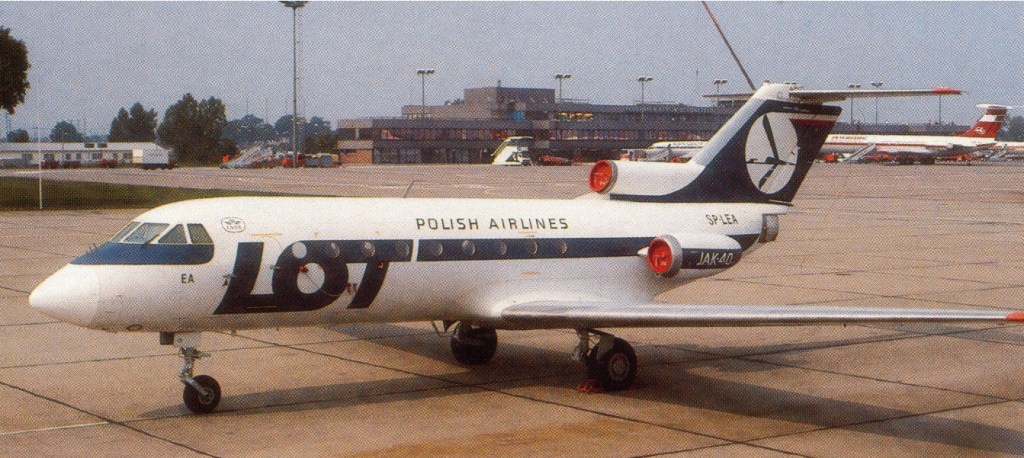
Development the Yak-40 as a replacement of the ageing LI-2, Il-12 and Il-14’s, started in 1965 by the Yakolev Design Bureau. The Yak-40 was required to operate from Class 5 grass airfields or semi-prepared strips. The resulting aircraft has high-lift lightly-loaded wings and, for added safety, three Ivchenko AI-25 turbojets. All three engines are operated on take-off, but the central engine may be throttled back to idle for fuel economy during cruise. In configuration, the Yak-40 is a cantilever low-wing monoplane with retractable tricycle landing gear, rear-mounted engines and with accommodation for a flight crew of two or three and up to 32 passengers. The provision of a ventral rear door with airstair makes it possible to operate the Yak-40 from airfields with minimum facilities, and an onboard auxiliary power unit makes the type independent of ground equipment for engine starting and the maintenance of cabin heating and air-conditioning.
The first prototype tri-jet was flown on 21 October 1966, the Yak bureau eventually building five pre-production test airframes. The type entering revenue service with Aeroflot on 30 September 1968 with 2 crew and 27-31 passengers (NATO reporting name ‘Codling’).
The Yak-40 is cleared for Class Five grass airfield operations, and to improve its short landing performance a single clamshell thrust reverser has been fitted to the centre engine on later production models. The rear mounted turbofan engines enable it to take off and land within 1500 ft (500 m), and it can operate from grass fields.

The Yak-40K cargo version is configured purely for the carriage of freight, the aircraft being cleared to carry a load of up to 5070 lbs in weight.
When production ended in 1980, 1011 Yak-40 airliners were built in Saratov in the former USSR. The majority of these are still in service in 1993, with both military and civilian operators.

Yak40
Engines, Ivehenko Al-25 (3 x 3300 lb thrust)
Max take-off weight, 27,500 lb
Payload. 5500 1h
Cruising speed, 405 kt
Range. 620-1240 st. miles
Take-off distance to 50 ft, 1950 ft
No. of passengers, 24
Engines: 3 x 3,306 lb (1,500 kg) st Ivehenko AI 25 turbofans
Wing span: 82 ft 0.25 in (25.00 m)
Length: 66 ft 9.5 in (20.36 m)
Wing area: 735 sq ft (70.0sq.m)
Gross weight: 30,200 lb (13,700 kg)
Max cruising speed: 342 mph (550 kph)
Typical range: 620 miles (1,000 km) with normal payload of 5,070 lb (2,300 kg)
Crew: 2
Passengers: 24 40
T/O run: 700m
Ldg run: 360m
Cargo: 5070 lbs
Engines: 3 x turbo-jet AI-25, 14.7kN
Max take-off weight: 12400 kg / 27337 lb
Empty weight: 8500 kg / 18739 lb
Wingspan: 25.0 m / 82 ft 0 in
Length: 20.2 m / 66 ft 3 in
Height: 6.5 m / 21 ft 4 in
Wing area: 70.0 sq.m / 753.47 sq ft
Cruise speed: 550 km/h / 342 mph
Range w/max.fuel: 1600 km / 994 miles
Range w/max.payload: 600 km / 373 miles
Crew: 2
Passengers: 24-33

 All Aero