During the autumn of 1946, the Yakolev OKB initiated a relatively modest redesign of the Yak-15 which was initially referred to as the Yak-15U – Uluchshennyi (improved).
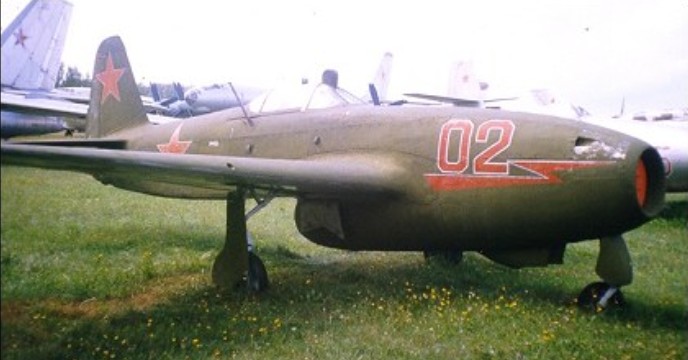
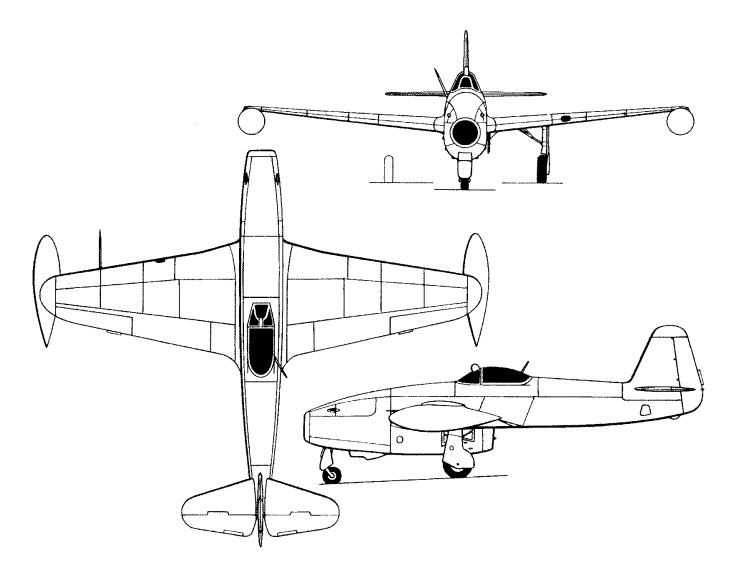
The prototype, flown early in 1947, differed essentially in having a nosewheel rather than tailwheel undercarriage. Owing to the position of the engine, it was physically impossible to retract the nosewheel completely, and this was therefore partly enclosed by a fixed fairing. Introduction of a nosewheel demanded transfer of the main undercarriage members from the forward to the rear wing spar and dictated considerable structural redesign and a reduction in wing tankage. To compensate, a jettisonable 300-litre tank was added beneath each wing tip. Redesignated Yak-17, this fighter was restressed throughout and, in series form, was fitted with a redesigned vertical tail and an RD-10A engine rated at 1000kg. Armament remained two 23mm NS-23 cannon.
The Yak 17 was powered by the uprated RD 10A rated at 1000 kg (2205 lb) of thrust. The NATO code named Feather was slightly faster and lighter than its competitor, the La 150, and was substantially superior in range; rough field performance of the Yak 17 was very much better than that of the Lavochkin design, which had a heavy narrow track undercarriage. The La 150 was abandoned in April 1947 and the Yak 17 was ordered into production.
A second cockpit was added in front of the existing position and a long sliding canopy was fitted; an enlarged fin was also adopted for both the Magnet and Feather. The Yak-17UTI entered flight test in April 1948, and about 150 were eventually built, 20 of these being exported to Poland and several to China.

One Yak-17 fighter was delivered to Czechoslovakia for evaluation, where it received the designation S 100, and three were supplied to Poland. Poland acquired manufacturing licences in 1950 for both the Yak-17 and its RD-10A turbojet, which were to be built at Mielec and Rzeszow respectively. The Polish programme was terminated in the winter of 1950-51 before any aircraft had been built as the Yak-17 had been overtaken by better fighters, but 30 RD-10 A engines were completed at Rzeszow.
The Yak-17 and Yak-17UTI were phased out by the V-VS in 1951 and 1953 respectively, and the latter from the Polish air arm by 1955.
Production of the Yak-17 from late 1947 to August 1949 and totalled 430, including a proportion of tandem two-seat Yak-17UTI conversion trainers. The Yak 17UTI was the Soviet air force’s first specialist jet trainer and remained in service until replaced by the MiG-15UTI.
Gallery
Engine: RD 10 A, 9810 N / 1000 kp
Max take-off weight: 3323 kg / 7326 lb
Empty weight: 2430 kg / 5357 lb
Wingspan: 9.20 m / 30 ft 2 in
Length: 8.78 m / 28 ft 10 in
Wing area: 14.85 sq.m / 159.84 sq ft
Height: 9.514 ft / 2.9 m
Max. speed: 750 km/h / 466 mph
Cruise speed: 600 km/h / 373 mph
Range: 717 km / 446 miles
Service ceiling: 42651 ft / 13000 m
Armament: 2x MK 23mm
Crew: 1-2
 All Aero