
A 1961 split ending Soviet assistance, left the Chinese with the task of getting the Tu-16 into production as the Hongzhaji-6 (bomber aircraft no. 6). The Chinese spent two years in reverse-engineering the Tu-16 and its Mikulin AM-3 turbojets, and started production in 1962 for first deliveries in 1968. Since that time the Air Force of the People’s Liberation Army has received more than 100 H-6s for the strategic free-fall bomber and anti-ship roles, the latter with two missiles carried under the wings. Principal version – H-6 (sole production model in several variants up to at least the H-6D, or H-6 IV, which is believed to be the anti-ship type). Low-rate production of the Tu-16 Badger continues at Xian in 1987, and the H-6 is still the mainstay of China’s strategic nuclear bomber force. Local developments of the design include an anti-shipping version carrying C601 missiles and equipped with an under-nose search radar. A four-engined variant of the H-6 has also been reported. Customer: China 120+

After decades of service, Xian finally performed a major overhaul of their H-6 (Tu-16) around the turn of the century. While previous modifications merely upgraded avionics of the design, the new variant developed, the H-6K, redesigned the airframe to extensively use composites, and replaced the old Chinese engines with Russian-made Saturn D-30KP turbofans. As Chinese bomber doctrine has long since shifted to the use of bombers as cruise-missile carriers, the bomb bay was replaced with larger fuel tanks, and the obsolete tailgun armament was replaced with an extensive ECM suite. Similarly, the glazed navigator position was replaced with a more powerful targeting radar. The H-6K first flew in January 2007, and after two years of testing, the bomber entered service with a combat radius nearly double that of the original H-6.
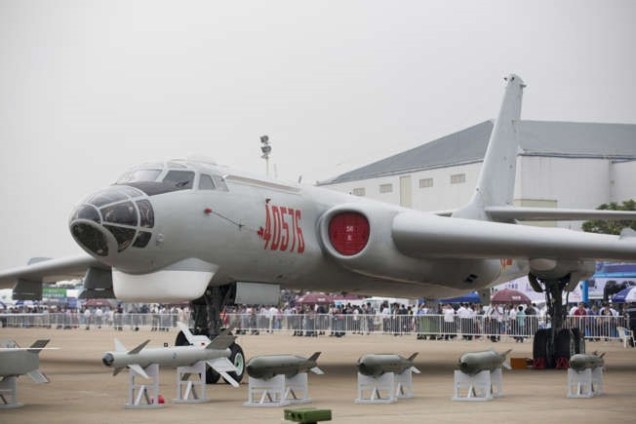
About 150 of its bombers have been built, and about 120 were still operational in 2025. The H-6 has been upgraded to carry modern weapons, including hypersonic and nuclear-capable missiles.
China sold H-6s to both Egypt and Iraq, but those countries no longer have their bombers operational. According to the Center for Strategic and International Studies, Iraq’s four H-6s were destroyed while in service.

The H-6 has four crew and is powered by two Soloviev D-30KP-2 turbofan engines, each with 27,000 pounds of thrust. Its top speed is 670 mph, and its cruising speed is 477 mph. Its combat range is 2,200 miles.
It can also carry 26,500 pounds of bombs, both guided and unguided (dumb bombs), but no longer carries free-fall nuclear bombs, as the H-6 could not be relied upon to penetrate an enemy’s air space.
Xian H-6
Type: six-seat strategic medium bomber and anti-ship missile carrier
Engines: 2 x 20,944-lb (9,500-kg) thrust Xian WP-8 turbojets
Maximum speed 616 mph (991 km/h) at 19,685 ft (6,000 m)
Initial climb rate 4,100 ft (1,250 m) per minute
Service ceiling 40,355 ft (12,300 m)
Range 2,983 miles (4,800 km) with an 8,157-lb (3,700-kg) warload
Empty weight about 82,010 lb (37,200 kg)
Maximum take-off weight 158,733+ lb (72,000+ kg)
Wing span 108 ft 1.2 in (32.95 m)
Length 114 ft 2.1 in (34.80 m)
Height 35 ft 5.2 in (10.80 m)
Wing area 1,772.87 sq ft (164.70 sq.m)
Armament: four 23-mm cannon in twin-gun dorsal and tail turrets, and up to 19,842 lb (9,000 kg) of bombs
 All Aero