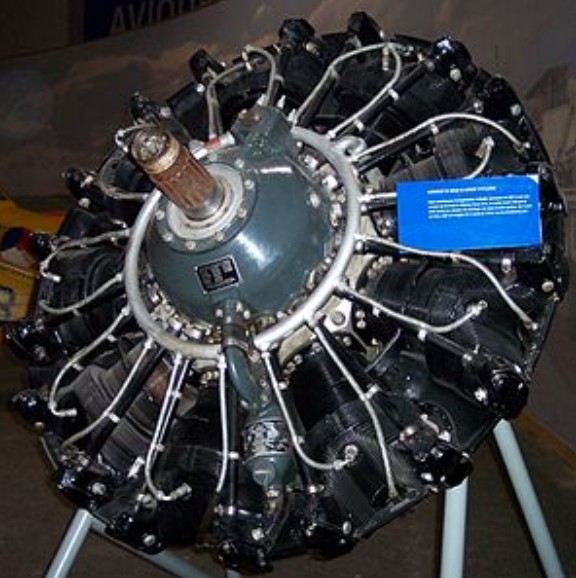
In 1932, the R-1750 was developed to a capacity of 1823 cu in. This was the F model Cyclone, designated R-1820 Cyclone 9. This engine introduced a forged aluminium crankcase and was developed through the 1930s to reach 890 hp. It used a General Electric supercharger, and Wright concluded that this feature limited the potential power output of the engine.
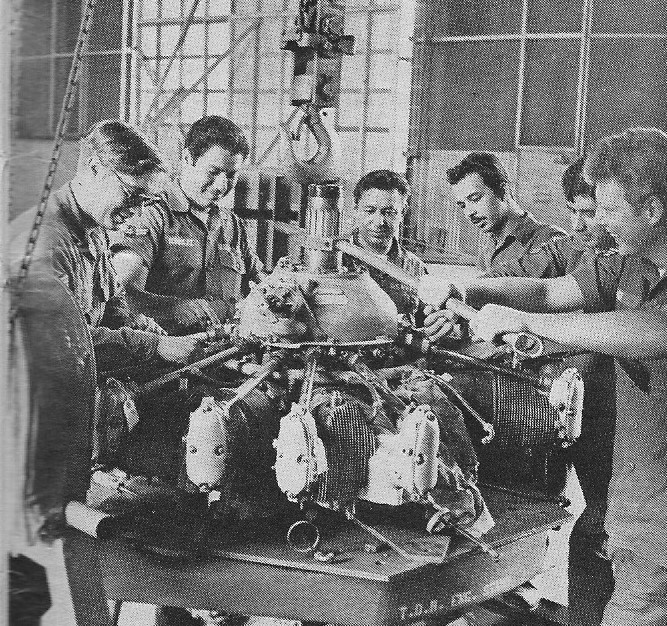
For the next development, the G-Series of 1937, Wright developed its own single-speed supercharger. The G-series was developed to deliver 1200 hp at 2500 rpm and made up the bulk of R-1820 Cyclone production during World War 2. It was installed in the Boeing B-17 Flying Fortress. The final phase of development of the single row radial design was the H-Series at 1350 hp.
In 1949 the Cyclone 9HE weighed less than 1400 lb and delivered nearly 1500 bhp. The first two were delivered to Douglas for installation in the new DC-3 Super. Apart from new engines, the DC-3 Super has a new tail unit and outer-wing panels, a strengthened undercarriage with complete wheel retraction, and re-arranged internal accommodation. The Cyclone 9HE engines would boost speed by 45 mph to 234 mph and maximum loaded weight increase from 25,200 lb to 27,300 lb.
The engine remained in production well into the 1950s.
The R-1820 was built under license by Lycoming, Pratt & Whitney Canada, and also, during World War II, by the Studebaker Corporation. The Soviet Union had purchased a license for the design, and the Shvetsov OKB was formed to produce the engine as the M-25. In Spain the R-1820 was license-built as the Hispano-Suiza 9V or Hispano-Wright 9V.
The Shvetsov M-25 was a licensed production variant of the Wright R-1820-F3. The first M-25s were produced from kits imported from the United States; the main difference between the later M-25 and the R-1820-F3 was the use of metric components. 13,888 M-25s were produced in the USSR at factories in Perm and Kazan. There were a number of sub-variants which differed from the original M-25 in that they had reduction gears, rather than direct drive. Performance was similar to the equivalent Wright engines. The M-25 was later developed into the ASh-62.
The Shvetsov M-25 was a licensed production variant of the Wright R-1820-F3. The first M-25s were produced from kits imported from the United States; the main difference between the later M-25 and the R-1820-F3 was the use of metric components. 13,888 M-25s were produced in the USSR at factories in Perm and Kazan. There were a number of sub-variants which differed from the original M-25 in that they had reduction gears, rather than direct drive. Performance was similar to the equivalent Wright engines. The M-25 was later developed into the ASh-62.
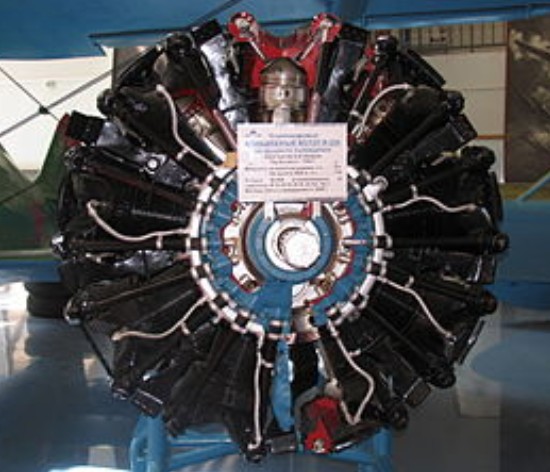
The R-1820 was built under license by Lycoming, Pratt & Whitney Canada, and also, during World War II, by the Studebaker Corporation. The Soviet Union had purchased a license for the design, and the Shvetsov OKB was formed to produce the engine as the M-25. In Spain the R-1820 was license-built as the Hispano-Suiza 9V or Hispano-Wright 9V.
The R-1820 was at the heart of many famous aircraft including the early Douglas airliners (prototype DC-1, the DC-2, earliest civilian versions of the DC-3, and the limited-production DC-5), B-17 Flying Fortress, and SBD Dauntless bombers, the early versions of the Polikarpov I-16 fighter (as M-25), and the Piasecki H-21 helicopter.
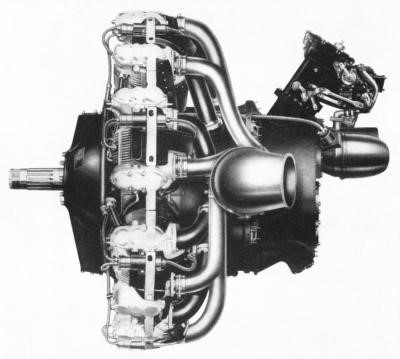
The R-1820 also found limited use in armored vehicles in two forms. The G-200 was a nine-cylinder gas-burning radial that developed 900 hp (670 kW) @ 2,300 rpm and powered the M6 Heavy Tank. The Wright RD-1820 was converted to a diesel by Caterpillar Inc. as the D-200 and produced 450 hp (340 kW) @ 2,000 rpm in the M4A6 Sherman.
Variants:
Unit numbers ending in/with W indicate engines fitted with water-methanol emergency power boost system.
R-1820-04
700 hp (522 kW)
R-1820-1
575 hp (429 kW)
R-1820-4
770 hp (574 kW)
R-1820-19
675 hp (503 kW)
R-1820-22
950 hp (708 kW)
R-1820-25
675 hp (503 kW), 750 hp (559 kW), 775 hp (578 kW)
R-1820-32
1,000 hp (750 kW)
XR-1820-32
800 hp (596 kW)
R-1820-33
775 hp (578 kW)
R-1820-34
940 hp (701 kW), 950 hp (708 kW)
R-1820-34A
1,200 hp (895 kW)
R-1820-40
1,100 hp (820 kW), 1,200 hp (895 kW)
R-1820-41
850 hp (634 kW)
R-1820-45
800 hp (596 kW), 930 hp (694 kW)
R-1820-50
850 hp (634 kW)
R-1820-52
1,000 hp (750 kW)
R-1820-53
930 hp (694 kW), 1,000 hp (750 kW)
R-1820-56
1,200 hp (895 kW), 1,350 hp (1,007 kW)
R-1820-57
1,060 hp (790 kW)
R-1820-60
1,200 hp (895 kW)
R-1820-62
1,350 hp (1,007 kW)
R-1820-66
1,200 hp (895 kW), 1,350 hp (1,007 kW)
R-1820-72W
1,350 hp (1,007 kW), 1,425 hp (1,063 kW)
R-1820-74W
1,500 hp (1,118 kW)
R-1820-76A, B, C, D
1,425 hp (1,063 kW)
R-1820-78
700 hp (522 kW)
R-1820-80
700 hp (522 kW), 1,535 hp (1,145 kW)
R-1820-82WA
1,525 hp (1,137 kW)
R-1820-86
1,425 hp (1,063 kW)
R-1820-97
1,200 hp (895 kW), Fitted with turbosupercharger
R-1820-103
1,425 hp (1,063 kW)
SGR-1820-F3
710 hp (529 kW), 720 hp (537 kW)
SGR-1820-F2
720 hp (537 kW)
R-1820-F53
770 hp (574 kW)
R-1820-F56
790 hp (589 kW)
GR-1820-G2
1,000 hp (750 kW)
R-1820-G3
840 hp (626 kW)
R-1820-G5
950 hp (708 kW)
R-1820-G101
1,100 hp (820 kW)
R-1820-G102
775 hp (578 kW)
GR-1820-G102A
1,100 hp (820 kW)
R-1820-G102A
1,100 hp (820 kW)
R-1820-G102A
1,100 hp (820 kW)
R-1820-G202A
1,200 hp (895 kW)
R-1820-G103
1,000 hp (750 kW)
R-1820-G105
1,000 hp (750 kW)
R-1820-G205A
1,200 hp (895 kW)
Hispano-Suiza 9V
Licence built R-1820
Hispano-Suiza 9Vbr
Hispano-Suiza 9Vbs
Hispano-Suiza 9Vd
Shvetsov M-25
Applications
Boeing B-17 Flying Fortress
Boeing 307
Brewster F2A
Curtiss AT-32-A Condor
Curtiss SBC-4 Helldiver
Curtiss P-36 Mohawk
Curtiss SC Seahawk
Curtiss-Wright CW-21
Douglas A-33
Douglas B-18
Douglas DC-2
Douglas DC-3 (DST, G-102 and G-202)
Douglas Super DC-3, R4D-8 / C-117
Douglas DC-5
Douglas SBD Dauntless
FMA AeMB.2 Bombi
General Motors FM-2 Wildcat
Grumman TF-1 / C-1 Trader
Grumman FF-1
Grumman F3F
Grumman HU-16 Albatross
Grumman J2F Duck
Grumman S-2 Tracker
Lockheed 14
Lockheed Lodestar
Lockheed Hudson
Martin B-10
North American NA-44
North American O-47
North American P-64
North American T-28B/C/D Trojan
Northrop YC-125 Raider
Piasecki H-21
Polikarpov I-16
Ryan FR Fireball
Sikorsky S-58/HUS/HSS/H-34
Vehicles:
M4A6 tank
M6 heavy tank
Specifications:
GR-1820-G2
Type: Nine-cylinder single-row supercharged air-cooled radial engine
Bore: 6 1⁄8 in (155.6 mm)
Stroke: 6 7⁄8 in (174.6 mm)
Displacement: 1,823 in³ (29.88 L)
Length: 47.76 in (1,213 mm)
Diameter: 54.25 in (1,378 mm)
Dry weight: 1,184 lb (537 kg)
Valvetrain: Two overhead valves per cylinder with sodium-filled exhaust valve
Supercharger: Single-speed General Electric centrifugal type supercharger, blower ratio 7.134:1
Fuel system: Stromberg PD12K10 downdraft carburetor with automatic mixture control
Fuel type: 87 octane rating gasoline
Oil system: Dry sump with one pressure and one scavenging pump
Cooling system: Air-cooled
Power output: 1,000 hp (746 kW) at 2,200 rpm for takeoff
Specific power: 0.46 hp/in³ (20.88 kW/L)
Compression ratio: 6.45:1
Specific fuel consumption: 0.6 lb/(hp•h) (362 g/(kW•h))
Oil consumption: 0.35-0.39 oz/(hp•h) (13-15 g/(kW•h))
Power-to-weight ratio: 0.84 hp/lb (1.39 kW/kg)
Shvetsov M-25
Type: 9-cylinder, air-cooled, radial engine
Bore: 6.125 in (155.6 mm)
Stroke: 6.875 in (174 mm)
Displacement: 1,823.1 in³ (29.876 L)
Dry weight: 499kg (999lb)
Supercharger: Single speed, single stage, geared centrifugal supercharger
Fuel system: 1 K-25 (Solex) Carburetor
Power output: 700-800hp depending on model
Compression ratio: 6.4:1
 All Aero