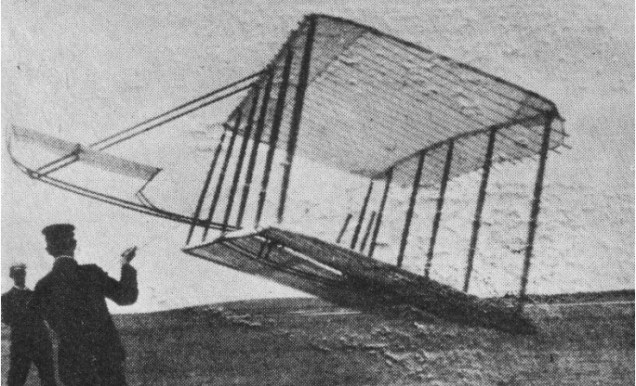
In 1901, the Wright brothers began a program of research, testing wing forms by mounting them on a spar projecting ahead of a bicycle; they also assessed them in homemade wind tunnels, their first was constructed from an old starch box. Soon it became obvious that almost all the published information on aerodynamics, and particularly the tables of force measurements, were simply wrong. They re-turned to Kitty Hawk with a still-bigger glider, its wing-warping controlled by the prone pilot rocking his hips in a body cradle, and achieved a glide they measured at 389 feet.
The second manned glider, of 1901, larger and heavier was rather less successful, chiefly because it was “less manageable than our smaller machine of last year … the trouble seems in the travel of the centre of pressure”. It had no tail surfaces. But the 1901 machine was generally un-manageable, and the lift of its wing less than the previous glider’s.

Wing span: 22 ft 0 in
Wing area: 290 sq.ft
Flying wt approx: 243 lb
No of flights approx: 60
Total flying time approx: 2 min
 All Aero