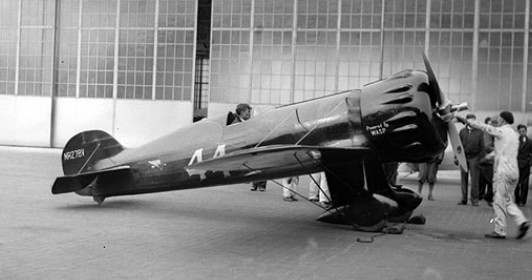
Experienced air-racer Jimmy Wedell formed a business partnership in 1929 with millionaire Harry P. Williams after giving him flying lessons. Initial plans were to teach flying, provide an aerial photography service and win an airmail contract. Wedell’s passion for air racing led him to convince Williams to build a racer for the January, 1930 Miami Air Races.
Wedel-Williams Model 44 Article
This first aircraft was named “We-Will” but as development and testing continued it became apparent it would not be ready for the 1930 Miami event. Wedell halted development of the “We-Will” design and began a new aircraft, the “We-Winc”.
In parallel to the development of the We-Winc, Wedell began the construction of a third aircraft, the “We-Will Jr.” This aircraft first appeared in the Cirrus Derby held in Detroit on July 21 but the design proved to be underpowered. Further development with improved aerodynamics, numerous technical innovations and a Hamilton Standard ground adjustable propeller radically changed the aircraft’s appearance. Incorporated into the design were the wheel spats that would be an iconic feature of the future racers. It was a typical construction with a braced, low-wing monoplane utilizing fixed landing gear in large spats. This version was however also underpowered. In development and in competition this version, by now dubbed “Model 22” proved to be a disappointment and further development was abandoned.
By 1931, Wedell had turned his attention back to the original We-Will and after a rebuild using the lessons learned in building the We-Winc and the We-Will Jr. attained an acceptable level of performance. First flown on 12 January 1930 (NR54Y), this version was named the “Model 44”. When mated with a Pratt & Whitney Wasp Jr. engine, the design’s true potential began to be realized. That year, on 13 June, the “44” placed second at the New Orleans National Air Races.
Soon after the ’31 Nationals, Wedell began rebuilding the 44 and the We-Winc as well as taking a contract to build a Model 44 for Roscoe Turner. On the second test flight of Turner’s Model 44 (NR54Y), the left wing experienced a structural failure and was destroyed in the ensuing crash. Flown on its test flight by Jimmy Wedell and seemed to perform very well. When he took it up again later that day for a high-speed low pass, aileron buzz caused a wing to flutter, then snap the flying wires and fold the wing. Wedell had designed the plane to have independent aileron control, so he held full aileron against the roll while pitching up for altitude and bleeding off speed, then pushed himself out of the cockpit. His ‘chute opened fully just as he touched down at the end of the field. After this incident, the assistance of Howard Barlow, an aeronautical engineer, was obtained in the redesign of the wings. The second Turner racer (NR536V) was built with the new wing design and proved to be an exceptional performer. The other two Model 44s (#92 NR61Y, #121, #57, #2 NR278V – #44, #91) were rebuilt according to the new wing specification as test pilots had noted wing vibrations in both aircraft previously.
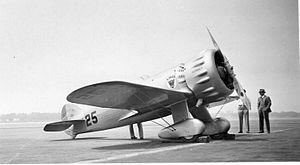
These three aircraft went on to dominate air racing for the next several years. Model 44s were raced in 1932, 1933 and 1934 Bendix Trophy races, as well as the 1934 Thompson and Shell Trophy. In September 1933 at the International Air Race in Chicago, the 44 piloted by Wedell set the new world speed record of 305.33 miles per hour.
NR61Y was built in Patterson, Louisiana, 1932. It had a NACA cowl housing a Pratt & Whitney R-985. Roscoe Turner flew it to California for the start of the 1932 Bendix race in an unpainted condition. His mechanic, Don Young, not only built it, but painted it literally just prior to racetime. The colors for that racing season were the famous silvery creme with red and black trim, and race #121.
Nicknamed the “Gilmore Red Lion,” Turner flew it to third place behind Jim Haizlip in the Wedell-Williams #92 and Jimmy Wedell in #44. Turner placed third in the Thompson Trophy, trailing Jimmy Doolittle in the Gee Bee R-1 and Jimmy Wedell in #44.
In 1933, after spending a morning avoiding a process server at Floyd Bennett Field in New York, Turner, in disguise as a mechanic, managed to get into the cockpit and fly to first place in the Bendix — but only sixth in the Thompson. For the Nationals, NR61Y sported a whitewashed #2 atop the sparkly gold paint of the fuselage, while the wings retained the creme, red, and black Gilmore scheme.
It also had a new P&W R-1340 beneath the cowl. Also, Gilmore Oil was replaced by 20th Century Fox as the new sponsor, hustling their movie The Bowery (which, naturally, had nothing to do with airplanes or racing). By the time the Chicago races came along, Fox had been replaced by Macmillan Oil, H.T. sparkplugs, Bendix, and Smith propellers, and the plane became the first “Ring-Free Special.”
In 1934 Turner upgraded the engine to a R-1690 Hornet, for which 61Y had a smooth NACA cowl, as well as a bumped cowl for another Pratt & Whitney, and another sponsor change, the Heinz pickle works logo and race #57 on the sides. 61Y had turned all-gold by then only because Don Young found time to finish painting after building a new engine mount and cowlings.
In 1935 61Y was primarily sponsored by MacMillan Oil Co, and the Ring Free logo was placed where the previous race number was located, in a circle under the cockpit window, with number 57 in black halfway down the length of the fuselage. When it came to the Bendix Race that year, Benny Howard in Mr Mulligan beat Turner across the finish line by 23.5 seconds.
During the Thompson his supercharger impeller went to pieces and exploded, perforating the cowling, accessory section, oil lines, etc. Trailing thick black smoke, Roscoe managed to see well enough out of an oil covered windshield (that rose only 5 inches above the fuselage) to make his normal three bounce landing to a standing ovation, while Howard, ignored by all but timers and judges, won the Thompson. Roscoe is quoted as responding to a reporter’s condolences by saying that walking away from potential disaster was luck enough.
In 1936 Turner put his Wedell-Williams out of the running when he bumped into the desert near Holbrook, Arizona, breaking off the fuselage completely just aft of the cockpit. After arguing with Larry Brown, who was pressing Roscoe for money for the rebuild, Turner hired Matty Laird to finish the project, which resulted in a shortened fuselage, new wheel fairings, and some other subtle changes.
Turner moved out of the picture in 1937 to fly his Laird-Turner Racer and Joe Mackay moved in, flying 61Y as race #25, continuing to place in the money until the end of its career with retirement after the 1939 NARs at the advent of World War 2.
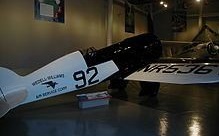
NR61Y still exists, on display at the Crawford Museum in Cleveland, Ohio, where Don Young used to be the curator.
Three replica Model 44s are on display at the Louisiana State Museum, Patterson, Louisiana.
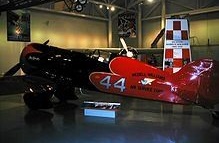
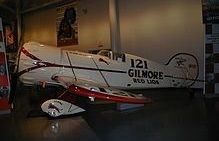
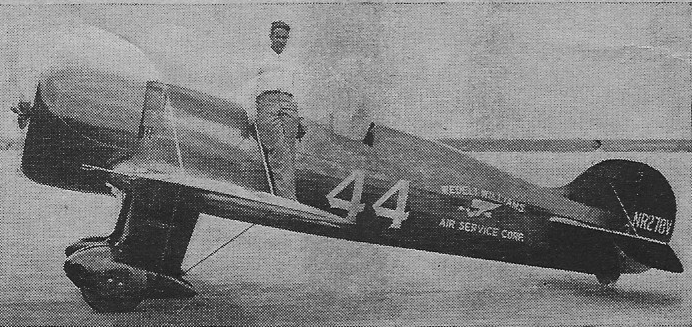
The fifth basic design was a complete rebuild of We-Will with a new wing, cowling, and enclosed cockpit, registered NR278V in 1932 as Miss Patterson for Roscoe Turner, with its old wings and undercarriage going into the Robbins Racer.
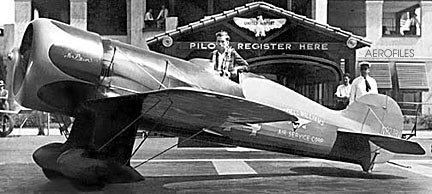
Wedell Williams Model 44 Racing History
Model 44
Engine: 1 × Pratt & Whitney R-1690-S1C3G, 1,020 hp (760 kW)
Propeller: 2-bladed Hamilton Standard ground adjustable, Curtiss adjustable or Smith adjustable propeller
Wingspan: 26 ft 3 in (8.0 m)
Wing area: 107.9 sq ft (10.02 m2)
Airfoil: M-10 (modified)
Length: 23 ft 0 in (7.01 m)
Height: 8 ft 1 in (2.46 m)
Empty weight: 1,702 lb (772 kg)
Gross weight: 2,677 lb (1,214 kg)
Maximum speed: 325 mph (523 km/h; 282 kn)
Range: 900 mi (782 nmi; 1,448 km)
Service ceiling: 14,000 ft (4,267 m)
Wing loading: 24.83 lb/sq ft (121.2 kg/m2)
Crew: 1
Model 44 (1932)
Gross Weight 3892 lb Empty Weight 2492 lb
Span 26 ft 2 in Length (overall) 21 ft 3 in
Powerplant P & W Wasp (500 hp) Powerplant (1933) P & W Wasp T3D1 (800 hp)
Max Speed 304.98 mph
Price $50,000
Model 44 NR278V
1931
Engine: P&W Wasp, 525hp
Wingspan: 26’0″
Length: 24’6″
Seats: 1
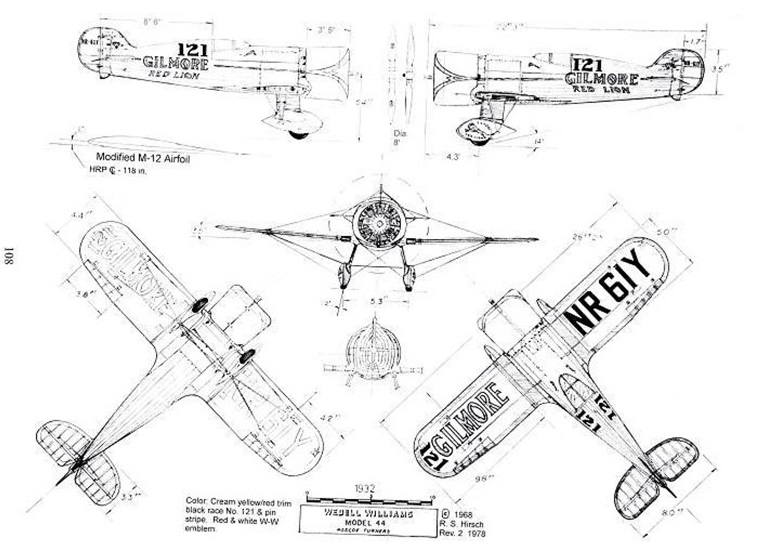
 All Aero