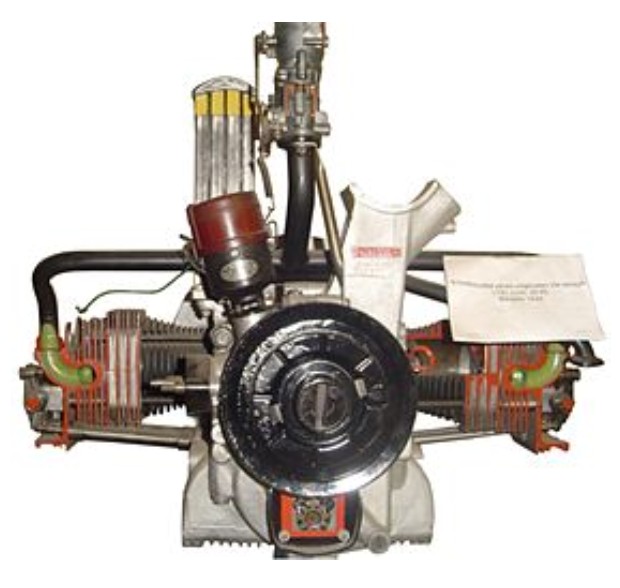
The Volkswagen air-cooled engine is an air-cooled boxer engine with four horizontally opposed cast iron cylinders, cast aluminum alloy cylinder heads and pistons, magnesium crankcase, and forged steel crankshaft and connecting rods.
Variations of the engine were produced by Volkswagen plants worldwide from 1936 until 2006 for use in Volkswagen’s own vehicles, notably the Type 1 (Beetle), Type 2 (bus, transporter), Type 3, and Type 4. Additionally, the engines were widely used in industrial, light aircraft and kit car applications.
Like the Volkswagen Beetle, the first Volkswagen Transporters (bus) used the Volkswagen air-cooled engine, a 1.1 litre, DIN-rated 18 kW (24 PS, 24 bhp), air-cooled four-cylinder “boxer” engine mounted in the rear. The 22 kilowatt (29 PS; 29 bhp) version became standard in 1955, while an unusual early version of the engine which developed 25 kilowatts (34 PS; 34 bhp) debuted exclusively on the Volkswagen Type 2 (T1) in 1959. Since the 1959 engine was totally discontinued at the outset, no parts were ever made available.
The second-generation Transporter, the Volkswagen Type 2 (T2) employed a slightly larger version of the engine with 1.6 litres and 35 kilowatts (48 PS; 47 bhp).
A “T2b” Type 2 was introduced by way of gradual change over three years. The 1971 Type 2 featured a new, 1.6-litre engine, now with dual intake ports on each cylinder head, and was DIN-rated at 37 kilowatts (50 PS; 50 bhp).
The Volkswagen Type 3 (saloon/sedan, notch-back, fastback) was initially equipped with a 1.5-litre engine, displacing 1,493 cubic centimetres (91.1 cu in), based on the air-cooled flat-4 found in the Type 1. While the long block remained the same as the Type 1, the engine cooling was redesigned reducing the height of the engine profile, allowing greater cargo volume, and earning the nicknames of “Pancake” or “Suitcase” engine. This engine’s displacement would later increase to 1.6 litres.
Originally a single- or dual-carburetor 1.5-litre engine (1500N, 33 kilowatts (45 PS; 44 bhp) or 1500S, 40 kilowatts (54 PS; 54 bhp)), the Type 3 engine received a larger displacement (1.6 litre) and modified in 1968 to include Bosch D-Jetronic electronic fuel injection as an option, making it the first mass production consumer cars with such a feature (some sports/luxury cars with limited production runs previously had fuel injection).
In 1968, Volkswagen introduced a new vehicle, the Volkswagen Type 4. The model 411, and later the model 412, offered many new features to the Volkswagen lineup.
While the Type 4 was discontinued in 1974 when sales dropped, its engine became the power plant for Volkswagen Type 2s produced from 1972 to 1979: it continued in modified form in the later Vanagon which was air-cooled from 1980 until mid-1983.
The engine that superseded the Type 4 engine in late 1983 retained Volkswagen Type 1 architecture, yet featured water-cooled cylinder heads and cylinder jackets. The wasserboxer, Volkswagen terminology for a water-cooled, opposed-cylinder (flat or ‘boxer engine’) was subsequently discontinued in 1992 with the introduction of the Eurovan.
The Type 4 engine was also used on the Volkswagen version of the Porsche 914. Volkswagen versions originally came with an 80 horsepower (60 kW) fuel-injected 1.7-litre flat-4 engine based on the Volkswagen air-cooled engine. In Europe, the four-cylinder cars were sold as Volkswagen-Porsches, at Volkswagen dealerships.
Porsche discontinued the 914/6 variant in 1972 after production of 3,351 units; its place in the lineup was filled by a variant powered by a new 95 metric horsepower (70 kW; 94 bhp) 2.0-litre fuel-injected version of Volkswagen’s Type 4 engine in 1973. For 1974, the 1.7-litre engine was replaced by a 76 metric horsepower (56 kW; 75 bhp) 1.8-litre, and the new Bosch L-Jetronic fuel injection system was added to American units to help with emissions control. 914 production ended in 1976. The 2.0-litre engine continued to be used in the Porsche 912E, which provided an entry-level model until the Porsche 924 was introduced.
For the Volkswagen Type 2, 1972’s most prominent change was a bigger engine compartment to fit the larger 1.7- to 2.0-litre engines from the Volkswagen Type 4, and a redesigned rear end which eliminated the removable rear apron. The air inlets were also enlarged to accommodate the increased cooling air needs of the larger engines.
This all-new, larger engine is commonly called the Type 4 engine as opposed to the previous Type 1 engine first introduced in the Type 1 Beetle. This engine was called “Type 4” because it was originally designed for the Type 4 (411 and 412) automobiles. There is no “Type 2 engine” or “Type 3 engine”, because those vehicles did not feature new engine designs when introduced. They used the “Type 1” engine from the Beetle with minor modifications such as rear mount provisions and different cooling shroud arrangements, although the Type 3 did introduce fuel injection on the “Type 1” engine.[citation needed]
In the Type 2, the Volkswagen Type 4 engine was an option from 1972. This engine was standard in models destined for the US and Canada. Only with the Type 4 engine did an automatic transmission become available for the first time in 1973. Both engines displaced 1.7 litres, rated at 66 metric horsepower (49 kW; 65 bhp) with the manual transmission, and 62 metric horsepower (46 kW; 61 bhp) with the automatic. The Type 4 engine was enlarged to 1.8 litres and 68 metric horsepower (50 kW; 67 bhp) in 1974, and again to 2.0 litres and 70 metric horsepower (51 kW; 69 bhp) in 1976. As with all Transporter engines, the focus in development was not on motive power, but on low-end torque. The Type 4 engines were considerably more robust and durable than the Type 1 engines, particularly in Transporter service.
During the 1970s, in Brazil, Volkswagen made available the 1700 cc engine for its regular production car SP-2. The 1700 cc engine was identical to the 1600 cc version, but with enlarged cylinder bores.
Volkswagen AG has officially offered these air-cooled boxer engines for use in industrial applications since 1950, lately under its Volkswagen Industrial Motor brand. Available in 18 kilowatts (24 PS; 24 bhp), 22 kilowatts (30 PS; 30 bhp), 25 kilowatts (34 PS; 34 bhp), 31 kilowatts (42 PS; 42 bhp), 33 kilowatts (45 PS; 44 bhp) and 46 kilowatts (63 PS; 62 bhp) outputs, from displacements of 1.2 litres (73 cu in) to 1.8 litres (110 cu in), these Industrial air-cooled engines were officially discontinued in 1991.
The air-cooled opposed four-cylinder Beetle engines have been used as an experimental aircraft engine. This type of Beetle engine deployment started in the 1960s. A number of companies produced aero engines that are Volkswagen Beetle engine derivatives: Limbach, Hapi, Revmaster, the AeroConversions AeroVee Engine, and others. The VW air-cooled engine does not require a heavy gear reduction unit to utilize a propeller at cruise RPM. With its relative low cost and parts availability, many kit planes or plans built experimental aircraft are designed around the VW engines.
Formula V Air Racing uses aircraft designed to get maximum performance out of a VW powered aircraft resulting in race speeds above 160 mph.
Some aircraft that use the VW engine are:
Airdrome Bleriot Model XI
Airdrome Dream Fantasy Twin
Airdrome Fokker DR-1
Airdrome Fokker D-VI
Airdrome Fokker D-VII
Airdrome Fokker D-VIII
Airdrome Nieuport 11
Airdrome Nieuport 24
Airdrome Taube
AirLony Skylane
Airmotive EOS 001
Akaflieg München Mü23 Saurier
Aurore MB 04 Souris Bulle
Bensen B-8
BK Fliers BK-1
Bounsall Super Prospector
Boyd G.B.1
Bradley Aerobat
Circa Reproductions Nieuport 11
Circa Reproductions Nieuport 17
Corby Starlet
Denney Kitfox
Druine Turbulent
Evans VP-1 Volksplane
Evans VP-2 Volksplane
Falconar F9A
Falconar F11 Sporty
Fisher Avenger V
Fisher Youngster
Flaglor Sky Scooter
Flitzer Z-21
Great Plains Easy Eagle
Harmon Der Donnerschlag
Harmon Mister America
Hummel H5
Hummel Ultracruiser Plus
JDT Hi-MAX
JPM 01 Médoc
Junqua Ibis
Just Superstol
Mignet Pou-du-Ciel
Mini-Hawk Tiger-Hawk
JDT V-MAX
Kolb M3X
Leger Pataplume 1
Light Miniature Aircraft LM-5
Milholland Legal Eagle – half VW and full Type 1 VW engines
Mini Coupe
Monnett Sonerai
Nicollier Menestrel
Parker Jeanie’s Teenie
Pazmany PL-4A
Pober Pixie
Preceptor STOL King
Preceptor Ultra Pup
Preceptor Stinger
RagWing RW1 Ultra-Piet – half VW and full Type 1 VW engines
RagWing RW7 Duster – half VW and full Type 1 VW engines
Rand Robinson KR-1
Rand Robinson KR-2S
Rutan Quickie
Sisler SF-2A Cygnet
Sonex Aircraft Onex
Sonex Aircraft Sonex
Southern Aeronautical Renegade
Southern Aeronautical Scamp
Stewart Headwind
Stolp SA-500 Starlet
Taiwan Dancer TD-3
Taylor Monoplane
Thatcher CX4
Vidor Champion V
Viking Dragonfly
Zenair CH 100
Half VW
For aircraft use a number of experimenters seeking a small two-cylinder four-stroke engine began cutting Type 1 VW engine blocks in half, creating a two-cylinder, horizontally opposed engine. The resulting engine produces 30 to 38 hp (22 to 28 kW). Plans and kits have been made available for these conversions.
One such conversion is the Carr Twin, designed by Dave Carr, introduced in January, 1975, in the Experimental Aircraft Association’s Sport Aviation magazine. The design won the John Livingston Award for its outstanding contribution to low cost flying and also was awarded the Stan Dzik Memorial Award for outstanding design.
Another example is the Total Engine Concepts MM CB-40.
Some aircraft that use the Half VW engine are:
Belite Ultra Cub
Duane’s Hangar Ultrababy
Hummel Bird
Hummel Ultracruiser
Milholland Legal Eagle – half VW and full Type 1 VW engines
Pop’s Props Pinocchio
RagWing RW1 Ultra-Piet – half VW and full Type 1 VW engines
RagWing RW4 Midwing Sport
RagWing RW7 Duster – half VW and full Type 1 VW engines
Spacek SD-1 Minisport
Ultravia Pelican
Specifications:
Type 1
Volkswagen 1100 engine
Production 1945–1953
Displacement 1,131 cc (69.0 cu in)
Cylinder bore 75 mm (2.95 in)
Piston stroke 64 mm (2.52 in)
Compression ratio 5.8:1
Power output 18 kW (24 PS; 24 bhp) @ 3,300 rpm,
22 kW (30 PS; 30 bhp)
Specific power 15.9 kW (22 PS; 21 bhp) / L (18kW variant)
Torque output 68 N·m (50 lbf·ft) @ 2,000 rpm
Volkswagen 1200 engine
Production 1950–1991
Displacement 1,192 cc (72.7 cu in)
Cylinder bore 77 mm (3.03 in)
Piston stroke 64 mm (2.52 in)
Compression ratio 6.1:1 – 7.0:1
Power output 22 kW (30 PS; 30 bhp)
25 kW (34 PS; 34 bhp)
27 kW (37 PS; 36 bhp)
30 kW (41 PS; 40 bhp)
Specific power 18.5–21.0 kW (25–29 PS; 25–28 bhp) / L
Volkswagen 1300 engine
Production 1966–1995
Volkswagen 1500 engine
Production 1961–1971
Displacement 1,493 cc (91.1 cu in)
Cylinder bore 83 mm (3.27 in)
Piston stroke 69 mm (2.72 in)
Power output 1500N: 33 kW (45 PS; 44 bhp),
1500S: 40 kW (54 PS; 54 bhp)
Specific power 22.1–26.8 kW (30–36 PS; 30–36 bhp) / L
Volkswagen 1600 engine
Displacement 1592cc
Cylinder bore 85.5mm
Fuel system initially: 30/31-Pict Carburetor for single port 34-Pict Carburetor for dual port,
later: Bosch L-Jetronic electronic fuel injection
Power output single port: 35 kW (48 PS; 47 bhp)
dual port: 37 kW (50 PS; 50 bhp)
Volkswagen Type 4 engine
Production 1968–1983
Volkswagen 1700 engine
Displacement 1,679 cc (102.5 cu in)
Compression ratio 7.8:1
Power output 76 PS (56 kW) @ 5,000 rpm
Torque output 127 N·m (94 lbf·ft) @ 3,500 rpm
Volkswagen 1800 engine
Power output 50 kW (68 PS; 67 bhp)
Volkswagen 2000 engine
Power output 52 kW (71 PS; 70 bhp)
 All Aero