
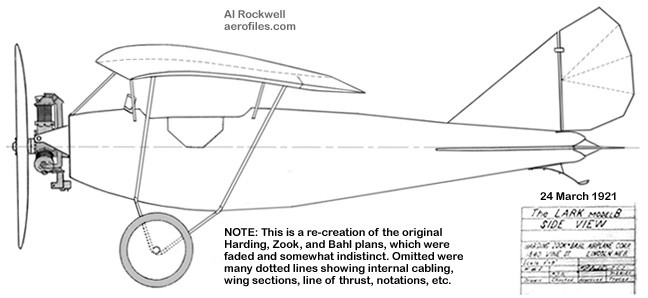
This Lark was built in 1921 by the Harding, Zook, & Bahl Airplane Co of Lincoln, Nebraska. The original design having been worked out by E.G. Bahl. It featured a layered wood-strip monocoque fuselage with only four bulkheads.
A Frankensteinian creation (NC5003?) reportedly from pieces of two Curtiss JN-4s, a Thomas-Morse S4C, and other wrecks, won an efficiency trophy at the 1921 Omaha Air Races. Sold in 1922 and moved to Richards Field, Kansas City, where it was badly damaged in a landing accident.
The Lark was purchased in the spring of 1924 by Bert E. Thomas and L.DeweyBonbrake, to what extent is uncertain.
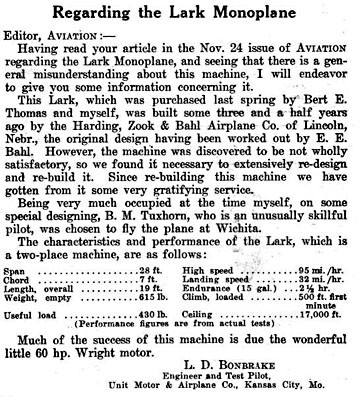
The machine was re-designed and rebuilt by Thomas and Bonbrake, with a Wright 60 hp engine, to improve flight characteristics. B.M, Tuxhorn was chosen to fly the plane at Wichita.
Purchased by Blaine Tuxhorn in 1924, redesigned by L D Bonbrake and rebuilt with 60hp Wright-Gale L-4, and reregistered as Tuxhorn Lark, again in 1929 as Bonbrake Parasol.
It became the Bonbrake Parasol in 1928, said to not have flown very well in its original form, but the basic design evolved into the Inland Sport.
Recent documentation found by John M Jarratt puts this Lark back at square one, and we start over. The airplane appearing as [NC5003] is a far cry from the one pictured in the 1/8/22 Denver Post, and its lengthy article about the Harding, Zook & Bahl operation indicate much of the data above describes another plane (that “wood-strip monocoque fuselage” certainly does not fit the picture), but which one is yet to be solved.
Specs mentioned in the news item: 65hp 2-cylinder Rockwell (Hugh M Rockwell—SEE Rockwell Corp entry); load: 607# v: 90/x/25; $2,500 planned market price. Empty wt: 650#. The article also mentions prior production at Lincoln, and that a "considerable number had been sold in the US, Canada, and Mexico" and they will "turn out 100 Lark monoplanes within a year." (2/28/02)
Trying to sort out this mess, we proceed another step further (or is it backwards?). From research by John M Jarratt and Vincent J Berinati, it seems that prototypical Bahl Lark was parts of the fuselage of surplus Standard J-1 [NC2119] mated with the wing of a Thomas-Morse something. Later on its meandering path it was reregistered as [NC1940], which shows in regs as a Standard J-1 because of its fuselage’s original c/n, but might have been Tuxhorn Lark at the time. (3/14/02)
Abstracts from NASM show that this ship had nothing to do with Bahl, Bonebrake, or Tuxhorn, but was a Nicholas-Beazley Standard J-1 remodeled with a monoplane wing and new tail by Joseph C Freeze, Kansas City KS. (— John M Jarratt 7/18/02)
Lark
Engine: 60hp Wright-Gale L-4 (later 55hp Velie M-5)
Wingspan: 28’0″
Length: 19’0″
Useful load: 430 lb
Max speed: 95 mph
Stall: 32 mpg
Range: approx. 225 mi
Seats: 2
Engine: Wright, 60 hp
Wingspan: 28 ft
Chord: 7 ft
Length: 19 ft
Empty weight: 615 lb
Useful load: 430 lb
High speed: 95 mph
Landing speed: 32 mph
Fuel capacity: 15 USG
Endurance: 2 hr 30 min
ROC: 500 fpm
Ceiling: 17,000 ft
 All Aero