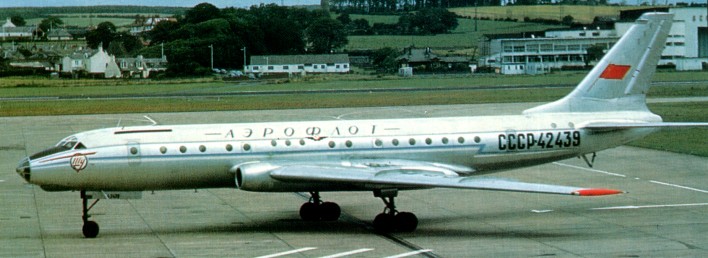
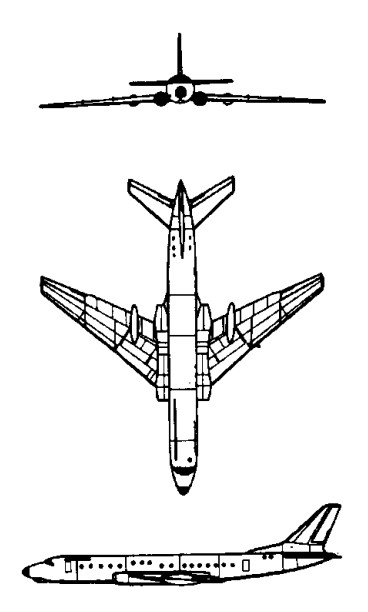
With an urgent Aeroflot need in the early 1950s for a modern airliner of greater capacity, range and speed than in-service aircraft, the Tupolev design bureau developed as the Tupolev Tu-104 a minimum-change civil version of the Tu-16 bomber, basically by introducing a new pressurised fuselage.
The first Soviet jet airliner was the Tu-104, which utilised the wings, engines, undercarriage and tail unit of the Tu-16 bomber in order to obtain a production jetliner in the minimum possible time. The navigator even had access to a bomber-style glazed nose.
The prototype made its first flight on 17 June 1955 and the type entered Aeroflot service in September 1956. Introduced first on the Moscow-Irkutsk route, the 50-passenger Tu-104 was powered by two 6750kg thrust Mikulin AM-3 turbojets and immediately reduced flight times by more than half, bringing transformation to the airline’s medium-range routes. In March 1956 the prototype visited Londons Heathrow Airport, and the aircraft was in regular service by that September.
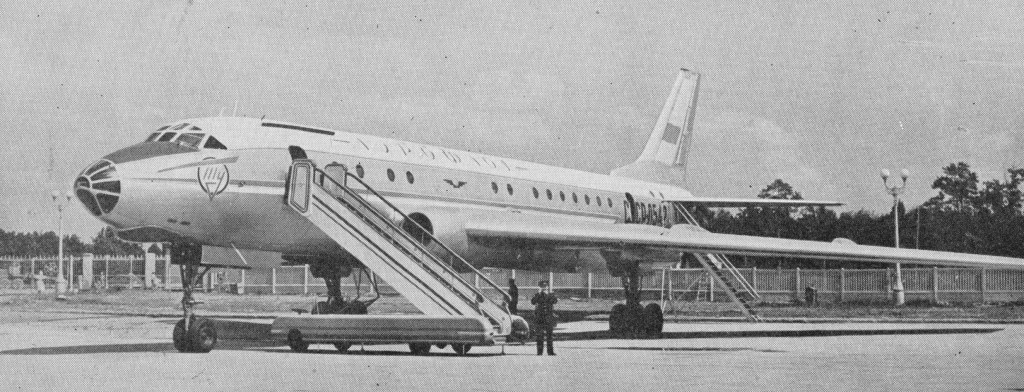
The powerplant was later uprated to the 8700kg thrust Mikulin AM-3M, which also powered the improved Tu-104A featuring a revised cabin for 70 passengers. About 20 Tu-104s were built before production switched to the stretched, 70-seat Tu-104A.
Continuing development of the Mikulin engine encouraged development of the lengthened-fuselage (by 1.21m) Tu-104B, with standard seating for 100 passengers. This entered service on 15 April 1959. A four-engined derivative, the 100-seat Tu-110, was flown in prototype form only, but its larger fuselage was combined with standard Tu-104 wings to produce the Tu-104B. The Tu-104B was basically a stretched and re-engined version.
A handful of Tu-104Gs were produced for crew training duties by the simple expedient of converting Tu-16 bombers, without any real passenger accommodation.
On 15 February, 1961, at an altitude of 10 km, the first in the Soviet Union observation of the solar eclipse was made from a Tu-104.
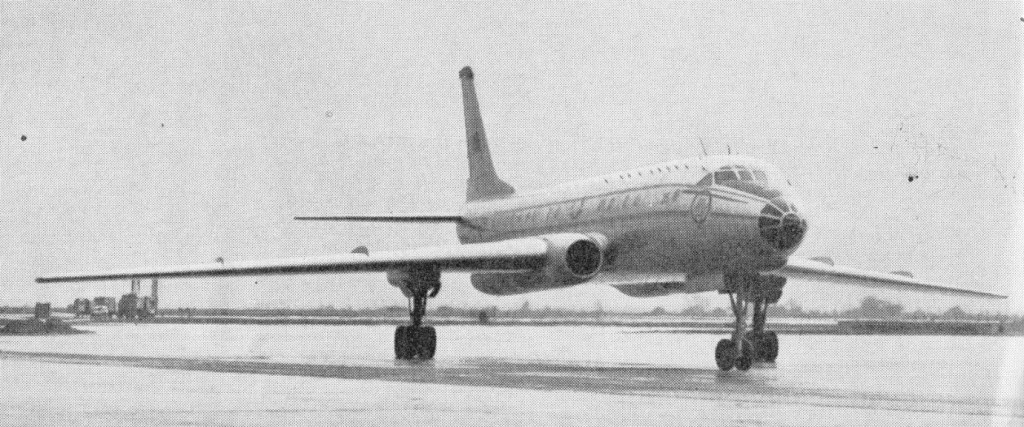
When production ended the following year about 200 Tu-104s of all versions had been built, these serving Aeroflot reliably until 1981. The designations Tu-104D and Tu-104V were applied to Tu-104As with in-service modifications to accommodate 100 and 85 passengers respectively, without the fuselage stretch. Six aircraft supplied to the Czechoslovakian airline CSA were basically Tu-104As seating 81 passengers, and small numbers of Tu-104s have been used by the WS for cosmonaut training and as personnel transports. One, with a pointed nose, served as a weather research aircraft.
The Tu-104E was used to set a 2000km closed circuit record while carrying a 15-tonne payload. The NATO reporting codename for the Tu-104 was ‘Camel’. At least one aircraft was converted on the production line to serve as the Tu-110 prototype, with four engines in the wingroots. It was assigned to the VVS after rejection by Aeroflot despite superior economy, field length requirements, performance and handling.
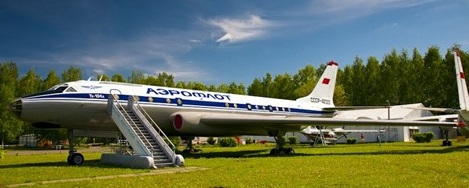
Tu-104A
Engines: 2 x 19,180 lb. (8,700 kg.) thrust Mikolin AM 3M turbojet.
Length 126.3 ft. (38.50 m.)
Wing span 113.3 ft. (34.54 m.)
Max. T.O. Weight 166,450 lb. (75,500 kg.)
Max cruise 560 m.p.h. (900 km.p.h.)
Cruise alt: 39,000ft. (12,000 m.) fully loaded.
Range: 2,610 miles (4,200 km.) with 17,640 lb. (8,000 kg.) payload.
Tu-104B
Engines: 2 x Mikulin AM-3M-500 turbo-jets, 95.1kN
Max take-off weight: 76000 kg / 167552 lb
Empty weight: 41600 kg / 91713 lb
Wingspan: 34.54 m / 113 ft 4 in
Length: 40.05 m / 131 ft 5 in
Height: 11.9 m / 39 ft 1 in
Wing area: 183.5 sq.m / 1975.18 sq ft
Ceiling: 11500 m / 37750 ft
Range w/max.payload: 2650 km / 1647 miles
Crew: 5
Passengers: 50-100
 All Aero