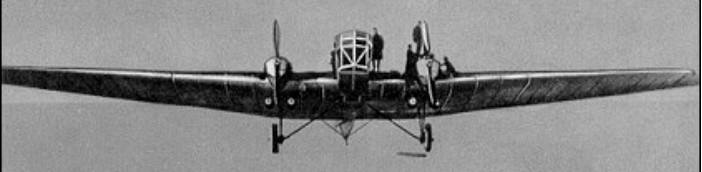
Design work on Tupolev’s first large air¬craft, the twin engined ANT 4, began before the first flight of the ANT 3. It owed much to the three engined Junkers G 23 transport, and was built on the second floor of a former Moscow merchant’s house which formed part of the TsAGI premises. The walls had to be knocked down and the components taken to the Central Aerodrome for assembly before the seven minute first flight on 26 Novem¬ber 1925.
A cantilever low-wing monoplane powered by two 336kW Napier Lion engines, the prototype TB-1 or Tupolev ANT-4 made its maiden flight on ski landing gear on 26 November 1925. Intended mainly for the heavy bomber role, the ANT-4 was of all-metal construction with corrugated metal sheet covering and a glazed nose section.
The second aircraft was the true TB-1 bomber prototype; flown initially in July 1928 it had a redesigned nose section with ‘balcony’-type gunner’s cockpit and a crew of five including three gunners, and was powered by two 544kW BMW VI engines. A third prototype, designated ANT-4bis, had revised engine nacelles and increased armament.
The first series machine was completed as a propaganda aircraft; named Strana Sovietov (Land of the Soviets) it was equipped for a staged flight across Siberia and on to New York but was soon damaged severely in a forced landing. A second aircraft was prepared and completed the journey, using wheels or floats as appropriate, and this second Strana Sovietov (URSS 300) covered 21242km between leaving Moscow on 23 August 1929 and arriving in New York on 1 November.
In its production form, as the TB 1 heavy bomber, the ANT 4 was armed with three pairs of 7.62 mm DA machine guns, in the nose and two dorsal positions. Two hun¬dred and sixteen were produced at the former Junkers concessionary factory at Fili, Moscow, which had been taken over by the Soviet authorities in July 1926.
Production of the TB-1 continued until August 1932, a total of 152 being delivered plus 66 TB-1P twin-float bomber/torpedo seaplanes.
The TB 1 was used for a number of duties (torpedo bomber, freight plane) and was the first Tupolev component of the ‘Zveno’ series of composite aircraft, devised by V S Vakh¬mistrov to extend the radius of action of fighter aircraft. Two I 4 (ANT 5) single seat fighters were to be carried into action on the wings of a TB 1 mother plane. The Zveno 1, as it was known, was first and successfully tested on 3 December 1931.
Pavel Grokhovsky proposed hanging special container under the wings of TB-1 aircraft, capable of transporting paratroopers. Officially these structures were called “Red Soldier Automatic Launchers” (“автоматическими выбрасывателями красноармейцев”). In each container there was a soldier with his parachute. In the landing area, the pilot released the containers, which, pivoting on their attachment to the wing, released their contents. The parachute was opened automatically by a rope attached to the structure. Members of the collective jokingly called the contenders “coffins.”
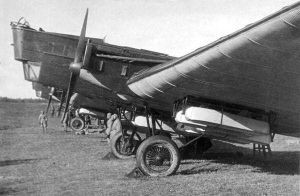
In the first tests it was Grokhovsky, and later his wife, Lidia Alexseyevna, who were launched from a container under the wing of a TB-1 bomber on July 14, 1931.
In the USSR the first flight with solid fuel accelerators (TTU for the acronym of Tviordo-Toplivnie Uskaritieli) took place in May 1931 and was carried out in a U-1 suitably modified by the engineers of the GAZ No.3 VI Dudakov and VA Konstantinov. The results obtained suggested the possibility of using the method on Tupolev TB-1 heavy bombers. In 1933, 6 accelerators were installed in a TB-1, three on each side of the fuselage, at the junction with the centroplane. Two aircraft were modified. In the first one (No.614) the six accelerators were located above the wing, in the second (No.726) one accelerator was located above the wing and two below. The tests, which concluded in October 1933, showed that with the use of the gunpowder accelerators the takeoff run of the bomber was reduced by 4 times.
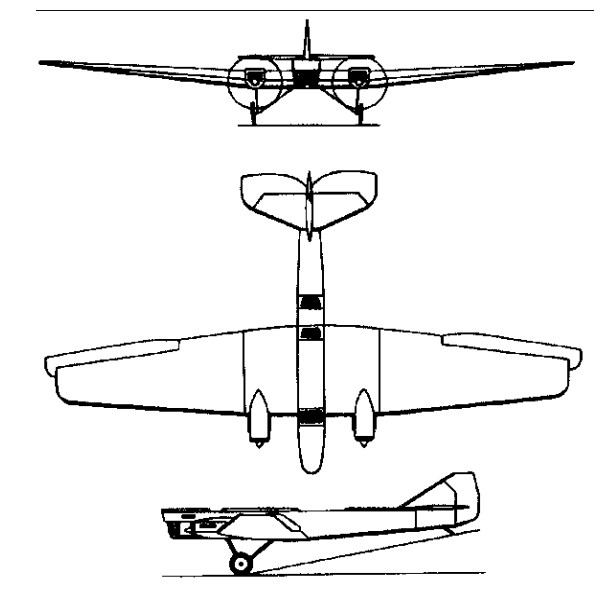
The ANT-4s were front-line equipment for a number of years before being relegated to the transport role with the revised designation G-1. Many were used as freighters by Aeroflot and by the Soviet Arctic Aviation Authority (Aviaarktika), final examples of the type being grounded in 1945. The TB-1 was also used in a number of experiments, including autopilot and drone trials, inflight refuelling of other aircraft, rocket-assisted take-offs, and cargo parachute drops. It was the first twin-engined all-metal cantilever monoplane to enter production in the world.
TB-1
Engine: 2 x M-17
Max take-off weight: 6712 kg / 14798 lb
Empty weight: 4420 kg / 9744 lb
Wingspan: 28.7 m / 94 ft 2 in
Length: 18.0 m / 59 ft 1 in
Wing area: 121.5 sq.m / 1307.81 sq ft
Max. speed: 200 km/h / 124 mph
Ceiling: 4800 m / 15750 ft
Range: 1000 km / 621 miles
Armament: 3 x 7.62mm machine-guns, 700 kg of bombs
Crew: 5
 All Aero