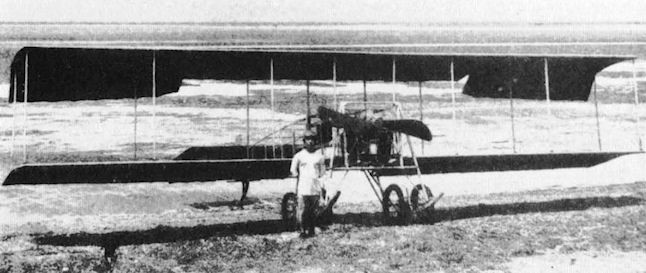
Shigesaburo Torigai with a new-found interest in aviation as a hobby, organized the Nihon Hiko Kenkyukai (Japan Flight Research Association). His ambition was to have an aeroplane of his own. To achieve this, he asked Toyokichi Daiguchi, who was associated with Narahara, for technical assistance in the building of his own aeroplane.
In 1913, to open the project, Torigai purchased a used 45hp Gregoire Gyp engine from Shinzo Morita of Osaka after his flying accident. Torigai completed his aeroplane in April 1913 and called it the Hayabusa-go (Falcon). It was an equal-span three-bay biplane with uncovered fuselage, tractor engine, ailerons on the upper wing and undercarriage comprising two sets of twin wheels and two skids. Otijiro Itoh assisted Shigesaburo Torigai, another Japanese pioneer, in the construction of the Torigai ”Hyabusa-go”.
He flew it for the first time on 3 May, 1913, at Inage, Chiba Prefecture, but at a height of about 20m the aeroplane stalled and crashed. Torigai survived, but the aeroplane was severely damaged.
After repairs by Daiguchi, Torigai took the aeroplane to Hokkaido. While preparing for a flying exhibition at the Tsukisappu Military Drill Grounds on 7 September, 1913, Torigai took off and, on the outskirts of Sapporo, soon crashed once again. Speculation about the cause of this and the earlier accident is that Torigai did not know how to fIy, for there was no record of him having been given formal flying lessons. Torigai escaped serious injury but the aeroplane was badly damaged. The wreckage was saved and eventually transferred to Otojiro Itoh, to help start his flying school at Inage the next year. Itoh made the necessary repairs along with his own modifications and made the aeroplane flyable.
Itoh eventually purchased the Gregoire Gyp engine from Torigai in August 1915 so that it could be installed in his first-built aircraft, the Emi 1 Aeroplane. This is the aeroplane that made the first flight to Tokyo from Inage on 8 January, 1916.
 All Aero