Professor Tanakadate, who started out as a researcher of geomagnetism and earthquakes, became interested in aviation after witnessing the flight of an airship in France in August 1907, while attending a Paris meeting of the General Conference on Weights and Measures. That experience, along with the findings he gleaned from an aerodynamics book he obtained from a British researcher, stimulated his interest in aviation science and set him on course to become one of Japan’s earliest and most important pioneers in the field.
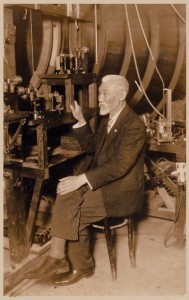
On returning home, Tanakadate built a wind tunnel, the first such device in Japan. His apparatus, created from a nagamochi, a wooden drawer used for storing kimonos, was fed air from one side and had a small glass window in the side through which to observe how a scale-model airplane, hung from the ceiling inside the tunnel, would react to the air flow. He may have used the wind tunnel to test scale models of the first glider to fly in Japan.
Tanakadate frequently emphasized that it was vitally important to fully understand the basics of all related phenomena when it came to aeronautical research. His advocacy for comprehensive learning resulted in the opening in 1918 of Aeronautical Research Institute attached to the University and the commencement of an aeronautical course in the Department of Shipbuilding. This course expanded to become the Department of Aeronautics in 1920.
 All Aero