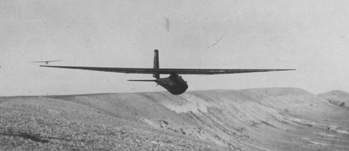
The Tijonrarov / Dubrovin / Vaxmistrov “Zhar-Ptitsa” (Firebird) (Russian: Тихонравов / Дубровин / Вахмистров «Жар-Птица») glider was designed in 1927 by MK Tijonrarov and AA Dubrovin in order to participate in the IV National Competitions Gliding, which took place in that year. Later this group would be joined by fellow student VS Vaxmistrov.
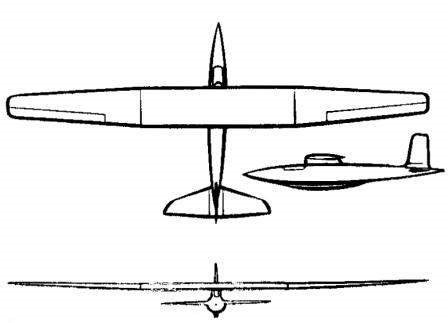
The “Zhar-Ptitsa” glider was designed as a single-seat monoplane with a cantilever wing in parasol. The structure was built in wood. The wing was fixed to the fuselage at three points on a 200 mm base pile, made as a continuation of the central structure of the glider. The centroplane had a rectangular shape and in the area of union with the fuselage it was covered with 3 mm plywood.
The wing consoles featured a single spar structure and plywood covering from the leading edge to the spar area. From then on, the covering was made of fabric. The fixation to the centroplane was carried out by means of two screws. Assembly of the glider at the flight site could be done in 10-15 minutes.
The fuselage was spindle-shaped with a tapered bow and tail. Its structure consisted of trunk-type frames linked together by light stringers.
The tail unit was of the conventional monoplane type with the rectangular empennage.
The landing gear consisted of a ski. On takeoff (towed), the aircraft was tied to the tugboat by means of a 100-meter, 5-mm diameter rope that ended in a 3-meter-long and 188-mm thick rubber band. A hook was located at each end. For takeoff, the plane was attached to a trolley that detached when it reached takeoff speed. After separating from the glider, the tow plane dropped the rope. The landing was made by landing on the ski.
The “Zhar-Ptitsa” was completed in the workshops of the Air Fleet Academy and presented in Koktebel by the trio of developers.
This glider was quite successful, to the point of becoming the “passport” of the next competitions. In order to participate in the tests, the glider pilots had to make a previous flight in the “Zhar-Ptitsa”.
The main deficiency of the “Zhar-Ptitsa” glider was its incorrect centering as a result of the increased weight of the wood used in relation to that of the project. To correct this defect it was necessary to place a weight of 10 kg in the forward part of the fuselage.
The official opening of the IV National Sailing Competition was held on 18 of September of 1927, but since dawn that day strong winds that prevented flying. However, later, the force of the wind abated and it was allowed to compete. The “Zhar-Ptitsa” piloted by KM Vienslav flew for 15 km, landing on the outskirts of Feodosia, setting a new record.
Only 10 gliders appeared at the V National Sailing Competition held in Koktebel between September 23 and October 2, 1928. During the development it was clear that the main results of the contest would be distributed among the “Zhar-Ptitsa” gliders and its derivative “Gamayún”. During one of the flights, VA Stepanchonok achieved an excellent altitude making spirals in the “Zhar-Ptitsa”, but the expected records were not reached as the glider was damaged when landing with a tailwind.
The “zhar-Ptista” would participate again in 1929 in the VI annual National Sailing Competitions. On this occasion, it was used mainly in training tasks for glider pilots and its mastery was a determining factor in being able to fly in the competition.
The starting point of the competitions in Koktebel was located on the top of the Uzun-Syrt Mountain and featured a piece of steel buried in the earth. Before the start the glider was fixed to this structure. For the launch, a rubber strip was used that at one end had a hook and at the other ended in two 5-meter ropes. The hook was attached to a piece on the glider, while 4 or 5 people began to pull the other end. After advancing about 20 – 30 steps, a good tension was achieved on the tape. At that moment the pilot, located in the cockpit, released the glider, which would shoot like a stone to get up from the ground up to about 25 – 30 meters high. This was enough for a pilot with some training to be able to take advantage of a current of air or a thermal to take the necessary height and perform the glide.
In those early days the important thing for the pilots was not to return to the starting point or even to the base of the mountain. The greatest attention was paid to being able to achieve takeoff after launch at 30 meters high and being able to glide to the base of the mountain without damaging the aircraft or themselves. Means to transport the devices did not exist there. The glider was climbed to the top of the mountain, on shoulders, with the help of volunteers who came to support the pilots and the spectators themselves.
These volunteers were also in charge of helping with the repairs that had to be carried out on the gliders. Generally, as a reward, these volunteer helpers were “paid” by allowing them to fly in the gliders.
During the IV National Sailing Competitions, one of these active volunteers was the Kiev Polytechnic Institute student Sergei Korolyov, who came to realize his childhood dream of flying. Sergei Korolyov took flight for the first time on board the “Zhar-Ptitsa”.
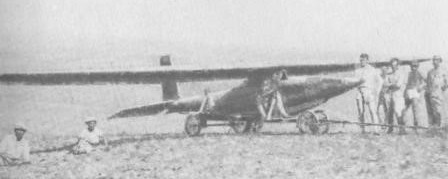
One of the most experienced pilots of the VMF military pilot school located in Kacha was Vasili Stepanchonok, who in 1930 proposed taking off on gliders towed from other aircraft and developed a variant of the towline. This initiative was supported by the school principal Robert Rataush. On 3 May 1931, for the first time in the USSR, there was a takeoff of a glider towed by a U-1 (copy of the Avro 504K ) airplane. The glider used in this flight was the “Zhar-Ptitsa”, piloted by Maxim Moiseyev. Three subsequent flights were made by Mikhail Nyuxtikov, Gury Gribakin and Robert Rataush himself. Initially, this type of take-off was considered a kind of trick, but its importance from the sporting and military point of view was soon understood.
Nyuxtikov had received this glider as a gift after his outstanding performance as a test pilot at Koktebel competitions in 1930. To carry out the take-off with a ttowplane, Nyuxtikov proposed to develop a wheelbarrow on which the glider was located and which would detach at the time of take-off. For the first time in the USSR this system was used and possibly it was also one of the first uses in the world. In the magazine “ Samoliot ” of 1931 the details of this truck used for the take-off of the “Zhar-Ptitsa” were published.
Zhar-Ptitsa
Wingspan: 11. 5 m
Wing area: 16.3 m²
Aspect ratio: 12.9
Length: 6.93 m
Height: 1.9 m
Empty weight: 172 kg
Wing loading: 15 kg / m²
Elevator area: 2.6 m²
Rudder surface area: 0.85 m²
Spoiler area: 2.92 m²
Accommodation: 1
 All Aero