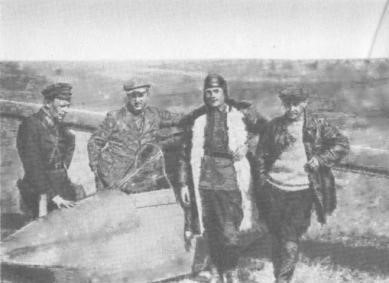
Despite being serving in the “Lenin” squad, Tijonrarov did not cease his constructive activity. During 1928, together with VS Vaxmistrov and AA Dubrovin, two new gliders were created, called “Gamayún” and “Skif” (Russian: Тихонравов / Дубровин / Вахмистров «Скиф»), both produced as a development of the excellent “Zhar-Ptitsa”.
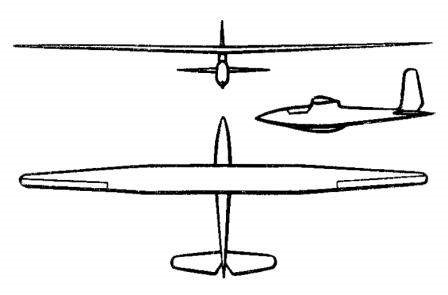
The “Skif” glider was a development of the scheme of the “Zhar-Ptitsa” glider. It was designed as a single-seater monoplane with cantilever wing in parasol. The structure was built in wood. The wing was fixed to the fuselage at three points on a 200 mm base pile, made as a continuation of the central structure of the glider. The centroplane had a rectangular shape and in the area of union with the fuselage it was covered with 3 mm plywood.
In this model the builders decided to use a modified structure, which introduced a second stringer. The plywood overlay was extended to the position of this second spar. From then on, the covering was made of fabric.
The fuselage was spindle-shaped with a tapered bow and tail. Its structure consisted of trunk-type frames linked together by light stringers. Another significant difference from the design of the previous “Zhar-Ptitsa” and “Gamayún” models was the shape of the tail. The “Skif” featured new removable triangular-shaped surfaces with rounded ends. At the bottom of the fuselage was the landing ski.
The pilot was located in a closed cockpit, which had a removable celluloid cover and two small windows located at the level of the pilot’s eyes. The cockpit had so much space that the pilot could sit with his parachute. The cover provided the necessary clarity to allow the pilot to see the instrument records. The cockpit panel featured a speedometer, barometer, altimeter, lap counter and overload indicator. A thermometer and an angle of attack marker were located on the outside.
During the tests some vibration was noted in the rudder area, but it was soon resolved by reducing the area.
In 1929, during the VI National Sailing Competitions in Koktebel A. B. Yumashiev on the “Skif” glider set several national records.
On October 12, taking off from the south slope, near the afternoon, when the flights had already ceased, the pilot felt that the glider was staying well in the air and began to rise. When it exceeded 570 meters the barograph stopped recording. Yumashiev began gliding using the northwesterly wind and landed safely after covering a record distance of 13 km. This was the first time that a glide over a thermal flow with ascent over the plain was achieved in the USSR.
On October 22, Yumashiev would once again become the news when he reached a record height of 1520 meters on the “Skif”. After achieving that height, Yumashiev decided to try a new distance record, but his glider lost 600 meters in height quickly. With the remaining height, he managed to maintain a linear flight until reaching Dalnie Kamishi village, located at 27.2 kilometers.
The “Skif” glider would be presented again in the VII edition of the national competitions, held in 1930.
Skif
Wingspan: 16.0 m
Wing area: 16.0 m²
Aspect ratio: 16
Empty weight: 170 kg
Wing loading: 15 kg / m²
Horizontal plane surface: 2.3 m²
Empennage surface: 1.15 m²
Glide ratio: 22.2
Accommodation: 1
 All Aero