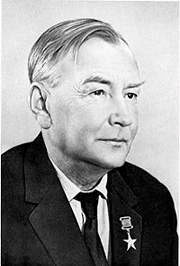
Mikhail Klavdievich Tijonrarov (Russian: Михаил Клавдиевич Тихонравов) was born on July 29, 1900 in the city of Vladimir.
In June 1919 he voluntarily joined the Red Army, serving as a political agitator in the military commissariat of the Vladimir governorship. In 1920 he began his studies at the Institute of Engineers of the Red Air Fleet (Институт инженеров Красного Воздушного Флота) which from 1923 would become the Military Aeronautical Engineering Academy Professor N. Ye. Zhukovski (VVIA) (Военно-воздушная инженерная академия имени Н. Е. Жуковского), graduating in 1925.
After finishing his studies, Tijonrarov served in the 1st “Lenin” light bomber squad. From 1926 he worked in various aeronautical companies, including the bureaus of DP Grigorovich and Nikolai. N. Polikarpov. From 1930 he became head of the KB engine group at Factory No.39 Menzhinski.
In those years, and as a complement to his professional activity, he built around 10 gliders in conjunction with VS Vaxmistrov and AA Dubrovin, among which the AVF-1 “Arap” of 1923, AVF-22 “Zmiei Gorinich” of 1925, “Zhar-Ptitsa” in 1927, “Gamayún” in 1928, “Skif” in 1928, “Konsomolskaya Pravda” or “Zhar Ptitsa-2” in 1929, “Skif-2” in 1931. Many of these specimens competed successfully in the National Sailing Competitions held in Koktebel, Crimea.
Sergei Koroliov proposed to Tijonrarov to devote himself to the development of ballistic missiles propelled by liquid fuel. From 1932 Tijonrarov was appointed brigade chief in the Group for the Study of Reactive Movements (GIRD), which was responsible for the development of the first Soviet two-stage reactive engine.
Starting in 1938, Mikhail Tijonrarov dedicated himself to the research of liquid reactive engines, the development of rockets for the study of the upper layers of the atmosphere, but at the end of the 1930s, work related to the development of ballistic missiles with reactive engines they were canceled and Tijonrarov set about developing the rockets for the “Katiuskas”.
Between 1940 and 1943 Tijonrarov led a construction group, under the leadership of AG Kostikov, which was in charge of the development of the intercept fighter “302” with combined power plant. In this stage of the war he developed an intense work in the development of reactive rockets for the VVS.
Starting in 1946, Tijonrarov was appointed substitute for the head of the reactive rockets group at Institute No. 4 of the USSR Academy of Gun Sciences. Between 1946 and 1956 Mijail Tijonrarov created within the institute a group for the development of a project known as BR-190 consisting of a piloted aircraft that took off vertically with the help of an R-1 rocket, reaching a height of 200 km.
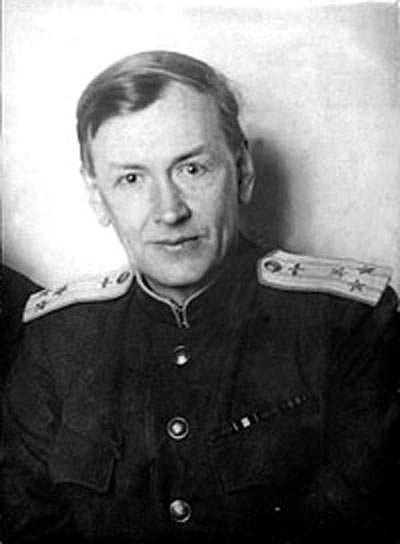
The next works of Tijonrarov’s group were devoted to the study of missile trajectory calculations.
In March 1950 at the NII-4 Tijonrarov gave a lecture entitled ” Rocket packages and prospects for their development.” In his speech he developed the above ideas and for the first time he spoke publicly about the possibility of using these rockets to locate artificial satellites in orbit, and even take people into space. The group’s work was directed to the development of a “package” made up of three R-3 rockets, designed to carry a 3-ton military payload over a distance of 3000 km.
Under the leadership of Tijonrarov, the world’s first manned cosmic ship was successfully developed and launched for which he was awarded on June 17, 1961 with the title Hero of Socialist Labor , along with the Order of Lenin and the Hammer and Sickle medal.
From 1961 Tijonrarov was promoted to head of department and substitute for the main builder of OKB-1, which from 1966 became the Central Construction Bureau for Experimental Machinery Construction (TsKBEM). In the next few years the group under the direction of Tijonrarov worked on the project to develop a manned spacecraft to fly to Mars, several artificial satellites with different objectives. From 1970 he became scientific director of TsKBEM.
Miajil Tijonrarov died on 4 of March of 1974 in Moscow at the age of 73 years.
 All Aero