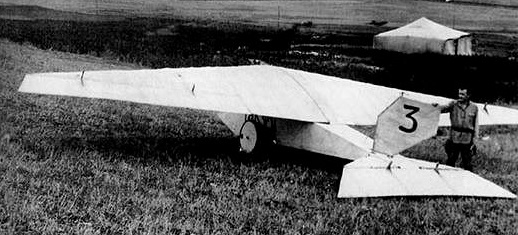
In March 1923 the Society of Friends of the Air Fleet (ODVF) was created (in Russian: Общество друзей Воздушного флота (ОДВФ)) with the aim of supporting the construction of airplanes and aeronautical engines, familiarizing the population with aeronautics and with the study of airplanes, engines, gliders, parachutes, as well as the development of gliding. To this end and under the direction of KK Artseulov, the Center for Motorless Aviation was created within the ODVF.
Tijonrarov became interested in the construction process and began to combine his studies at the Academy with the projection of a glider that he called “Arap”. This was the first glider created within the Air Fleet Academy (AVF), for which it was officially designated AVF-1 (Russian: АВФ-1 “Арап”).
The AVF-1 “Arap” was developed by a group of academy students. The assembly was carried out at the “Aviarabotnik” factory in Moscow.
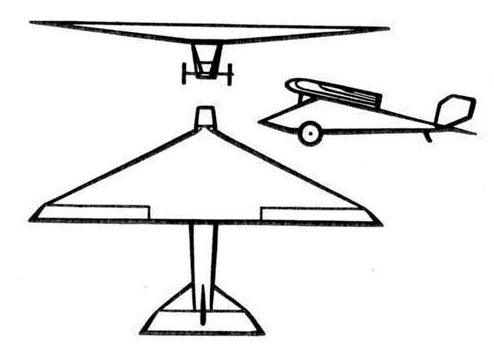
The AVF-1 “Arap” glider was designed as a monoplane with a triangular cantilever wing. The structure was built in wood with a textile covering. The wing profile was achieved by taking the shape of a Junkers monoplane with modifications to the shape and its structure had wooden stringers converging at a point on the wing root, joined with perpendicular ribs. Roll control was ensured by large ailerons on the trailing edge.
The fuselage, with a trapezoidal section, was made up of two flat surfaces joined by pieces of wood. Towards the tail section the fuselage closed towards a horizontal rib to which the tail was attached.
The tail unit was of the monoplane type. The large area horizontal stabilizer was located at the rear of the fuselage with a single large area elevator. The empennage functioned entirely as a rudder.
The landing gear was of the conventional type, fixed, with a tail skid. The two large wheels were located on either side under the cab, with a large light between them.
The cockpit for the pilot was located in the forward portion of the fuselage, under the wing.
The first flight was made on October 12, 1923. The AVF-1 was ready in time to participate in the First National Sailing Competitions, promoted by the ODVF and held between November 1 and 18, 1923 in the Uzun-Sirt mountains, Crimea.
Ten gliders appeared in this contest. The technical commission, chaired by Professor VP Vietchinkin authorized the flight of only 9, among which stood out the AVF-1 Arap of MK Tijonrarov, the AVF-2 Strizh of VS Pyshnov, the AVF-3 “Mastyazhart-1” of SV Ilyushin; the Maori of SN Lyushin and tailless glider BICH-1 of BI Cheranovski.
After tests that comprised flight for more than 15 seconds, the AVF-1 was one of the four gliders that were authorized to perform flights. In November or December 1923, piloted by VF Denisov, this flight lasted only 1 minute 5 seconds in which the glider reached 385 meters with a maximum height of 70 meters. On the second flight the “Arap” made a turn and destroyed the wing.
AVF-1 Arap
Wingspan: 10.1 m
Wing area: 15 m²
Aspect ratio: 6.8
Length: 6.2 m
Height: 1.9 m
Empty weight: 70 kg
Wing loading: 9.5 kg / m²
Stabilizer surface 0.65 m²
Elevator surface 2.5 m²
Rudder surface area: 0.65 m²
Spoiler area: 2.4 m²
Accommodation: 1
 All Aero