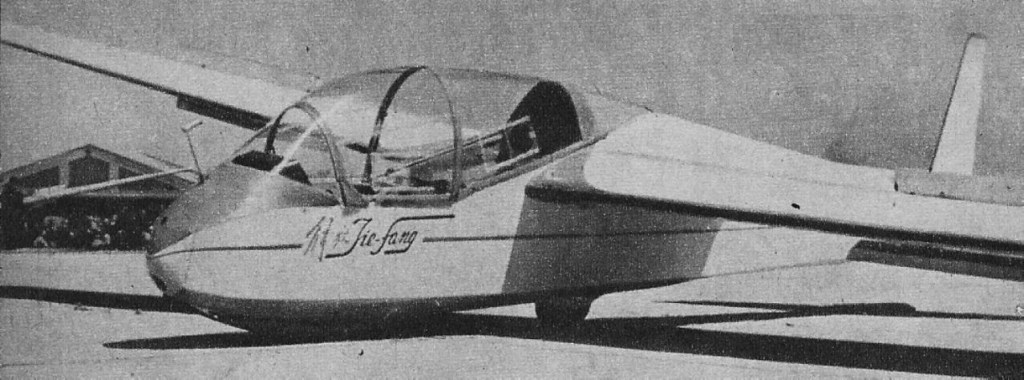
When during the 1950s the Chinese People’s Republic decided to revive the country’s sporting gliding movement it was to Poland that they turned for help, and with the aid of instructors, technicians and designers from the Polish SZD organisation a central Gliding School was organized at An-Yan and large gliding establishments were set up at Tchan-Tia-Kou. It was here that a Chinese glider design office was formed towards the end of 1956 under the direction of Dipl Ing Niespal of the Polish SZD, and a Glider Manufacturing Centre was organized for the licence production of Polish types such as the ABC, Salamandra, the SZD-8 Jasolka, the SZD-12 Mucha 100 and the SZD-9 Bocian, examples of which had already been purchased from Poland; production of these types began during 1955-56.
It was at Tchan-Tia-Kou that the first Chinese glider of original design, the Lie-Fang (or Liberation) two seater intermediate trainer, was created. The design of the Lie-Fang, one of the first gliders to originate in China, was led by the Polish J. Niespal. He was assisted by two Chinese engineers, Tchen-Kuei-Wen and Li-Ti-Tuin.
Niespal used the 1953 SZD-12 Mucha 100 as a starting point. There were many differences between the Mucha and the Lie-Fang, partly because the latter was a two-seat aircraft and therefore longer, with a much modified nose and more strongly forward-swept wings; the Lie-Fang’s fuselage was a simpler, flat sided structure compared with the Mucha’s oval section monocoque and the empennage was more angular.
The Lie-Fang 1 (English: Liberation 1), some sources Jeifang 1, is wood framed, with some use of the local “poton” wood and with a mixture of plywood and fabric covering. It has a high mid mounted single spar wing with a plywood covered torsion box leading edge, Behind the spar the wing is fabric covered. In plan it is straight tapered with unswept leading edges, resulting in forward sweep of 2° at one quarter chord. There is 4° of dihedral and 2° of washout. Its ailerons are slotted and fabric covered and spoilers, mounted behind the spar at about one third span, open above and below the wing.
The wooden slotted ailerons are also fabric covered and there are spoilers on both top and bottom wing surfaces. The fuselage is a plywood monocoque with a light alloy nose-cap, and the cantilever tail unit is of wood with fabric covering.
The fuselage is a flat sided monocoque which tapers gently to the rear, with the straight tapered tailplane mounted on top of it and forward of the fin. The rear surfaces are fabric covered. The straight edged rudder extends to the keel and moves in a cut-out between the elevators, one of which has a trim tab. The cockpit, mostly ahead of the wing leading edge, seats pupil and instructor in tandem with a single set of instruments that they can both see. The fixed, two part forward canopy reaches almost to the nose; a rear transparent section opens sideways for access to both seats. The Lie-Fang lands on a fixed monowheel undercarriage under the wing, fitted with brakes and aided by a short, rubber sprung nose skid and a tail bumper.
The landing gear consists of a non-retractable monowheel with brake, and a rubber-mounted skid under the forward fuselage. The two pilots are seated in tandem under a large sideways-opening Perspex canopy.
The prototype made its first flight on 10 May 1958. It was cleared for cloud flying and classed as semi-aerobatic. It went into production at the Tchan-Tia-Kou manufacturing centre, Shenyang, and was intended that pupils should graduate from the Lie-Fang to the single-seat SZD Mucha, which it resembles in appearance, for their first solo flights and the Lie-Fang went into small-scale production for the Chinese gliding centres.
Wingspan: 15.00 m (49 ft 3 in)
Length: 8.00 m (26 ft 3 in)
Wing area: 18.5 m2 (199 sq ft)
Aspect ratio: 12.4
Airfoil: Göttingen 549 over most of the span, NACA 4412 at tip
Height: 1.35 m (4 ft 5 in)
Empty weight equipped: 242 kg (534 lb)
Max takeoff weight: 420 kg (926 lb)
Stall speed: 55 km/h (34 mph, 30 kn)
Never exceed speed: 165 km/h (103 mph, 89 kn)
Rough air speed max: 138 km/h (85.7 mph; 74.5 kn)
Aerotow speed: 140 km/h (87.0 mph; 75.6 kn)
Winch launch speed: 100 km/h (62.1 mph; 54.0 kn)
Terminal velocity: with full airbrakes 165 km/h (103 mph; 89 kn)
g limits: +4.5
Max l/d: 22 at 53 mph / 86 km/h / 46.4 kn
Min sinking speed: 0.8 m/s / 160 ft/min / 2.62 ft/sec at 38.5 mph / 62 km/h / 33.5 kn
Min sink: 2.6 ft/sec at 38.5 mph
Crew: Two
 All Aero