
The Air Ministry felt that it could no longer stand by and see foreign aircraft winning the Schneider Trophy contest, so it ordered a number of racing seaplanes and formed a special RAF High Speed Flight to enter them in the 1927 contest at Venice.
One of the types ordered was the Supermarine S.5, that won the race at a speed of 281.65 mph. Two years later (the contest became biannual from 1927) the success was repeated by a slightly larger machine on the same lines, the S.6, with a 1,900 h.p. Rolls¬Royce R engine.
In 1929, the world absolute speed record went up to 358 mph when a British Supermarine S-6 seaplane made an official run.

The Air Ministry financed the Schneider racers until 1929, when they decided the cost was too high to continue. Two years later, at the last minute, Lady Houston provided the cash which enabled Britain to win a the third consecutive victory. Pilots of the winning machines in 1927, 1929, and 1931 were members of the specially formed RAF High Speed Flight.
In 1931 Britain gained the Trophy outright when the S.6B with its Rolls¬Royce engine boosted to give 2.300 h.p. won the third consecutive contest at 340.6 mph over the 189 mile course. The S.6 and S.6B also set up new world speed records of 357.74 and 406.99 mph (29 September 1931) respectively. They were forerunners of Mitchell’s Spitfire.
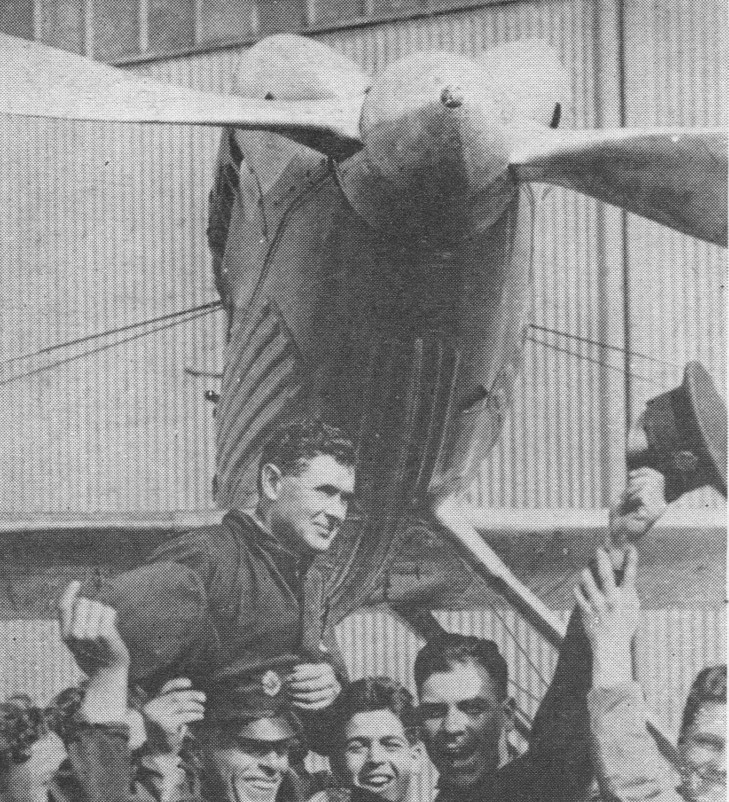

S.6B
Engine: 1900 hp Rolls-Royce ‘R’
Span 30 ft
Length 28 ft. 10 in
Height 12 ft. 3 in
Wing area 145 sq.ft
Weight empty 4,560 lb
Loaded weight 6,066 lb
 All Aero