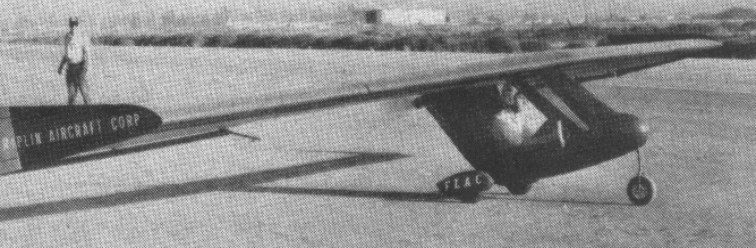
Single seat twin engined high wing mono¬plane with conventional three axis control. Wing has swept back leading edge, and tapering chord; no tail. Pitch/roll control by stabilator; yaw control by tip rudders; control inputs through stick for pitch/roll and pedals for yaw. Cantilever wing; wing profile Worthmann FX 126; double surface. Undercarriage has three wheels in tricycle formation; nosewheel retractable; suspension NC on nosewheel and glass fibre suspension on main wheels. Push right go right nosewheel steering connected to yaw control (Flac). No ground steering (Super Flac). Brakes Nod. Glass fibre/foam fuselage, totally enclosed. Engines driving pusher propeller.
Designed in June 1977, the prototype Flac (Foot Launch Air Cycle) made its first flight on the 24 October 1978 and despite its name was fitted with an auxiliary undercarriage to help the legs of its occupant. A tail less aircraft with a cantilever high wing set at 3 deg incidence with 8 deg of leading edge sweep back, even the earliest Flacs had a closed cabin of glass fibre and polyurethane foam, mounted under the wing. The wing tips were furnished with fins carrying rudders, while the stabilators at the trailing edge acted as elevators when used together or as ailerons when used differentially. The wing structure was glassfibre and epoxy on a foam base, fabric covered between spar and trailing edge. The main undercarriage was mounted on glassfibre legs, while the steerable nosewheel was manually retractable into the fuselage nose.
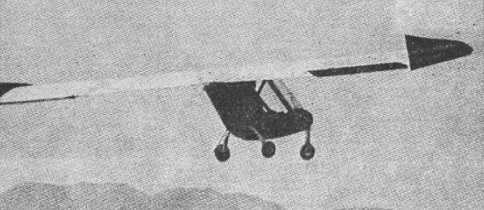
With two Chrysler Westbend motors giving 9hp each, the Flac cruised at 65mph (105kph) with a Vne of 80mph (129kph), a stall around 20 mph (32 kph) and a climb rate of 1630 ft/min (8.3 m/s). Add in weights of 156 I.P (71 kg) empty and 386 lb (175 kg) at maximum gross and a range of 200 mile (322km) on 5.0 US gal (4.2 Imp gal, 18.9 litre.
In addition to two prototypes, five Flacs had flown by January 1980 and 79 were being built by amateurs. Ken Striplin was not content with that and that Spring announced the Super Flac, which had more space for the pilot’s legs, thanks to a fixed nosewheel, and Soarmaster rather than Chrysler engines.
FLAC
Engine: Mac 101, 12-hp
Cruise: 25-30 mph
Air Cycle II
Engines: 2 x West Bend, 10 hp
Cruise: 65 mph
Stall: 23-30 mph
MAUW: 550 lb
Useful load: 300 lb
Super Flac
Engine: Two Soarmaster, 11.5 hp
Propeller diameter 48 inch, 1.21 m
Power per unit area 0.15 hp/sq.ft, 1.6 hp/sq.m
Fuel capacity 5.0 US gal, 4.2 Imp gal, 18.9 litre
Length overall 7.0ft, 2.13 m
Height overall 4.0ft, 1.22m
Wing span 32.0ft, 9.75m
Mean chord 4.911, 1.47m
Dihedral 8 deg
Sweepback 0 deg
Total wing area 155 sq.ft, 14.4 sq.m
Wing aspect ratio 6.6/1
Empty weight 200 lb, 91 kg
Max take off weight 434 lb, 197kg
Payload 234 lb, 106kg
Max wing loading 2.80 lb/sq.ft, 13.7 kg/sq.m
Max power loading 18.9 lb/hp, 8.6 kg/hp
Never exceed speed 80 mph, 129 kph
Max cruising speed 55 mph, 88kph
Stalling speed 24mph, 39kph
Min sink rate 180ft/min at 36mph, 0.9m/s at 58 kph
Best glide ratio with power off 20/1 at 38 mph, 61 kph
Take off distance 150 ft, 45 m
Landing distance 100 ft, 30 m
Air Cycle II
Engines: 2 x West Bend, 10 hp
Cruise: 65 mph
Stall: 23-30 mph
MAUW: 550 lb
Useful load: 300 lb
 All Aero