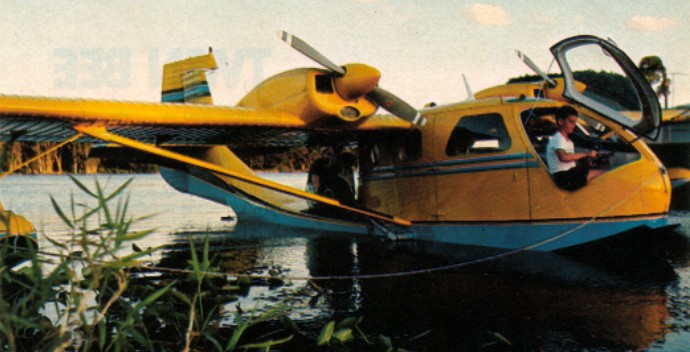
The Seabee inspired a number of follow-on designs, including the “Twin Bee”, a twin-engine conversion implemented by Joseph Gigante and his United Consultants (later STOL Aircraft) firm at Norwood Airport near Boston and sold by Seaplane Services, Meredith.
Designed by Joseph W Gigante, United Consultants added three foot wing root extensions on each side, plus a three foot center fuselage plug. The airframe is zero-¬timed, and all of the hydraulics, cables, instruments and furnish¬ings are new. Capping the makeover are two Lycoming IO-360-B1D 135 kW / 180 hp fuel injected engines driving two-bladed Hartzell variable propellers in tractor configuration on each wing. Two 180hp Lycoming O-360-A1A tractors originally in the 1960 built prototype N87588, IO-360-B1D for production (A6EA).
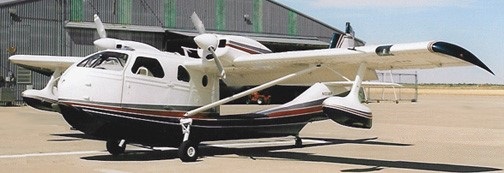
The result had center of gravity problems, which were solved by increasing the size of the fuel tank and installing a new fuel tank in the tailboom, which increased range at the expense of some fiddling with fuel management during a flight.
The Twin Bee is fuelled at the left rear of the cabin wall, direct¬ly above the 85 USG main tank in one of the keel compart¬ments. There’s a 16 USG auxiliary tank in the tail, just below the elevator. While an access panel leads to the auxiliary tank’s fuel cap, you customarily fill it by transferring fuel from the main. A single switch on the panel operates a valve and pump that move fuel in either direction between the two tanks.
The two seats in the second row can be replaced by a bench seat for three, the rearmost solo seat between the two portholes provides a little less space; it’s a nice place for a child to sit.
The doors hinged on the rear instead of the front. Changing the door hinge from front to rear was motivated by the need to keep the occupants from stepping out into the prop arc. The doors were implemented with additional latching and warning lights to indicate if they weren’t locked.
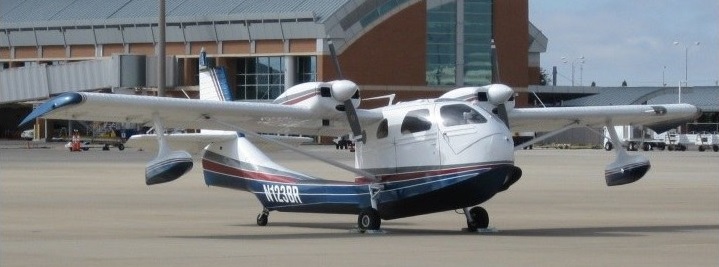
The first conversion was performed in 1960 built in the old hangars of Helio Aircraft at Norwood Airport, MA,
In her original configuration, the prototype had two 180 hp Lycoming O-360-A1A engines, and made her first flight in 1960 with a Helio test pilot at controls. Later most test flights were made by test pilot Peter Annis. During development, engine model was changes to injection type, the cowlings were redesigned and the tail control surface areas were increased.
After extensive flight tests for five years, the UC-1 Twin Bee was awarded the US FAR Aircraft Type Certificate No: A6EA on 25 June 1965. The first production aircraft was delivered one year later.
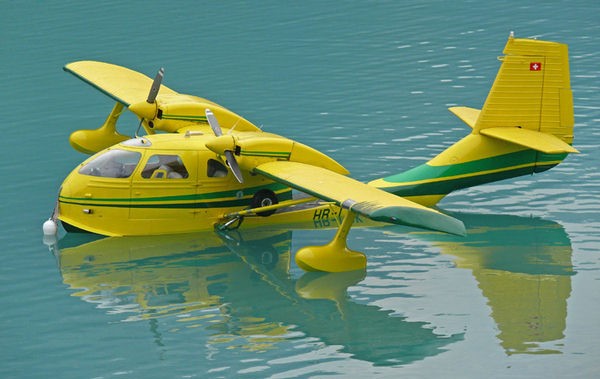
Conversion is accomplished by replacing the Seabee’s original 215 hp Franklin engine by two 180 hp Lycoming IO-360-B1D engines, driving 2-blade CS/feathering tractor propellors. The original wing span is increased by 6 ft, to 43.33 ft, by adding a 3-foot wing-root extension on each side. The hull is stretched 3 ft by inserting a “plug” just aft of cabin, to counter-act shift of CG. Further the rudder/trim-tab area is increased according to the increased power. The fuel capacity is increased from 75 US gal to 101 US gal by the addition of a new 85 US gal main fuel tank above step and 16 US gal fuel tank in the tail boom. The instrument panel, and the seat tracks, are moved forward to allow a fifth seat in the original cargo area.
23 updates sold from 1965 to 1987, the last one in 1987.
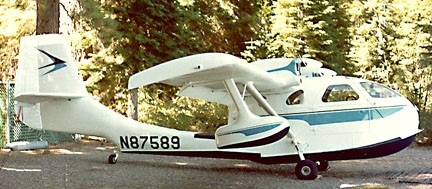
UC-1 Twin Bee
Engines: two Lycoming IO-360-B1D 135 kW / 180 hp
Wingspan: 43’3″
Length: 31’4″
Useful load: 1300 lb
Max speed: 147 mph
Cruise speed: 131 mph
Stall: 38 mph
Range: 900 mi
Ceiling: 19,000 ft
Seats: 5
 All Aero