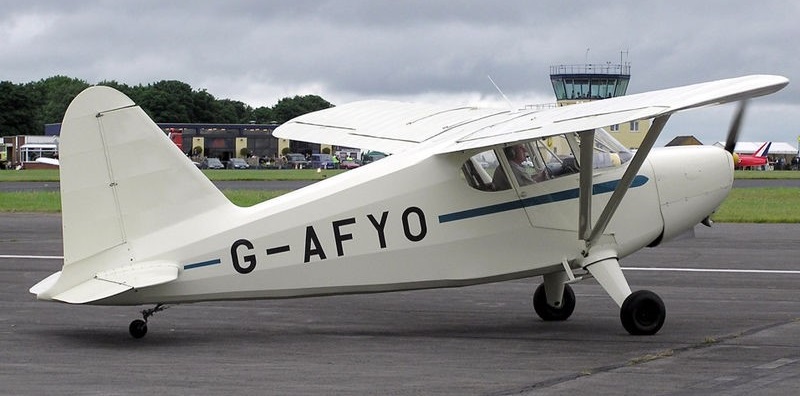
The pre-war civilian Stinson HW-75 (ATC 709) was a 75-horsepower civilian high-wing design built by Peter Altman, William Mara, Maurice A Mills, and Lewis E Reisner at the Stinson Aircraft Company at Wayne, Michigan and marketed as the Model 105. The “105” designation was unofficial, indicating cruising speed and used for publicity when first introduced at NY World’s Fair, priced at $2,995. The prototype HW-75, NC21121 c/n 7000, first flew on 3 February 1939 (piloted by Al Schramm) with a 50 hp engine but the production Model 105 airplanes were fitted with either the standard 75 hp engine, or an optional 80 hp Continental for $3,375. The Stinson 105 featured two side-by-side seats up front and a third “jumpseat” in the rear of the small cabin on which a child or small adult small could sit sideways. Featuring aerodynamic Handley-Page style slots on the outer third of the wings, the design was easy to fly, difficult to stall aerodynamically, and nearly impossible to spin.
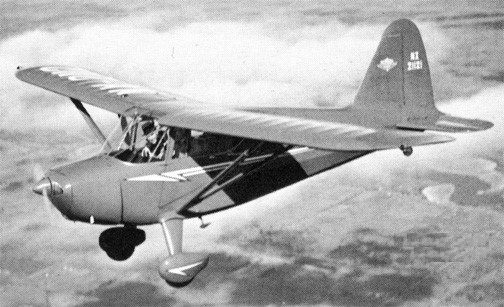
275 HW-75 were built, including 20 to the RCAF. The design was modified in 1941 as the Stinson-Vultee V76 with a 185hp Lycoming O-435 engine.
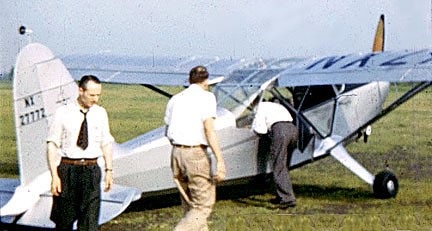
The Model 76, NX27772, first flew on 28 June 1941, piloted by Al Schramm.
In 1940, the Model 105 saw some minor improvements and was marketed as the “New 105”. Four months later, in keeping with the automobile industry practice of introducing a new model in the spring each year, Stinson came out with the Model 10 Voyager that had a slightly wider cabin and some cosmetic changes but was essentially still a Model 105 with a new look. The engineering designation was HW-80, but the 75 hp engine was also offered as a cheaper option. The 80 hp engine was now standard and they called it the “Voyager”. In early 1940, Stinson moved production from Michigan to a new factory built in Nashville, Tennessee where the Model 10’s were built. Shortly after this move, the company became a subsidiary of the Vultee Aircraft Corporation.
For the 1941 model year, more cosmetic changes and interior refinements were made and a 90 hp Franklin 4-cylinder engine was fitted. This version was sold as the Model 10A Voyager. In the postwar era, the fuselage of the 10A was enlarged to accommodate four seats, and the four-cylinder powerplant was replaced with a Franklin 125 hp six-cylinder engine, and eventually a 150hp and 165 hp “heavy case” version. This 4-seat conversion became the Stinson Model 108 Voyager and was the only civilian plane commercially produced by Stinson after WWII. The prototype first flew in December 1944.
Six examples of the Model 10 Voyager equipped with 80 horsepower Continental A-80 engines, Lear radios and wind-driven electric generators were purchased by the military for testing under the experimental designation YO-54 41-143 to 41-148.
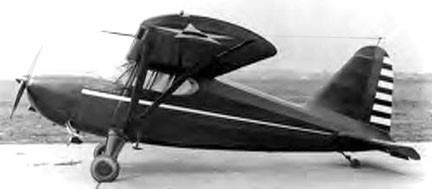
The Stinson 75, or Vultee-Stinson V75, of 1940 was the first prototype of L-5, militarized from the Model 10 with a 100hp Lycoming engine. Designed by A P Fontaine, it was first flown on 19 June 1940, piloted by Al Schramm. Evaluated in September 1940 by the Air Corps for potential use as a low-cost off-the-shelf replacement for the complex, expensive and much larger O-49 Vigilant that Stinson had designed in 1939, the YO-54 failed to meet performance requirements and other military criteria. The only addition not found on the stock Model 10 was a wind generator used to run a radio set specified in the contract. Four of the six were passed to the Civil Air Patrol. The other two were scavenged for parts.
The sole 75C, NX27711, was a 75B modified with a 125hp Franklin engine.
The US Army Air Corps used at least six 1940 V-75 for observation and liaison in 1942. They were 10-A (Model HW-90 ATC 738) powered by 90 hp Franklin O-200 engines and designated L-9A and YO-54. About 500 of the 10A were built, priced at $3,355. Eight civilian Model 10-A with 90 hp Franklin 4AC engines were used designated O-49/L-9B with Franklin O-200 engines. A few of 600 ordered by France were operated in France. One went to the RAF. One -75B was modified with a 125hp Franklin as the -75C, NX27711.
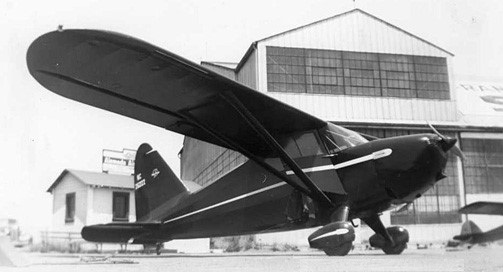
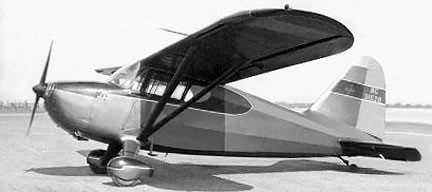
The Stinson 10-A, also known as the Voyager 90, was a three place high wing monoplane, powered by a four cylinder, 90 hp Franklin 4AC engine, with a fixed pitch, wooden propeller. It received ATC #738 in early March 1941. The Voyager was a new version of the Model 105. It had improved attributes and performance, the cowling had been redesigned and shortened, and along with a newly contoured windshield, provided better visibility. Over 700 of those Voyagers were built in 1941.
The 10-A was equipped with ball-bearing mounted flight controls and leading edge slots. Three position flaps, shock absorbing oleo spring gear struts, 48 inch tread main gear, hydraulic brakes and a steerable tail wheel suited short field work.
The 10-A wings had spruce spars, and the fuselage was welded steel tube. A 20 USG fuel tank was installed in the right wing and another 20 USG tank could be installed in the left wing. The vertical stabiliser was steel, while the horizontal stabiliser was built up from spruce and covered with poplar plywood.
The aircraft had a fly away price of US$3355. The plane was available as a Standard or Deluxe model. The Deluxe having navigation lights, an electric starter and a generator, and bonding for a radio that could be later mounted in its walnut finished instrument panel.
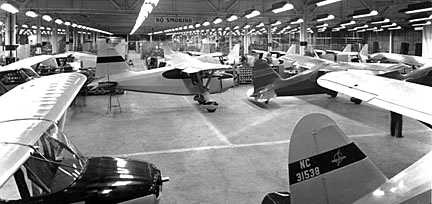
The 10-B of 1941 (ATC 738) was a conversion of 10-A NC27714 c/n 7761 to 75hp Lycoming GO-145-C3 engine.
In 1948 Piper took over the Stinson Division of Consolidated Vultee Aircraft Corporation and acquired the Stinson Voyager production rights, but production of this type was soon halted.
HW-75 1
Engine: 50hp Lycoming
Seats: 3
HW-75 / 105 Voyager
Engine: 75hp Continental A-75-3
Wingspan: 34’0″
Length: 22’2″
Useful load: 657 lb
Max speed: 105 mph
Cruise: 100 mph
Stall: 43 mph
Range: 350 mi
Ceiling: 10,500′
Seats: 3
10 Voyager / HW-80
Engine: 90hp Franklin 4AC-199
Wingspan: 34’0″
Length: 21’8″
Useful load: 677 lb
Max speed: 115 mph
Cruise: 108 mph
Stall: 47 mph
Range: 330 mi
Ceiling: 13,000′
Seats: 3
10-A Voyager / L-9B
Engine: Franklin 4AC, 90 hp
Height: 6 ft 6 in
TO dist: 550 ft
ROC: 600 fpm
Max speed: 115 mph
Cruise range; 330 miles
Landing speed: 47 mph
Landing roll; 150 ft
L-9A
Engine: 90 hp Franklin O-200
 All Aero