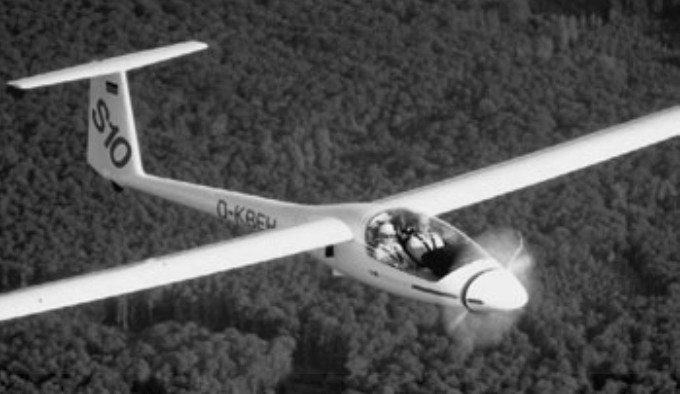
A two seat, side-by-side, motor-glider designed by Reiner Stemme, first flown in 1986, and first produced in 1990 at the Stemme factory at Strausberg Airfield, east of Berlin. The fuselage has a central steel tube frame, which forms the attachments for the wings, undercarriage and fixed internal powerplant. The carbon fibre rear fuselage bolts onto this frame, and the cockpit sec¬tion, which is a Kevlar lined carbon fibre shell, fits on the front. It has an electrically retractable undercarriage; not the conven¬tional glider mono wheel, but the more con¬ventional powered aircraft variety (although the track is quite narrow at 1.15 m). The engine is mounted behind the cockpit with a carbon shaft running through a Kevlar tunnel to a folding prop located behind a large retracting nose cone.
There are three basic varia¬tions of the Stemme, the S10, the S10V and the S10VT. The S10 has a four cylinder 93 hp Limbach four-stroke engine powering a fixed-pitch propeller. This combination gives a cruise speed of 90 knots. The S10V uses the same engine but with a variable-pitch propeller, giving a higher cruise speed of 121 knots.
The S10VT utilises a 115 hp turbocharged Rotax 914 engine, which gives a cruise speed of 140 knots at 10,000 ft. All variations a have a 23 m wingspan and can achieve a glide ratio of 50:1 while accommodating a crew of two. The three piece, 23 metre span, folding wings, contain two 45 litre fuel tanks.
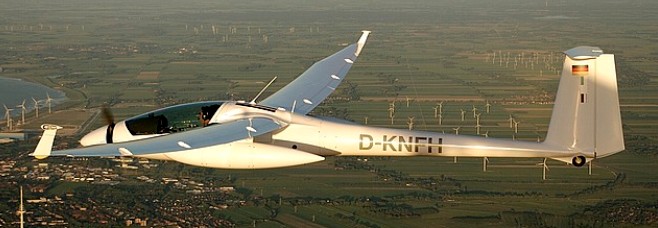
The S 10 VT engine, a 115 horsepower Rotax 914 Turbo (thus the “T” in the designation) with water cooled heads and a dual ignition system, is located in the lower fuselage be¬hind the cockpit. A centrifugal clutch turns a carbon fibre driveshaft, which is encased in a Kevlar tunnel and runs through the cen¬tral console to a reduction gearbox (0.9: 1) mounted behind the propeller in the nose section. The variable pitch (the “V” in the designation) folding propeller blades extend au¬tomatically by centrifugal force when the engine is started, with the nose cone mov¬ing forward and out of the way. When the engine is stopped, the blades fold inwards by a spring system and the nose cone is re¬tracted (which takes about six seconds) and the machine becomes a glider. The two-seater has carbon-fiber wings and solar panels for 30W of electrical power once airborne.
No. Built: 60
The U.S. Air Force Academy operates 2 S 10’s as the TG-11 A model (S 10VT), 94-1400 and 94-1500 also as civil N94FT and N94FW.
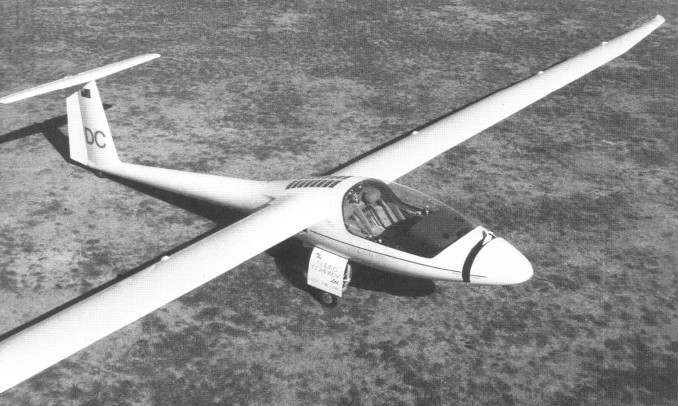
S10
Engine: 69 kW/ 93 bhp Limbach L2400 EB1. D
Wing span: 23m / 75.46 ft
Wing area: 18.74sq.m / 201.7sq.ft
Aspect ratio: 28.22
Airfoil: HQ-41
Empty Weight: 635kg / 1400lb
Payload: 215kg / 474lb
Gross Weight: 850kg / 1874lb
Wing Load: 45.39kg/sq.m / 9.29lb/sq.ft
Cruise: 90 kts
L/DMax: 51
MinSink: 0.56 m/s / 1.83 fps / 1.08 kt
Structure: GFRP/ CFRP/ Kevlar/ Steel tube
Seats: 2
S10V
Engine: Limbach, 93 hp
Prop: variable pitch
Wing span: 23m / 75.46 ft
Wing area: 18.74sq.m / 201.7sq.ft
Aspect ratio: 28.22
Airfoil: HQ-41
Cruise: 121 kts
S10
Engine: Rotax 914, 115 hp
Wing span: 23m / 75.46 ft
Wing area: 18.74sq.m / 201.7sq.ft
Aspect ratio: 28.22
Airfoil: HQ-41
Cruise: 140 kts
 All Aero