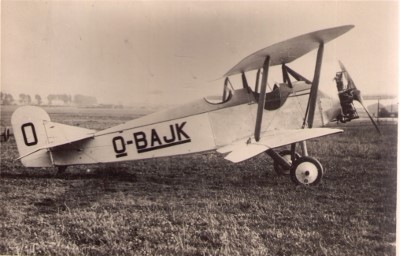
In the late 1920s. Belgian company Stampe et Vertongen decided to compete with the British manufacturers that then dominated Europe. In 1928, the talented Belgian engineer Alfred Renard was given a technical task to develop a light training aircraft.
Structurally, it was a conventional, single-bay biplane with staggered wings of equal span. The pilot and passenger sat in tandem open cockpits and power was provided by a radial engine in the nose. The fixed undercarriage consisted of main units braced to one another, and a skid to support the tail. The military showed interest in the new aircraft, and they were quite ready to support the domestic manufacturer. The only question was whether Renard could provide the required indicators. Fortunately, the terms of reference turned out to be quite reasonable, and the RSV.26/140 became the first aircraft for the Belgian own Air Force.
At the time, Stampe et Vertongen designated their aircraft with two numbers: the wing area (measured in square metres) and the engine power (measured in horsepower). Renard’s new design had a wing area of 26 m² and was to be powered by a 75 kW (100 hp) Renard Type 100 and was therefore designated RSV.26/100. Two years previously, the firm had introduced a training biplane for the Belgian Air Force that also had a wing area of 26 m² (280 sq ft); powered by a 75 kW (100 hp) engine, it had been designated the RSV.26/140. The similar designations caused confusion in the aviation press, but Renard insisted that the RSV.26/140 and RSV.26/100 were two distinct aircraft.
Thus, the first prototype of the aircraft, intended for the Belgian Air Force and equipped with a 140-horsepower engine, was designated RSV.26/140. Some time passed and in 1928 the RSV.26 / 100 aircraft equipped with a 100-horsepower Renard engine came out for testing. Although the wing area of both aircraft was the same structurally, they had a number of fundamental differences.
The first prototype was completed on December 12, 1928. By April 15, 1929, this aircraft was registered in Brussels as OO-AJU. Prototype tests were completed successfully, after which Stampe et Vertongen concluded that mass production was possible. However, the construction of the RSV.26 / 100 was limited to 5 copies, some of which entered the service of the Belgian Air Force. These aircraft were used for their intended purpose until May 1940, when Belgium was occupied by German troops. The surviving RSV.26/100s were then scrapped. Traces of the first prototype were lost at the very beginning of the war, but only in February 1947 it was removed from registration.
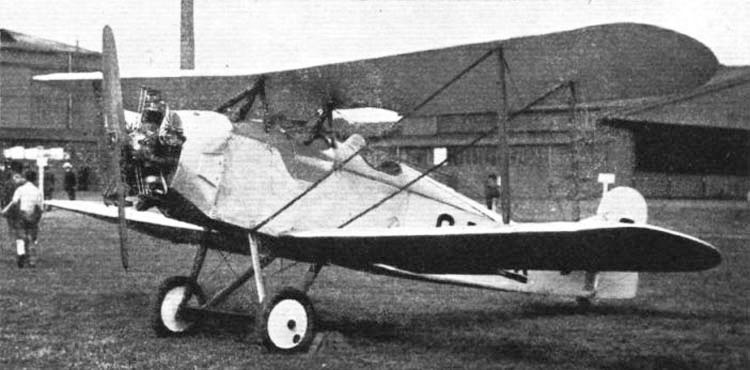
With monoplanes becoming more popular, Stampe et Vertongen considered the possibility of marketing a version of the RSV.26/100 in this configuration. Renard was able to realise this design by removing the lower pair of wings and bracing the upper pair of wings to the fuselage with two struts on each side. The resulting aircraft, having lost 8 m² of wing area, was now designated the RSV.18/100. The monoplane version was a little faster than the biplane, but climbed a little more slowly. With the differences between the two configurations so minimal that one could be converted to the other within one hour, Stampe et Vertongen decided to market the type as a convertible, the RSV.26/18.
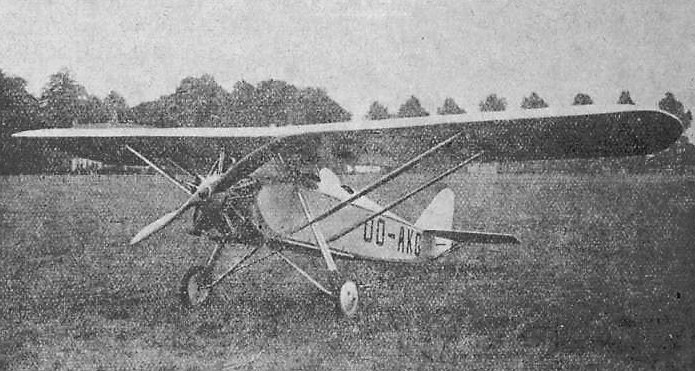
The onset of the Great Depression also halted Stampe et Vertongen’s production of the type. After George Ivanow joined the firm, he made one final attempt to market the design, modifying the RSV.18/100 (OO-AKG) to use a de Havilland Gipsy III engine[ and rebuilding the fuselage and empennage along similar lines to the SV.4. Marketed first as the SV.18M (Modification) tourer, then further modified and marketed as the SV.18MA (Modification Armée) fighter-trainer, no further production ensued.
Despite such modest successes, the RSV-26/100 was noticed by foreign buyers. American businessman and apologist for light aviation Ivan R. Gates, owner of Wright Tuttle Motors, in 1929 began negotiations on the possibility of licensed production of the Belgian aircraft in the United States. Previously, a “reference” sample O-BAJK was purchased from the manufacturer. At the same time, for the RSV-26/100, a project was developed to replace the wooden fuselage with a steel pipe structure – engineer Nathan F. Vanderlip was engaged in this refinement. However, it was not possible to achieve the expected commercial success again – until October 29, 1929, only two aircraft were assembled, after which the country plunged into economic stagnation for almost 10 years. Wright Tuttle Motors immediately went bankrupt, and its owner committed suicide. The fate of almost finished aircraft was unenviable. Three or four fuselages survived, one of which was used as a chicken coop as recently as 1975.
Variants
RSV.26/100
biplane version with Renard Type 100 engine (5 built)
RSV.18/100
monoplane version with Renard Type 100 engine (1 built)
RSV.18/105
monoplane version with Cirrus Hermes engine (1 built)
SV.18M
monoplane with de Havilland Gipsy III engine (1 converted from RSV.18/100)
SV.18MA
militarised SV.18M (1 converted)
RSV.26/18
convertible version with Renard Type 100 engine (2 built)
Gates Convertiplane
American variant of RSV.26/18 with Renard Type 100 engine and fuselage of steel tube construction (2 built)
RSV.26/100
Powerplant: 1 × Renard Type 100, 75 kW (100 hp)
Wingspan: 9.36 m (30 ft 8 in)
Wing area: 26 m2 (280 sq ft)
Height: 2.73 m (8 ft 11 in)
Length: 7.10 m (23 ft 3 in)
Empty weight: 484 kg (1,060 lb)
Gross weight: 747 kg (1,640 lb)
Maximum speed: 168 km/h (104 mph, 90 kn)
Cruise: 135 km/h
Range: 640 km (400 mi, 350 nmi)
Service ceiling: 4,600 m (15,000 ft)
Rate of climb: 6.0 m/s (1,000 ft/min)
Crew: 1 pilot
Capacity: 1 passenger
 All Aero