Swiss-born Mare Birkigt, chief designer of Hispano-Suiza, who had foreseen that the rotary engine was dose to its limit in development, embarked on the design of a new water-cooled V-8 engine. Designated Hispano-Suiza 8A, it produced 140hp; but even more important was Birkigt’s own design for a synchronising gear. Bechereau, therefore, found awaiting him a unique opportunity, of designing a completely new scout around the new engine and gun synchronising mechanism.
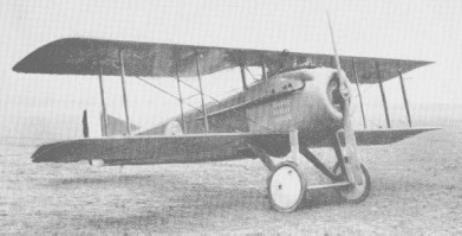
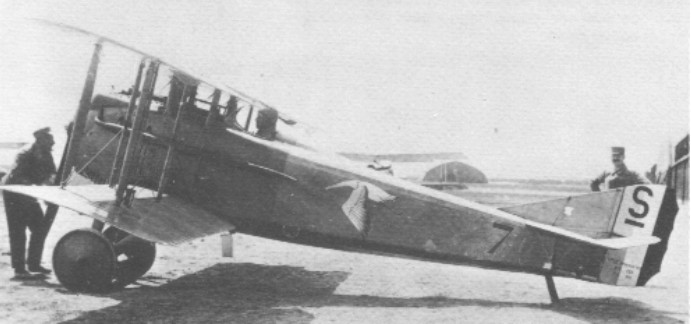
This single seat Spad Scout fighter of 1916 was one of the more successful aircraft of the First World War; 8,472 were built. It was used extensively by French, Italian and American air units and, on the Western front, two British squadrons who flew machines swopped from the R.N.A.S. for Sopwith Triplanes. SPADs equipped the French Cigognes whose insignia was a symbolic stork, and who used the machine’s ability to dive steeply without failing to bits to good effect in dog fights.
Engine: Hispano, 150 hp
Span: 25 ft 6 in
Wing area: 200 sq.ft
Length: 20 ft 3 in
Height: 7 ft
Empty weight: 1177 lb
Loaded weight: 1632 lb
Max speed: 119 mph at 6500 ft
Service ceiling: 17,500 ft
ROC: 810 fpm
Time to 6500ft: 6 min 30 sec
Endurance: 2 hr 30 min
Armament: 1 x Vickers mg
Crew: 1
Engine: Hispano, 175 hp
Span: 25 ft 6 in
Wing area: 200 sq.ft
Length: 20 ft 3 in
Height: 7 ft
Empty weight: 1177 lb
Service ceiling: 17,500 ft
Armament: 1 x Vickers mg
Crew: 1
Engine One 200 h.p. Hispano Suiza.
Length 20.7 ft. (6.34 m.)
Wing span 27 ft. (8.23 m.)
Weight empty 1,255 lb. (570 kg.)
Crew 1 pilot
Armament Two fixed machine guns, firing forward
Max. speed. 130 m.p.h. (210 km.p.h.) at SL
Ceiling 22,000 ft. (6,700 m.) fully loaded
Endurance 2 hours
 All Aero