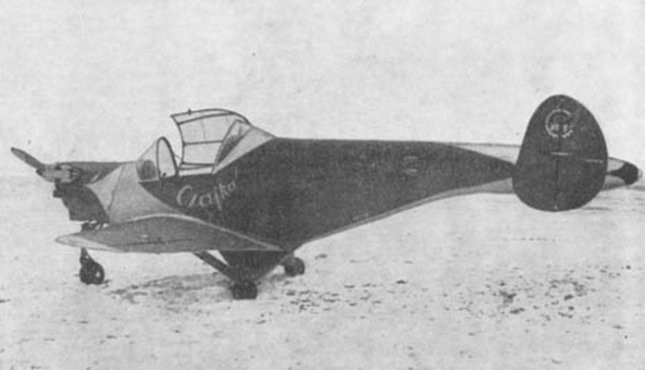
In 1949, Stanisław Sobkow started to construct an amateur plane, which he called WS-3 “Czajka”.
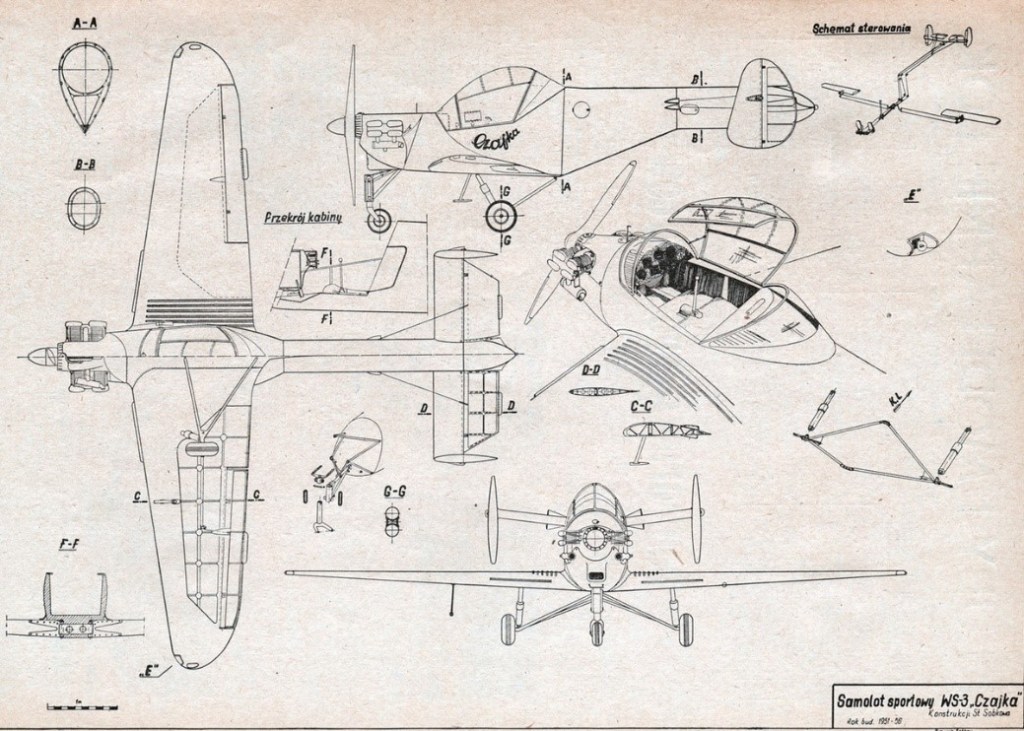
Single-seat, self-supporting low-wing wooden structure.
The wing is divided, with a trapezoidal contour, with rounded ends and with a slant backwards, the end of the wings is elliptical. The wing had a working caisson and two girders. The rear part of the wing is covered with canvas, at the fuselage and at the ends of the wings with plywood. Slotted ailerons, covered with linen.
The wooden fuselage had a rectangular cross-section in the front part, passing into a rounded tail part. Half-shell frame and longitudinal structure covered with plywood. Covered cabin.
Horizontal control with a rectangular contour with a rise. Covering the fins with plywood, the rudders with cloth. The spreading of the rudders made them act as aerodynamic brakes.
Three-wheeled chassis with a front wheel, fixed.

The construction was started in 1951. The woodwork was made in the carpentry workshop of Spółdzielnia Rzemieślnicza in Kielce, Poland, and metal details were made by the workshops of the Kielce Aeroclub, at the airport in Masłów, where the construction of the airframe was completed in mid-April 1956. The engine received from the Board of the League of Friends of the Soldier. Although “Czajka” was an amateur construction, only aviation materials were used for its construction. During the assembly of the plane of his idea, S. Sobkow used many ready-made structural elements from the glider and the factory plane. The works were completed on April 15, 1956.
After the taxiing tests carried out in the spring of 1956, on August 26, 1956, WS-3 “Czajka” made its first flight. The plane was also demonstrated at air shows, once at the Aeroclub in Kielce, once at the Workers’ Aeroclub in Mielec, arousing the understandable interest of the public, and above all, aviation hobbyists. This amateur, light and small plane was the first, thoroughly successful structure of this type, built in Poland after World War II. It was proved easy to fly, and of simple construction.

Up to 1959, “Czajka” spent about 20 hours in the air in about 70 flights. The constructor tried to legalize his activity, but the Institute of Aviation he did not respond to applications and letters for approval. The documentation sent there has not been checked. As a result, the designer was forced to stop using his plane, which was pushed behind the hangar.
In 1960 “Czajka” was completely destroyed. At that time, the construction and piloting of own aircraft were strictly forbidden in Poland. That is why a commission burned down the structure, which – apart from arsonists – was convinced by all to be successful. The structure that Stanisław Sobkow had been building for 6 years, putting 15,000 man-hours into it, was thoughtlessly destroyed.
Engine: Praga D, 55 kW (75 HP) max, 44 kW (60 HP) nominal
Span: 8.2 m
Wing area: 10.0 m2
Length: 6.4 m
Height: 2.2 m
Empty weight: 320 kg
MAUW: 470 kg
Useful load: 150 kg
Max speed: 195 km / h
Cruising speed: 150 km / h
Stall speed: 80 km / h
ROC: 3.3 m / s
Ceiling: 3300 m
Range: 450 km
Endurance: 3 hr
 All Aero