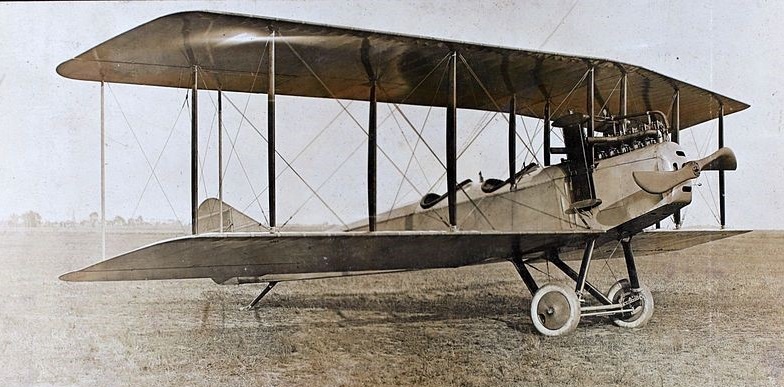
Designed by Charles H Day and originally known as the Sloane H-2, the Standard H-2 was built by the Standard Aircraft Corporation. Modified from Sloan H-2, three were built by Standard Aircraft Corp, AS82 to 84.
An early American Army reconnaissance aircraft, ordered in 1916, it was an open-cockpit three-place tractor biplane, powered by a 125 hp (90 kW) Hall-Scott A-5 engine. It had swept-back wings and originally had mid-wing ailerons. Only eight were built; AS82 to AS89.
An improved version, the H-3, with the same engine, swept-back, and equal-span wings, earned an order for eight aircraft, AS85 to 93, while the Navy ordered four with floats as the H-4H, 137 to 140.
These, like J-1 and Curtiss JN-4, were the basis of countless modifications as surplus civil aircraft after the war.

Two Standard H-3s were sold by the US Army to Japan, where a further three were built by the Provisional Military Balloon Research Association (PMBRA) in 1917, powered by 150 hp (110 kW) Hall-Scott L-4 engines. They were used as trainers between May 1917 and March 1918, although they were considered dangerous.
H-2
Engine: 125hp Hall-Scott A-5;
Wingspan: 40’1″
Length: 27’0″
Speed: 84 mph
Range: 350 mi
Seats: 2
H-3
Engine: 1 × Hall-Scott A-5, 135 hp (101 kW)
Wingspan: 40 ft 1 in (12.22 m)
Wing area: 532 sq ft (49.4 m2)
Length: 27 ft 0 in (8.23 m)
Empty weight: 2,500 lb (1,134 kg)
Gross weight: 3,300 lb (1,497 kg)
Fuel capacity: 68 US gal (57 imp gal; 260 L)
Maximum speed: 84 mph (135 km/h, 73 kn)
Stall speed: 46 mph (74 km/h, 40 kn)
Endurance: 6 hr
Time to altitude: 10 minutes to 3,400 ft (1,000 m)
Crew: 2
 All Aero