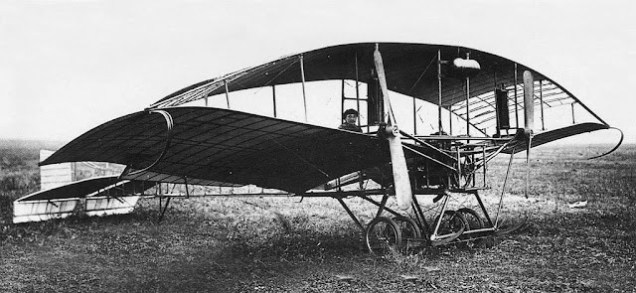
Between 1910 and 1912, American expatriate Jacques-Jules Sloan built a series of biplanes he called Bicurves in his small workshop in the Paris suburb of Charenton-le-Pont. The Bicurve’s fuselage, tail and landing gear were similar to those found on French Blériot monoplanes of that period. As initially constructed, the fuselage terminated in a movable rudder, without a fixed fin, and fixed horizontal stabilizers of flat section without any airfoil. The elevators were originally mounted ahead of the fuselage on struts, in canard fashion. Those struts were subsequently removed and the elevators relocated to a more conventional position at the tail, hinged at the trailing edge of the horizontal stabilizers.
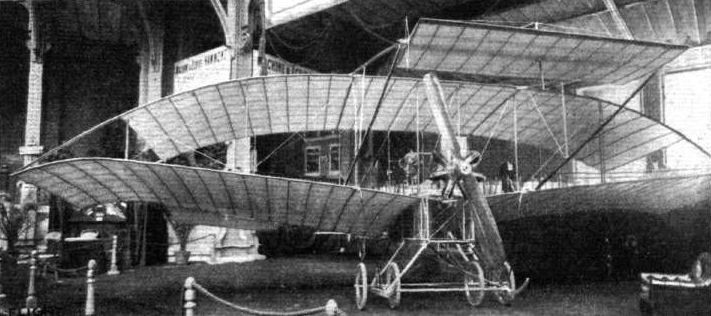
It was in its wing cellule that the Bicurve differed markedly from any of its contemporaries, or from any subsequent biplane designs. The Bicurve’s lower wing attached to the upper fuselage longerons. The lower wing, which was reminiscent of that found on contemporary Antoinette monoplanes, was designed with marked dihedral, transforming to anhedral near the tips, and was fitted with conventional trailing-edge ailerons. The upper wing, on the other hand, was deeply arched, both in section and in span, so much so that the tips curved sharply downward and were attached by struts to the lower wingtips.
The initial version of his Bicurve was fitted with two propellers driven by a single engine via chains and gears. An examination of photographs of the airplane provides a clue as to why he added the additional weight and complexity of such a drive system. The two propellers were clearly arranged to turn in opposite directions, suggesting that Sloan was trying to further improve the airplane’s handling characteristics by canceling out the torque effect imparted by a single propeller.
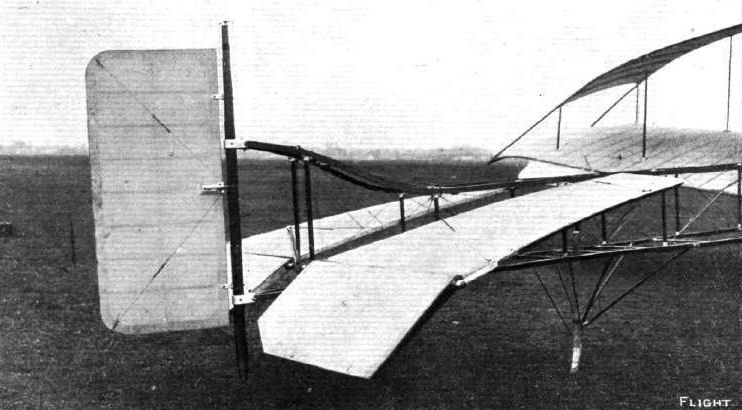
Lateral control was achieved not by wing-warping but by means of fins installed on the trailing edge of the lower wings, just before the wingtips drooped. Due to the airplane’s inherent natural stability, their surface area was quite small. Vertical control could be achieved any of two ways, depending on the pilot’s preference. One method involved using two elevators, one at the front coupled with another at the rear, acting simultaneously by opposite bearings. This control system was very effective, but some pilots preferred to use only the rear elevator.
The main undercarriage consisted of two forward-facing skids carrying two pairs of wheels, which were equipped with dampers and mounted on a universal joint that could absorb shocks from rough field landings. The undercarriage was secured, as with the fuselage itself, by means of special aluminum fittings. The main gear was complemented by either a rear skid or wheel.
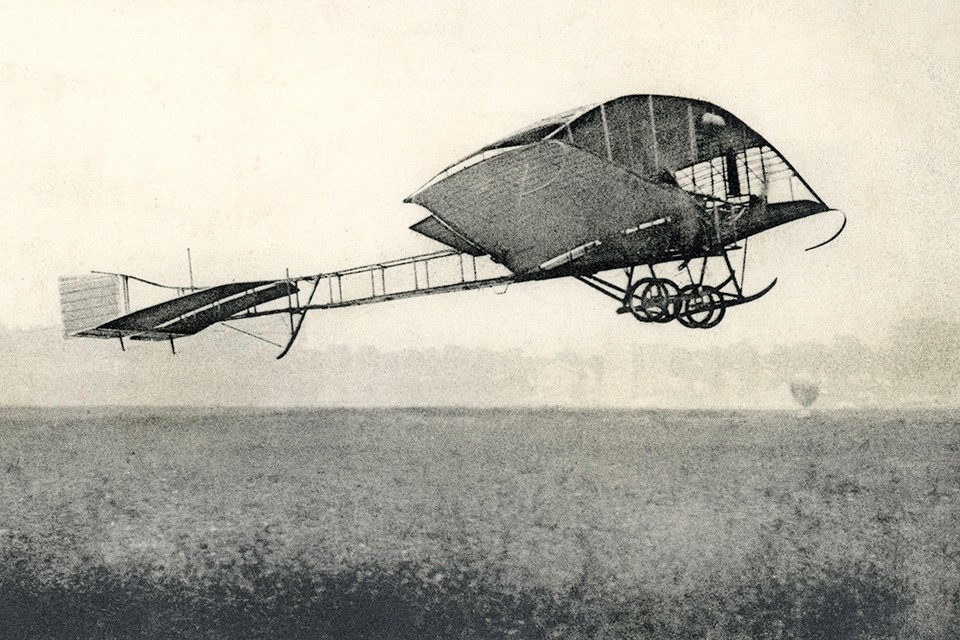
The original Bicurve had a wingspan of 35 feet 11 inches, a length of 37 feet 1 inch and wing area of 161 square feet. Maximum speed was recorded as 46 mph.
Sloan seems to have built and flown at least three different versions of the Bicurve between 1910 and 1912, and it is also reported to have been powered at various times by at least two different engines: a 35-hp Labor-Aviation and, later, a 50-hp Gnome. As was the case with numerous early airplanes, however, there is little documentation as to whether the various Sloan Bicurves were new builds or simply improved versions of the same airframe. For example, while the original airplane had twin propellers driven by a single engine and elevators mounted in front, other versions featured a single propeller and conventional tail-mounted elevators.
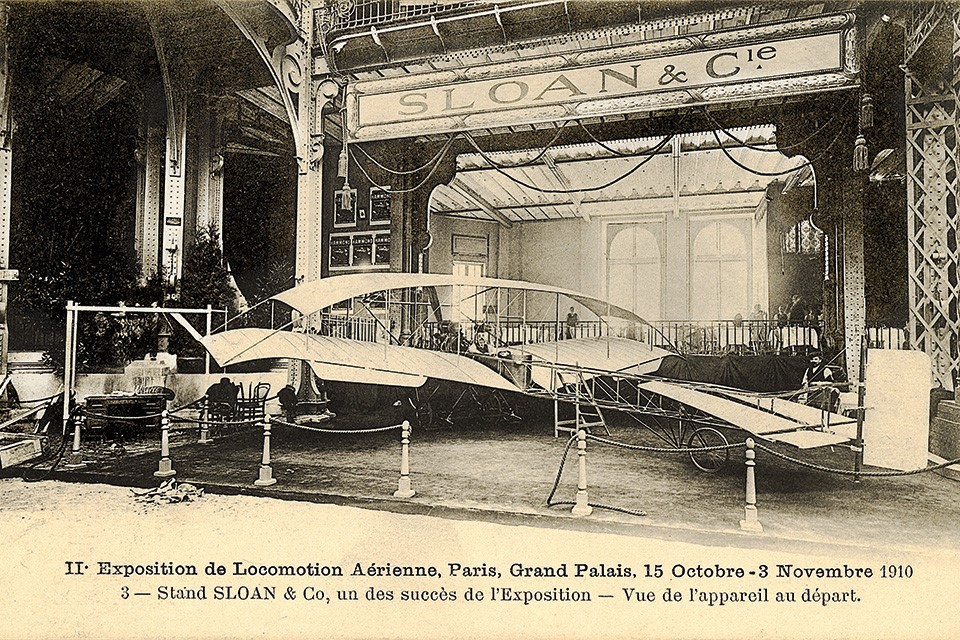
A photograph exists of the Bicurve exhibited by Sloan & Company at the Exposition de Locomotion Aérienne in Paris between October 15 and November 3, 1910. In spite of that publicity, the airplane was not a financial success and the design proved to be a dead end. Nevertheless, unlike many strange-looking early airplanes, the Sloan Bicurve actually flew, and apparently flew well. Motion picture footage still exists showing the machine taking off and landing, and it appears to do so quite smoothly.
 All Aero