Slingsby Sailplanes Ltd
Slingsby Aircraft Company Ltd
Having served in the Royal Flying Corps in the First World War Frederick N. Slingsby helped to found the Scarborough Gliding Club in 1930 and, from repairing the first Primary the club owned, in his furniture works, soon became a designer and builder of gliders. His first glider, the Falcon I, was a version of the Schleicher Falke, built from plans bought from the German Aero Club.
Mr. C.E. Hardwick requested Slingsby build another Falke for himself and this was the beginning of the Slingsby glider works. He also began to manufacture primary gliders and the first advertisement appeared in “Sailplane and gliders” in November 1933 offering primary gliders for £45 complete.
For several months the empty tramsheds of Scarborough Corporation were used but, in September 1934, a move was made to part of an engineering factory in Kirkbymoorside. The move was at the invitation of Major J.E.D. Shaw, a local landowner, who owned several aircraft and had a small aerodrome on his estate at Welburn Hall. His objective was to bring employment to the region and he offered Slingsby complete financial backing. The engineering firm then operated as Slingsby, Russell & Brown Ltd.
During a slack period, light aircraft were also considered and the construction of two different types began in 1938 but both types were abandoned.
In 1938, at Kirbymoorside, Yorkshire, Slingsby Sailplanes Ltd built Kirby Kitten single-seat monoplane, designed by F. N. Slingsby.
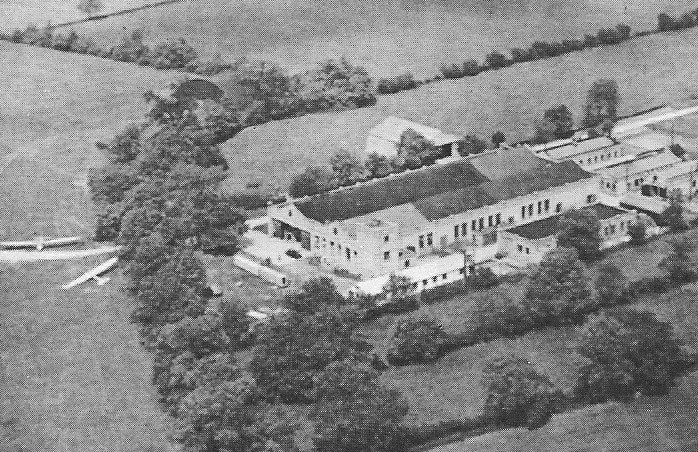
Demand called for larger premises and a new factory was built at the side of Major Shaw’s airfield at Welburn just outside Kirkbymoorside was built. In July 1939, when the new factory was ready for occupation, a separate company, Slingsby Sailplanes Ltd, was formed with Major J.E.D. Shaw as Chairman and F.N. Slingsby as Managing Director and Chief Designer. It was planned to officially declare the new factory open on Monday September 4th but the outbreak of the war on the previous day put a stop to all private flying in the UK.
Chiefly famous for gliders, Motor Tutor of 1948 was Slingsby Tutor glider with engine and landing gear.
On 21 April 1955 Major Shaw died. His share in Slingsby Sailplanes had to be sold to settle death duties on his estate. To avoid a take-over bid the shares were acquired by a trust formed by the leading members of the British gliding movement. The company was then owned by the Shaw-Slingsby Trust, and Phillip Wills was appointed Chairman.
In 1962 Slingsby was affect by heart trouble and in 1964, aged seventy, decided to retire. P.R. Street joined the company as Managing Director.
In 1965 J.W. Bradley was appointed Chairman of the Board, with W.N. Slater as Managing Director. In 1967 the company was split into Slingsby Aircraft Ltd and Slingsby Joinery Ltd, with a holding parent company Slingsby Aircraft Holdings Ltd.
The whole of the main aircraft factory area was burnt to the ground on 18 November 1967. No Slingsby drawings were lost in the fire but all records and drawings of Operation Sigma Ltd were destroyed.
After the fire many employees were made redundant. The total number before the fire was 120. Further redundancies were declared in February 1969 but on 11 July it was announced Slingsby Aircraft Holdings Ltd was in the hands of a Receiver.
On 3 November 1969 Vicker Ltd acquired the entire assets of the company for a reported figure of £179,150. A new company using the old title of Slingsby Sailplanes Ltd was established.
The fibreglass work which was by then a speciality was continued, but aimed more at the military and marine environment, such as bathyspheres and small submarines.
Slingsby Aviation Ltd. is member of ML Holdings Plc group and offers professional pilot training and subcontract component building, in addition to sales of the T67 Firefly side-by-side two-seat civil/military piston-engined trainer and private aerobatic-capable lightplane (first flown May 1981, as license-built Fournier RF6B).
Jim Tucker came along later and bought the company, being a major shareholder of Slingsby Aviation which continued to produce for military GRP contracts and underwater craft, as well as hovercraft and gondolas for airships.
 All Aero