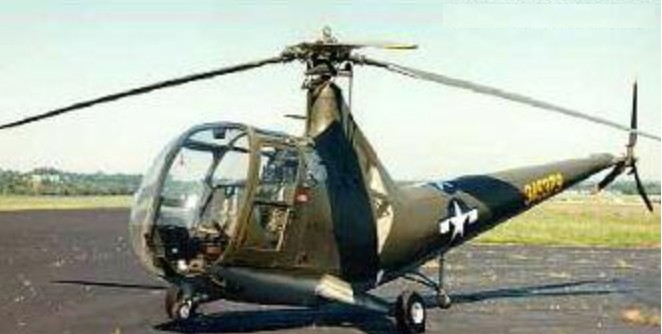
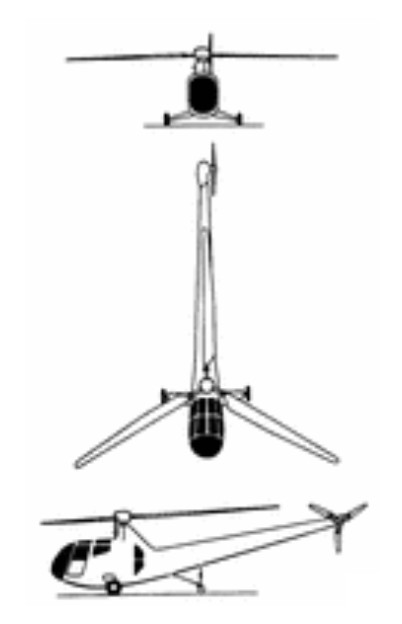
The Sikorsky R-6 was developed parallel with the improved R-5. Ordered in 1943, the Sikorsky VS-316B or XR-6 prototype (43-47955) made its maiden flight on 15 October 1943. It was essentially a refined and developed version of the R-4, and the same rotor and transmission system was used in both types. A 225hp Lycoming O-435-7 engine provided the power, and the fuselage was transformed into a highly streamlined, metal-skinned unit with a one-piece moulded plexiglas cabin for the 2 crew members, and a four-wheel landing gear arrangement
First flown on Oct 15, 1943, Les Morris, was the Chief Test Pilot on the Sikorsky VS-300 starting in March, 1941 (and on the XR-4, XR-5 and XR-6 which followed).
On a March 1944 the XR-6 set new helicopter distance, endurance and altitude records when it made a non-stop flight of 623km from Washington, D.C, to Dayton, Ohio, in 4 hr. 55 min, climbing to 1524m over the Allegheny Mountains en route.
The XR-6 was followed by five 2-seat service test XR-6A’s for the USAAF (43-28240 to 28244) of which three, 46446 to 46448, went to the U.S. Navy (as XHOS-1), built by Sikorsky with 240hp Franklin O-405-9 engines.
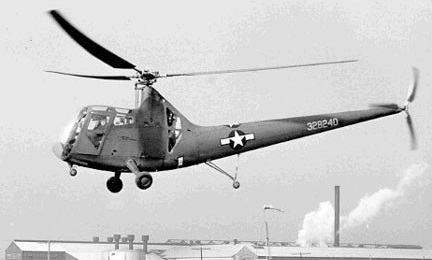
Twenty-six generally similar pre-production YR-6A’s, 43-45316 to 45341, were built by the Nash-Kelvinator Corporation under license from Sikorsky. Sikorsky Co, heavily involved in F4U production, contracted Kelvinator—then a licensee of Pratt & Whitney building airplane engines—to take over production of the R-6A. Redesignated as YH-6A in 1948. Kelvinator had an available plant in Detroit, and the tooling for the project was moved there. Kelvinator carried out the production of the one hundred and ninety-three R-6A’s (43-45342 to -45534) built from 1945. Thirty-six of these were delivered to the U.S. Navy as the HOS-1, 75589 to 75624 and 75729 to 75730, and formed the equipment of that service’s first helicopter squadron, which commissioned in July 1946. Twenty-seven were later were handed over to the USCG as HOS-1G. Those remaining in service in 1948 were redesignated as H-6A. One hundred and fifty went to the RAF in 1946 as Hoverfly II.
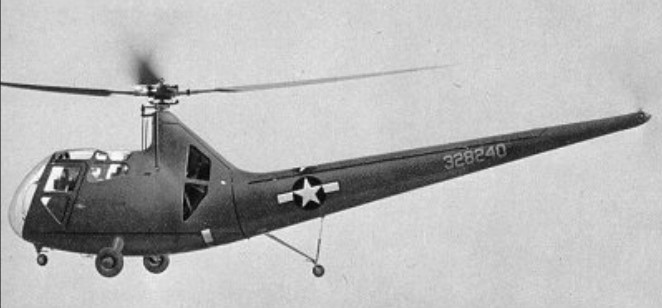
Forty R-6A’s were supplied to Britain under Lend-Lease, these being named Hoverfly II in British service. Fifteen of them were allocated to the Fleet Air Arm for communications and training in 1946; others served with No.657 (AOP) Squadron RAF and the Airborne Forces Experimental Establishment.
Like the R-4, the R-6 could be fitted with pontoons as an alternative to a wheeled landing gear, and was employed on a variety of duties including air/sea rescue, casualty evacuation and observation.
Beginning with the R-6, helicopters flown by the U.S. Coast Guard had Navy designations with the suffix letter G (as HOS-1G) until the 1962 redesignation of U.S. military aircraft.
Its career was, however, a short one: it was frequently beset by engine difficulties, and soon gave way to the more reliable R-5 and its derivatives. A proposed Lycoming-powered R-6B version by Nash-Kelvinator was cancelled.
XR-6
Engine: Lycoming O-435-7, 225hp
R-6
Engine: One Lycoming O-405-9, 235 hp/168kW
Rotor diameter: 11.58 m
Length: 11.60 m
Height: 3.4 m
Max take-off weight: 1317kg
Empty weight: 923kg
Cruise Speed: 110 km/h
Max speed: 161km/h
Range: 565 km
Rate of climb: 4.0m/s
Service ceiling: 3050m
Passengers: 1
Crew: 1
R-6A / H-6A
Engine: Lycoming O-435
Main rotor: 38’0″
Length: 38’3″
Max speed: 96 mph
HOS
Engine: Franklin O-405-9
Main rotor: 38’0″
Length: 38’3″
Max speed: 105 mph
 All Aero